

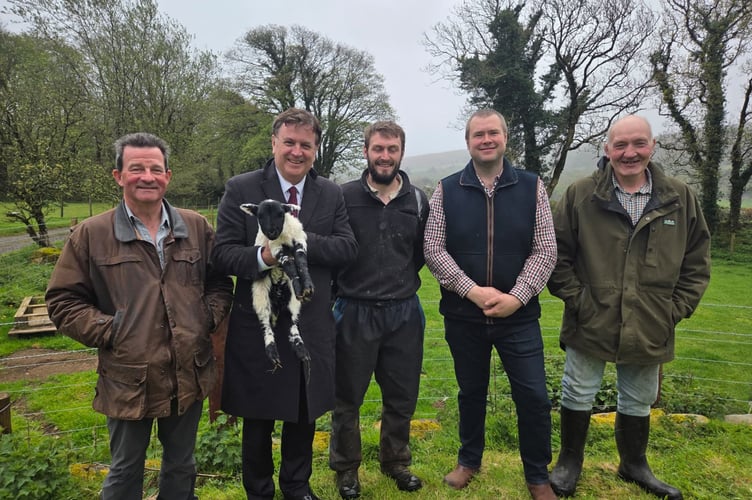
I RECENTLY spent valuable time with South Tawton Commoners on Dartmoor, talking through the pressures facing upland farming and the future of those who work this remarkable landscape.
It was a useful and candid discussion, and I came away even more convinced that decisions made in Westminster must be rooted in the reality of farming life on the ground.
Upland farming is not easy. The weather is tougher, the margins are often tighter, and the land itself brings responsibilities that go far beyond producing food.
Farmers and commoners on Dartmoor help maintain a landscape that is loved by locals and visitors, supports biodiversity, stores carbon, manages water, and sustains communities that have shaped Devon for generations.

Yet these public benefits do not happen by accident. They depend on people being able to make a living.
When I speak to farmers locally, the same themes come up again and again: uncertainty over funding, schemes that can feel too rigid, rising costs, and concern about whether the next generation will see a viable future in farming.
That concern deserves to be heard properly, because once skills, stock and family businesses disappear, they are not easily replaced.
Nationally, farming remains central to who we are and how we live. The UK has around 209,000 farm holdings, using about 17 million hectares of land, which is roughly 69 per cent of the UK’s land area.
Food security is also not an abstract issue. In 2024, the UK produced an estimated 65 per cent of all the food it consumed, and 77 per cent of the food types that can be produced here.
Those figures matter, especially after recent years have shown how quickly global supply chains can be disrupted.
For upland areas, the question is not simply how much food is produced. It is also about resilience, heritage, stewardship and the strength of rural communities.
On Dartmoor, commoning is part of a living tradition.
It supports local families, local businesses and the careful management of open moorland.
If policy fails to understand that, it risks weakening not only farming businesses, but also the character of the place itself.
I believe future farming policy needs to be more flexible, more practical and more consistent.
It should recognise that what works on a large lowland farm may not work for a hill farm or for common land.
It should also give farmers enough confidence to plan ahead, invest, and hand their businesses on. Their voice should carry weight in future decisions.
My visit to South Tawton was a reminder that the best policy often starts with listening.
I will continue taking these concerns back to Westminster and making the case for Dartmoor’s farmers, commoners and rural communities.
Facebook: Mel Stride MP X: @MelJStride Instagram: @melstridemp Website: www.melstridemp.com
Mel Stride
MP for Central Devon
Comments
We've recently changed our login process. If you have an account for commenting, you will need to re-register on the login window.
This article has no comments yet. Be the first to leave a comment.