
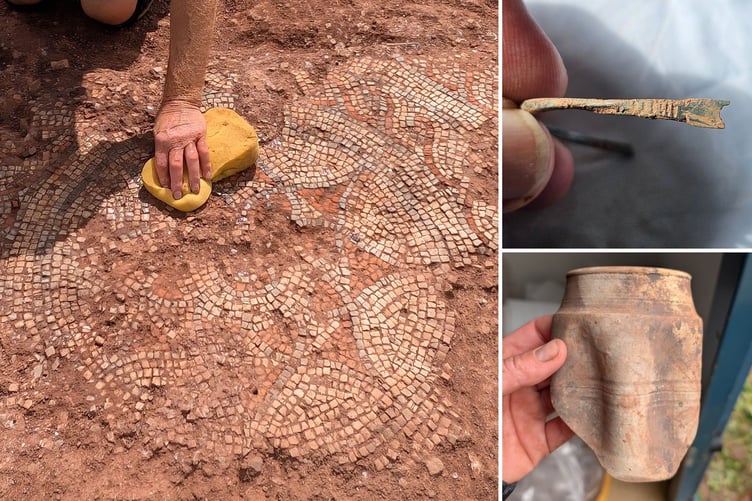
A RARE Roman mosaic, elaborate bathhouse and high-status artefacts have been uncovered during a major archaeological project in Mid Devon.
The discoveries were made during a two-month dig on farmland between Halberton and Sampford Peverell, led by the University of Exeter and Cotswold Archaeology.
The mosaic, made up of thousands of red, white and dark blue-grey cubes, is thought to have formed a striking floor feature in one of the villa’s rooms. It was probably installed during the fourth century AD.
Archaeologists have also uncovered an elaborate bathhouse away from the main villa, with at least two plunge pools and painted plaster walls.
Finds from the site include a blue glass intaglio depicting the goddess Victory, a delicate copper alloy bangle, a fine silver-plated spoon, pieces of pottery and a large storage jar.
The combination of finds suggests the villa was occupied by people of wealth and status, living a very Roman lifestyle. Such evidence is rare in Devon, where only a handful of Roman villas are known.
Devon County Council commissioned a geophysical survey of the site after it was initially identified by metal detectorist John Hill in 2004. Community volunteers later found tiles, mosaic tiles and roofing slates through coordinated fieldwalking and small-scale excavations.
The survey confirmed the presence of enclosures and probable buildings, paving the way for further excavations and surveys, including work carried out by a University of Exeter PhD student, which later revealed the presence of the mosaics.
Scores of community volunteers have taken part in the excavation, working alongside 65 archaeology students and professional project members.
Archaeologists believe the villa may have been extended several times from its original, modest rectangular layout.



Additional rooms were added to the north and south ends, while walls and a rainwater gulley at the rear suggest the area may have been used for storage or kitchens. Evidence of a timber staircase suggests part of the villa may have had two storeys.
Two further stone-built buildings have also been excavated. One contains at least two large water tanks, thought to be a plunge bath, built from opus signinum, a form of waterproof Roman concrete. The other is a large rectangular building that may have been used as a barn or for agriculture.
Having fully uncovered the mosaic, specialists will lift it in July so it can be preserved at Tiverton Museum of Mid Devon Life, along with the other artefacts recovered from the site.
This year’s dig is the first of three annual visits to the site. Future excavations are expected to focus on the wider Roman estate on neighbouring land.
“At the outset, we knew this villa, and its surrounding working areas, was an important site for understanding the ‘Romanisation’ of Devon,” Dr Susan Greaney from the University of Exeter’s Department of Archaeology and History said.
“But from day one, it has offered us a wealth of interesting and sometimes surprising finds in addition to this striking polychrome mosaic.
“This villa was undoubtedly home to people of wealth and high standing.”
Comments
We've recently changed our login process. If you have an account for commenting, you will need to re-register on the login window.
This article has no comments yet. Be the first to leave a comment.