

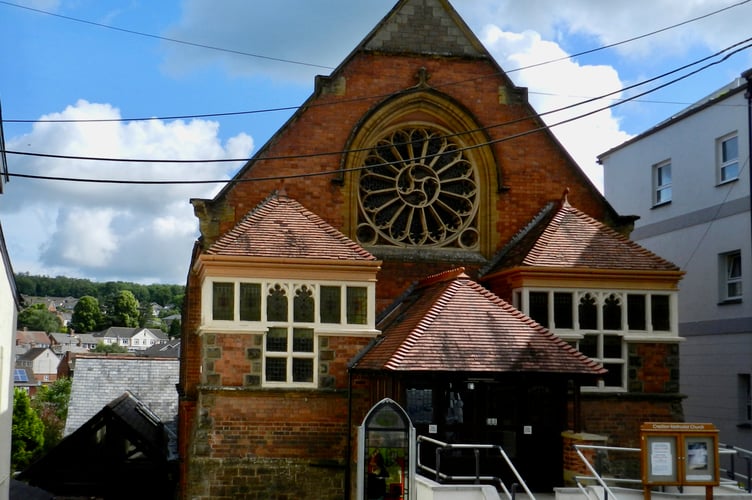
THE Crediton Methodist Church service on Sunday, January 25 was led by Rev Dr Stephen Mosedale. His theme was “trust”.
“The Lord is my light and my salvation. Whom shall I fear? The Lord is my stronghold. Of whom shall I be afraid?” Psalm 27:1.
Stephen told the story of Munroe Parker, an evangelical preacher who, on a very hot day in South Alabama, stopped at a stall and asked how much a watermelon cost.
The reply was one dollar 10 cents. Parker said he only had a one dollar bill and the stall holder said he would trust him for it.


Then Parker walked off and the stall holder called him back and asked why he had not paid the one dollar. Munroe said he had told him he would trust him.
Most people find it hard to trust a stranger but it is trust that gives meaning to human life.
Some might say that all you need is love. Love can remain but it does not build a relationship between the one who loves and the one who is loved. You must have trust.
The word trust can describe the one who puts their trust but it can also be used to be the one who is trustworthy. If we are honest, we would recognise trust we see in others as the same as we see in ourselves. How often is not an agreement accepted as valid unless it had been written down, signed, sealed and witnessed.
That makes the message of Psalm 27 and the calling of the first four disciples in Matthew chapter four all the more notable. God can be trusted.
The words of the psalm are attributed to David and reflect what anybody feels who knows that God can be trusted. The Lord is my light – is not just saying the light shows us the way.
But we see the light when we understand something and the light dawns on us when something makes sense.
The Lord is my light is an affirmation that God is the source of everything and that we value what God does for us.
The second half of the first verse of the psalm is the Lord is the stronghold of my life. We have all visited castles with their strongholds that were safe. God can be trusted to keep our lives safe.
God can be trusted is the response of the psalmist – whom shall I fear, of whom shall I be afraid? Despite his trust in God, the psalmist says do not hide your face from us.
Maybe his trust is wavering. If you trust someone you do not need to implore them to look out for you. Even if actions speak louder than words, words are also needed.
In Matthew chapter four the four disciples demonstrate proper trust in God.
It is too early for them to recognise Jesus. It is an invitation for them to trust in someone they do not know. Matthew says that Simon and Andrew and James and John left their nets, boats and father and went with Jesus immediately.
It expresses that level of trust which is rare in the initial stages of a relationship. It was a deep trust but later there was scope for doubt – Peter denying Jesus three times.
It is easy to say I trust God, whom shall I fear? We can feel afraid even though we know God is to be trusted.
In the psalm we see how trust generates a longing as well as a seeking. We always need to be close to God and to feel secure.
It is because of our human frailty. It should be our goal always to be with God.
What does this psalm express about our trust of other people? Stephen said he would always hope to err on showing trust for others. Showing trust can cultivate trust in the person you trust.
Whatever things of value God has entrusted to us, He is looking for us to show ourselves trustworthy in the way we handle them.
May God deepen our trust in Him and those who need to be trusted.
Bronwyn Nott
Comments
This article has no comments yet. Be the first to leave a comment.