
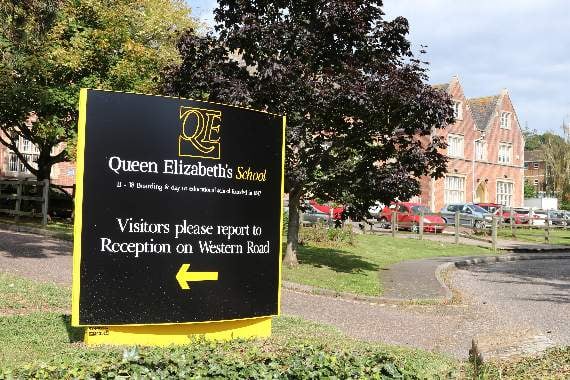
IF the governors at Queen Elizabeth’s School in Crediton vote yes to being a part of Dartmoor Multi Academy Trust (MAT) then it can say goodbye to control.
Our QE governing body/trustees will cease to own QE. Land, buildings, staff and all decisions will transfer to a faceless entity if the governors pass a majority yes vote to join the Dartmoor Multi Academy Trust.
I still have a few deep reservations for joining the Dartmoor MAT. If this was a MAT on our doorstep, Mid Devon, looking towards Exeter, involved our Crediton Learning Community primary schools, I would be much more positive.
Wouldn’t it be prudent to hold out and stay as a single academy? Build on the steps QE has put in place with regards to behaviour, uniform policy, better communication with parents and keep encouraging parents to support their children’s learning and in turn help support teachers.




My children and their friends have noticed a change at QE with regards to learning and are seeing the efforts by management and teaching staff to make QE a better experience for all students.
It appears that QE is trying to build its reputation again and this will be attractive to other schools in our immediate area to one day, maybe, forming it’s own MAT if needs be.
Surely it would make sense to continue speaking to the Crediton Learning Community, Chulmleigh and possible Tiverton rather than go outside of QE’s natural geography.
If QE keeps moving in the right direction and exercises best practice then an OFSTED inspection would not be cause for concern. QE shouldn’t fear it would be beaten into a MAT as a result of a poor outcome.
QE should not be swayed by the Regional School Commissioner’s desire to form up with the Dartmoor MAT and the governments desire to Multi academise the nation.
Who knows what government and policies we will have in two years time?
Personally I don’t think it’s the best QE can do. Once you are in the Dartmoor MAT you are in it.
Joining any MAT will have it’s concerns, the following must be a reason not to join Dartmoor. True governance will become a faceless body.
Where will governing body meetings be held?
Who will be attending them from QE?
How long will it take to have simple issues resolved or more complex ones discussed and sorted?
At least when QE was under LEA control it still had a governing body in the true sense of a governing body.
Can we really expect educationalists to be business people? When MAT’s go wrong it isn’t pleasant and there has been some spectacular failures recently. Example, “Collapsing academy trust asset-stripped its schools of millions”, “The Guardian” reported on Saturday, October 21.
What will a multi academy trust mean for QE’s governing body?
Let’s get some of the terminology right at the outset.
In maintained schools, a governing body is a statutory body with statutory powers. Under the original legislation in the 1986 Education Act and the 1988 Education Reform Act, a governing body is set up with the legal responsibility to oversee the school. Whist the local authority is a real presence in terms of keeping a watchful eye on standards, admissions, exclusions and the budget, local management of schools (from the 1988 Act) means that it is the governing body, not the local authority who runs the school.
Perhaps the most precise representation of this is shown where a local authority has to intervene and manage the school directly, and the term used for this is “withdrawing delegation of the budget”, demonstrating that it is the devolution of funds that is the actual devolution of statutory powers.
In an academy, the statutory body is the board of directors, and it is the directors who exercise the statutory powers.?In a single academy, the directors and the governors are the same people. Article 1 (k) defines governors thus:?“the Governors” means the directors of the Academy Trust (and “Governor” means any one of those directors)?Article 46 describes the make up of the governing body, with parent governors, staff governors etc. The powers of the governing body are defined in Article 94:?…the business of the Academy Trust shall be managed by the Governors who may exercise all the powers of the Academy Trust.
This merging of the terms “directors” and “governors” in a single academy, does not occur in the multi academy model, where the term “directors” is used exclusively.
In the Model Articles of Association in a multi academy the corresponding articles are:?Article 1(j): “the Directors” means save as otherwise defined at Article 6.9 the directors of the Company (and “Director” means any one of those directors);?Article 46 describes staff directors and parent directors in the way we think of parent and staff governors in maintained schools and Article 93 defines the statutory powers:?…the business of the Company shall be managed by the Directors who may exercise all the powers of the Company.?A multi academy trust will include a number of different academies, in which a new school-based body can be established by the board of directors.?This is the “local governing body”.?A local governing body can be set up in each academy in the group by the directors. It is defined thus:?Article 1(o): “Local Governing Bodies” means the committees appointed pursuant to Articles 100-104 (and “Local Governing Body” means any one of these committees);
Governors in the maintained sector are well used to committees and committee structures. We understand that establishment, membership, terms of reference and dissolution of committees are entirely in the remit of the governing body, and articles 100-104 of the multi-academy model Articles define the relationship between the directors and a local governing body in precisely the same way.
Why is this so important? Because all over the country, in multi academy chains, people are being appointed as members of a local governing body; they are told they are governors; they think they are governors; they attend governor training; but they are not governors – at least not in the “1986 Act” sense of the word, neither is the local governing body a real governing body in the accepted sense of the term.?A budget can be devolved to a local governing body if the board of directors decides this. They can also withdraw it. The board of directors, not the local governing body, appoints the Headteacher. Members of a local governing body can be removed by the directors.
It is nevertheless questionable, and hard to justify, to carelessly use the term “governors” or “governing body” in an interchangeable way between that found in maintained schools, where governors have statutory responsibilities and statutory powers, and the more informal arrangements in a “local governing body” within a multi academy chain.
There are signs that the drive towards all schools becoming academies might be beginning to fade. The additional funds that come with academy status are diminishing. Some outstanding schools are choosing to stay within the maintained sector.
Schools are also working out that they can work in partnerships with other schools, which brings real change and improvement when done well, without the bureaucratic challenge of becoming an academy.?Once governing bodies realise that joining a Multi Academy Trust means abandoning their powers and responsibilities, they may have further cause to pause and think.
Andrew Vaccari
Crediton
by email
Comments
This article has no comments yet. Be the first to leave a comment.