
THE following letter has been sent to Devon County Council after the public Link Road exhibition at the Old Town Hall, Crediton:
Crediton Link Road
I VISITED the public exhibition on both Friday and Saturday. I was able to talk to Simon Newcombe and Dave Scott from MDDC, Chris Sanders and Marcus Wood from Parsons Brinckerhoff as well as Pat Jackson and others from DCC.
I have sent queries about traffic and air quality information presented at the exhibition to Parsons Brinckerhoff, but to date have not received a response.



The leaflet, which had been sent out, identifies the traffic related Air Quality problems in Exeter Road and the High Street in Crediton.
However the section on the Solution identifies a relief road as potentially providing a solution, without clearly indicating that, if a relief road carried some traffic directly from the A377 to the industrial estate, it could reduce pollution in Exeter road, but would not, indeed could not, reduce traffic related air pollution in the High Street.
It should be apparent to all concerned, that while poor air quality in the Exeter Road area affects residents and those, like myself, who walk or cycle along the road, as well as those in vehicles using the road, the poor air quality in the High Street affects far more people who shop or live along it or use it to travel to school etc.
It would be a major mistake to present a relief road as a solution to all Crediton Air Quality problems, without consideration of how the construction and use of a relief road could be a first stage in a longer term scheme to improve air quality in Crediton High Street, so that it at least satisfies present and proposed European AQ standards.
Air Quality
It is surprising that there was no attempt in the exhibition, nor in the leaflet about the link road proposals, about the health effects associated with poor air quality, which have been recognised by the designation of Crediton as an Air Quality Management Area.
The two parameters, which are monitored continuously in Exeter Road and by diffusion tubes elsewhere, are nitrogen dioxide, NO2 and particulates, PM10s, the concentration of particles less than 10 microns in size.
There are several other air pollution parameters, associated with traffic emissions, which are not routinely measured.
Both NO2 and PM10s are recognised as contributors to poor health, breathing difficulties and cardiac and other vascular problems, and it would have focused people's minds if it had been made clear how poor air quality really is a major health problem in Crediton.
It should be made clear to councillors and officers that poor air quality is responsible for more deaths in the UK than road traffic accidents.
The statutory Air Quality Objectives, AQO, are for annual mean values and the number of exceedances, which are defined as 24 hour means in excess of a particular value.
In Exeter Road the Air Quality exceedances for PM10s have consistently failed the AQO in each year since 2003 and the annual mean has been close to, or above, the AQO.
The exceedances will be associated with the daily flow of traffic and dependent on particular weather conditions. The annual means will be associated with annual mean traffic flows and the overall annual weather conditions.
It is important therefore to be able to estimate the maximum daily flow of traffic and in particular the HGV numbers, if the number of exceedances is to be determined.
The peak concentrations, which may be related to acute health effects, can be linked with peak flows over a period of a few hours, but are not legally controlled.
Traffic Census Figures
The traffic flows presented at the exhibition are apparently annual mean 24 hour flows, although there is no indication on the posters that this is the case.
The Crediton Traffic Action Group have recently conducted 12 hour censuses from a point overlooking the junction of East Street and Charlotte Street which indicate considerable daily variations in the traffic flows.
This variation is sufficient to raise doubts about the ability of the AQ modellers to predict the effect of any relief road on the air quality in Exeter road and in particular the number of exceedances.
Prediction of the effect
of a Relief Road
Only one figure was shown at the exhibition to compare the effect of a "relief" road with the "NO" relief situation. There was no indication of the assumptions made by the traffic modellers about the probability of vehicle drivers choosing to use a particular relief road.
DCC engineers have previously admitted that they had no powers to require drivers to take a particular relief road, so the poll of traders on the industrial estate is relevant, which revealed that their HGVs would probably not use the Hillside Route.
There was no attempt to estimate the effect of a "Valley Route" on the number of vehicles using Exeter Road.
Arguments which might be presented at a Public Inquiry, about there being alternatives to the "Valley Route" are very thin, if it can be demonstrated that none of the alternatives are as effective as the "Valley Route" in reducing the air pollution in Exeter Road.
Traffic Routing from each Relief Road Route
Both the possible routes proposed by DCC bring relief road traffic into the industrial estate at the top of Marsh Lane. No attempt is indicated as to how the traffic from there could be further routed.
It would be hoped, before a route for the much needed relief road was chosen, that consideration be given as to how that route could become a first stage in providing an alternative, short of a bypass, for diversion of some traffic away from the High Street, so that it can be argued convincingly, that both the AQ problems in Crediton are being addressed.
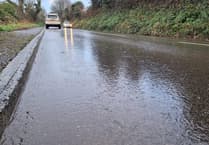
If the "Valley Route" were chosen, it would lie along part of the route previously selected for the bypass. The Environment Agency is rightly concerned about developments in the flood plain and one of their objections is that the road would be liable to flood.
I am surprised that DCC have not used the opportunity to develop a design for a road along the Creedy Valley, which by judicious choice of route and use of embankments, could provide flood free access to Crediton at all times; I am sure that DCC and the EA are both aware that the present A377 has been impassable in the Downes Mill region on several occasions within the last 30 years.
If the Hillside Route is chosen, then there would have to be work done at various junctions in the industrial estate and it might open up the option of traffic from there using Blagdon, Jockey Hill and Higher Road, possibly as part of a one-way system.
The proposed "Western Route" as well as encroaching on a historic part of Crediton and enclosing houses along Exeter Road, is something of a dead end as far as future developments are concerned.
English Heritage should be reminded of the number of listed properties in Crediton, which are at present severely compromised by traffic on the A377.
The most disappointing aspect of the information presented at the consultation exhibition is related to the absence of any information from the MDDC planning department about how a significant extension of the road network would influence future developments in Crediton.
With the limited information that I have, I would hope that more serious consideration be given to a route along the Creedy Valley, moved up the contours wherever possible and constructed on an embankment across the flood plain. This route offers most for further developments in Crediton.
If further consideration of this route is rejected, then I would hope that the "Eastern Route" extension of the "Hillside Route" would be developed as it does seem to prepare the way for future road developments to reduce traffic in the High Street.
I look forward to learning DCC and possibly also MDCC response to my comments.
John Boyle
Fordton
Crediton
EX17 3DH