

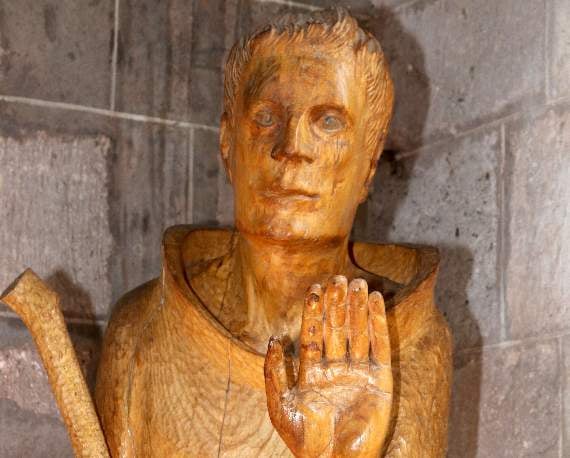
WHY did Crediton choose to twin with Avranches – as we read in the Courier recently – but not with Dokkum and Fulda with whom we have a far longer relationship?
As many readers will know, our ties with Dokkum and Fulda go back to the 8th century and the life of Wynfrith, later (St.) Boniface, c.680-754 AD.
At the time of Boniface’s death near Dokkum and burial in Fulda in 754, interest in this country in his life and work abroad was considerable particularly, though not exclusively, within the church.
Through a large body of surviving correspondence we know he kept in close contact with events in England and the English church at least was well aware of his amazing missionary and diplomatic work on the continent.

Indeed at a synod shortly after his death he was unanimously adopted as one of the three patrons of the English church.
Unfortunately, with the coming of the Vikings, thoughts turned to survival at home rather than missionary efforts abroad.
TOO SAXON
When the Normans arrived, Boniface probably seemed too Saxon to catch their attention, although in the 14th century Bishop Grandisson of Exeter did try to establish some sort of commemoration of Boniface at least in Crediton, though with little recorded success.
Finally, with the country turning to protestantism after the Reformation in the 16th century the general cult of saints was abandoned, though no doubt Catholics continued to venerate them, first secretly and then more openly.
Nowadays, the Catholic diocese of Plymouth is dedicated to St Boniface and we know there were some Catholic celebrations of his feast day in Crediton between the World Wars.
More general interest in him, and his feast day in particular, only really took off after World War Two, when Crediton was invited to send representatives to Dokkum to commemorate the 1,200th anniversary of his martyrdom.
SOCIETY
This sparked the foundation of the Society of St Boniface, one of whose aims was to erect the statue we now have in Newcombes Meadow, where anyone, of any faith or none, interested in the saint, could come to focus on his life and achievements.
Unfortunately, the Society did not survive despite many years of successful contacts with both Dokkum and Fulda.
This may have been in part because of its specifically protestant Christian aims, changes in public interests or perhaps because attention turned to the more modern and easily understood Twinning Association.
There was, however, always the problem that, over the centuries, Crediton, Dokkum and Fulda had developed quite differently.
Crediton remained a small town, Dokkum grew into a considerably larger town and Fulda became a large and wealthy city, more akin to Exeter than Crediton.
In 1988, celebrations of the 1688 “Glorious Revolution”, which had brought the Dutch William of Orange onto the British throne led to renewed Crediton/Dokkum contacts and there was talk of formal twinning.
CHARTER
The size discrepancy was felt to be a barrier, however, so on July 16, 1988 a Charter of Friendship was signed by the Mayors of the two communities recognising our ancient association through the life of St Boniface. Some years later a Charter of Friendship was also signed between Crediton and Fulda.
This renewed interest sparked increased contacts between all three Boniface communities and led the Town Council to call for an organisation to assist with such matters.
In July 1997 the Boniface Link Association was founded to assist the Council and community in Boniface-related contacts and business.
The Link is an entirely secular organisation and membership is open to any individual or organisation in sympathy with its aims. New members are always welcome.
Judy Tucker
Crediton
Comments
This article has no comments yet. Be the first to leave a comment.