
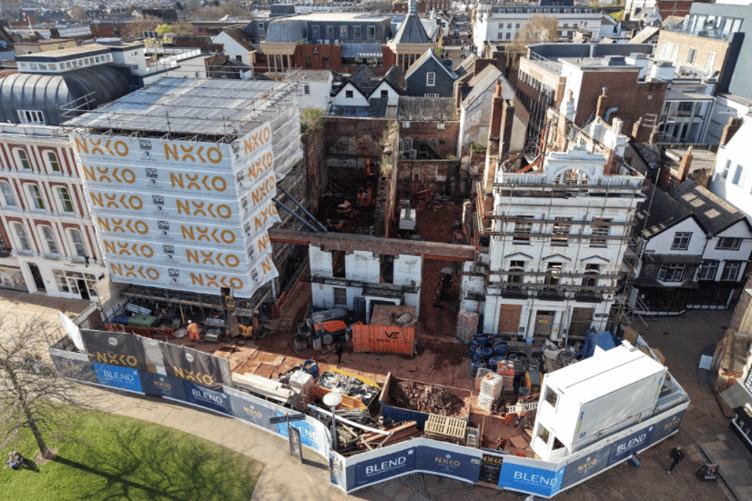
THE journey of the Royal Clarence Hotel in Exeter – often cited as the first property in England to be called a ‘hotel’ – has been a long and complex story of tragedy, delays, ownership changes and ultimately restoration since the disastrous Cathedral Yard fire on October 28, 2016.
As its new owners mark the 10th anniversary by shining a spotlight on their ambitious plans for the site, they are also looking back on the extraordinary history of what was probably the country’s first ever “hotel”.
Archaeological digs beneath the cellars have uncovered early Roman remnants, placing the site at the heart of the Roman city of Isca Dumnoniorum.
A clue to the true age of a building on the site comes in the form of the “Skeleton Beneath the Well”, which has been dubbed Exeter’s oldest mystery.
Tucked away beneath a stone stairwell, the remains lie beside what is believed to be a well dating back to Norman times, though some suggest it could be even older, with Roman origins.
The identity of the skeleton remains uncertain, but it has been the subject of intense speculation down the years. Some say the bones belonged to a victim of the Black Death, hastily buried near the well during one of the city’s many pandemics.
Others believe the remains belong to an Anglo-Saxon teenager. There are even theories that the skeleton is a composite made up of both male and female bones.
By the 13th century, as Exeter Cathedral was being rebuilt, the site housed a grand Canon’s house under the jurisdiction of the Dean and Chapter.
Then, during the 15th and 16th centuries, timber-framed buildings lined Cathedral Yard. Portions of these early party walls and subterranean stone vaults survived inside the building structure right up until the 2016 fire.
Built by local banker William Mackworth Praed from 1769, the property opened as a Georgian assembly room complex designed for grand balls, concerts, and social gatherings overlooking Cathedral Close.



In September 1770, Pierre Berlon, a French manager, took over the management and advertised the property as an “hotel”, the first recorded adoption of the French word for a high-standard lodging establishment in England outside London.
In July 1827, Adelaide, Duchess of Clarence – the wife of the future King William IV – stayed at the hotel and, in honour of her visit, the inn officially took the title the Royal Clarence Hotel.
Under proprietor Sarah Street in the 1820s, the hotel was updated with an Egyptian-style assembly hall and subsequently expanded by taking over the adjoining former Exeter Bank building on Martin’s Lane.
Over the 19th and early 20th centuries, the hotel hosted famous historical figures including Admiral Lord Nelson, composer Franz Liszt, author Beatrix Potter, and Hollywood stars touring the West Country.
Remarkably, it survived the Exeter Blitz bombing raids in May 1942 which devastated surrounding streets and much of the town centre.
The building was designated a Grade Two listed building as part of the historic group around Cathedral Yard, and in 2003 hotelier Andrew Brownsword bought it for £4.5 million, renovating it into a 53-room boutique hotel branded as ABode Exeter.
It operated successfully under this name until the morning of October 28, 2016.
That was the day fire broke out in an adjacent art gallery on Cathedral Yard. Fuelled by old timber framing and a ruptured gas main, it spread into the hotel. While all guests and staff were evacuated safely, the interior was gutted, leaving only a ruined facade and a standing shell.
In the immediate aftermath, structural engineers carried out controlled ‘takedowns’ of unsalvageable, dangerous masonry. Historic timber, metalwork, and medieval elements were documented, tagged, and safely archived for future rebuilding.
Andrew Brownsword announced plans to sympathetically rebuild the property as a 74-bedroom hotel, receiving initial planning consent. However, the escalating costs of rebuilding a heritage landmark proved economically unviable for the group.
After standing as an empty site for nearly four years, the plot was sold to South West Lifestyle Brands, led by former Plymouth Argyle football club chairman James Brent.
Recognising that a full hotel rebuild was unfeasible, he submitted revised plans to convert the upper floors into luxury residential apartments, with high-end eateries and shops on the ground and basement levels. Exeter City Council officially granted planning permission in September 2023.
However the after-effects of the Covid pandemic brought economic uncertainty not only for the Clarence project but also for the country as a whole. The site was eventually sold to local developer NooKo in April 2025, with the new owners becoming the third to hold the deeds to the shell since the devastating fire.
NooKo came in with ambitious plans to transform the landmark on Cathedral Green into a mix of sustainable residential apartments and ground-floor commercial spaces.
Its plan is for an exclusive collection of 25 private residences, with one, two and three-bedroom apartments available.
“This is a rare opportunity to own a piece of the city’s storied heritage, reimagined with unparalleled sophistication for modern living,” says the company’s website. “The building was left as a shell, but the spirit of the Royal Clarence remains unbroken.”
Work started on site in January 2026 and full planning permission was granted just this month. The show apartment is on target to open by private invitation in early 2027, with the building due to be completed by the end of the year.
The historic facade of the Clarence is being reconstructed to match its former appearance using authentic materials and salvaged fabric where possible.
The famous coat of arms is being re-cast from pieces of the original mould and Mark Hill, the signwriter who painted the name on the front, is coming back to paint it again.
The famous skeleton, and the well beside it, will be preserved.
On Wednesday, October 28, on the exact 10th anniversary of the fire, historian Dr Todd Gray and Max Sayers of NooKo will give a public talk on the Royal Clarence at The Mint Methodist Church Centre in Exeter.
The afternoon is in two parts. Dr Gray will speak on the fire and its aftermath, looking back at the day of the blaze and what followed, while Mr Sayers will give an update on the project.
The event starts at 2pm and tickets are available through the Exeter Corn Exchange.
Comments
We've recently changed our login process. If you have an account for commenting, you will need to re-register on the login window.
This article has no comments yet. Be the first to leave a comment.