
IN 2003 Network Rail's plans to put 30m high radio communications masts along the Tarka Line caused much consternation.
This week Network Rail showed revised plans with mast half as high at 15m at 13 places along the track. People had the chance to see these plans at an exhibition at Yeoford, Crediton, Umberleigh and Chulmleigh.
It was the first time Network Rail has shown its plans in this sort of exhibition and if it works, it could be repeated elsewhere on a network such as Anglia Rural in East Anglia.
Camilla Lambert, Network Rail communications manager based in London, said at Yeoford that responses made on the forms provided at each exhibition would be gone through and analysed, with the findings reported to parish councils along the Tarka Line in about a month's time.

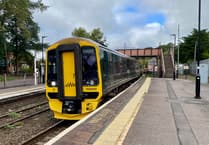


"If all goes well, work would begin in September to put the masts up and be completed by Christmas. Most of the poles can be put up in two days and we hope this would not cause too much disturbance to people.
"When the work is all done, we run a test train. We do not anticipate having to put in any five metre high repeater masts and would hope to find 100 per cent coverage along the whole track on the first run," said Camilla.
"These exhibitions are to tell people we have nothing to hide. It was a chance for them to come and ask us and tell us what they think about the plans. Many people have been very positive," she added.
Mavis Choong, Network Rail media relations manager, explained that the Network Rail communication system works with a linear signal, not like the mobile phone signal.
"At present we have an analogue system, which means our signallers might not be able to get through to the train drivers all the time, nor they to respond. This new system means they would be in contact all the time.
"We run a safe railway and we want to make this more reliable and more robust," added Mavis. She said the new system would mean more reliability and improve punctuality.
Use of the Tarka Line has grown year on year with more than a 50 per cent increase in passenger numbers since 2003. Technology has changed as well, to the benefit of people living near the 13 places along the track.
A new hourly timetable began in December with 14 trains each way (7am-7pm) except on Sundays. Mavis added that reliability of the infrastructure has improved with Network Rail's track and bridge investment.
Instead of the original lattice style masts, Network Rail will be using slimline monopole masts to go along the side of the railway track in the 13 places.
Where masts will be sited
At Newton St Cyres the mast has been moved 600m east away from the original site close to the station to minimise distance from houses.
At Crediton the mast would be on a new location, down the line from the signal box, opposite the breaker's yard.
At Yeoford the mast has been moved 250m north west of the station towards Colebrooke. The 30m mast would have been at the station.
At Morchard Road the original plan was for a 30m mast under the railway bridge over the Morchard Bishop road. It has been moved past the houses and almost opposite the fishing lake, screened by trees.
At Nymet Bridge the original plan was for one 30m mast, now there will be two, some distance apart, at 10m high.
At Eggesford Barton the original mast has been moved 1200m north west, from opposite Eggesford Barton to a site between the station and the Fox and Hounds, where there is a lot of screening by trees.
At Kings Nympton the mast has been moved to the other side of the track near Newnham Railway bridge over the river.
There will be a 15m mast at Abbotts Marsh where the mast has been moved 1km east, further away from the Portsmouth Arms, the station and houses.
A mast will be at Park Farm, moving it 550m north of the previous location to where it will have more tree screening.
At Umberleigh the new mast would be more than 700m north, away from the station and houses.
Radio communication between signallers and train drivers was introduced in the 1980s, with more improvements recommended since the Ladbroke Grove disaster.
Comments
This article has no comments yet. Be the first to leave a comment.