

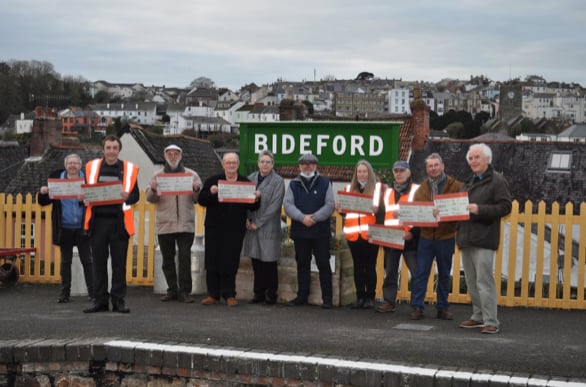
“A NEW train service connecting Bideford with Exeter and beyond” is the title of the Preliminary Strategic Business Case put together by Railfuture on behalf of the Northern Devon Railway Development Alliance.
It is on the Agenda for Torridge District Council’s External Overview and Scrutiny Committee’s evening meeting tomorrow, Wednesday, January 7.
The Council had committed some of its UK Shared Prosperity Fund allocation from central government, for feasibility studies, to support a specialist economic assessment and initial engineering feasibility review which contributes vital supporting material to complement the 132-page business case.
Match funding had come from Railfuture, two local Town Councils and the County Council.




Railfuture’s Roger Blake, who is the national Board Director for Infrastructure and Networks and also Acting Convener of the Northern Devon Railway Development Alliance (NDRDA), will be following up on the presentations given to study funders’ representatives at a Bideford workshop last September.
The Alliance’s independent adviser Peter West OBE had given a progress report on the draft Preliminary Strategic Business Case, which he has been finalising since, and professional consultancy SLC Rail’s Strategy Director Ian Baxter had presented the main findings from his team’s 83-page independent specialist economic assessment and initial engineering feasibility review.
The core message is that with such strong stakeholder and official policy support, a scheme to put Bideford back on the rail map is both desirable and deliverable, and fully justifies being developed in further detail.
Roger’s introduction is clear that the size of the prize, with a Bideford station ranked in the top 25%, or even 20%, of all mainline stations nationally, and significant socio-economic benefits valued in the 100s of £millions for the town and its rural catchment area, is however dependent on securing three main features:
• low scheme cost with a minimal contribution to estuary flood defences which are already necessary
• reduced journey time and increased service frequency on existing Exeter-Barnstaple services
• accommodating newly-specified requirements to meet local housing need in the Barnstaple-Bideford catchment through the next joint Local Plan.
Reflecting ahead of tomorrow’s meeting, he recalls that at the first meeting of the Northern Devon Railway Development Alliance, held in Bideford in March 2024, it was remarked that every community up and down the country which has seen its passenger rail services reinstated has had over many previous years the same kind of conversations as are taking place in northern Devon today.
The challenge, he believes, is to find any community, from Okehampton in West Devon to Ashington in Northumberland, from Ebbw Vale in Wales to Galashiels and Leven in Scotland, which has had their train services restored and have since regretted it as a bad idea which those communities now wish had never happened.
Contrastingly, there are many communities, and in the South West Bideford is by far the largest, which have seen their fortunes decline and continue to struggle in recent decades especially since their passenger train services were withdrawn.
Roger Blake is ready to address directly a consistent concern raised by many ever since the former ACE Rail campaign began four years ago, namely the potential impact on the Tarka Trail which had been established along the former rail alignment in 1987, just a few years after the track was lifted.
He notes that only last month the County Council has committed over £2 million to fill in some missing sections of the Trail north of Braunton.
That’s a decision which he believes should be seen as the clearest signal yet that as owner of the Tarka Trail neither the County Council nor any successor will contemplate being party to creating a new missing section elsewhere.
Engineering solutions will have to be found to maintain an unbroken active travel route between Bideford and Barnstaple, however challenging that will undoubtedly be in some locations.
Looking ahead for 2026, Roger sees two parallel lines of support for “Making tracks to Bideford” –
• representatives of official partner and stakeholder organisations already in the three dozen-strong Northern Devon Railway Development Alliance will continue to collaborate in developing the essential business case work, including working to secure the likely 6-figure sum necessary for the all-important Treasury / DfT-compliant Strategic Outline Business Case to be commissioned;
• representatives of all partner and stakeholder organisations whether as present or potential members of the Alliance will need to continue to anticipate and articulate ‘the Bideford bonus’ – the various benefits coming to the town and its wider catchment communities from being rail-connected once again – as such campaigns succeed on the foundation of unified local support elevated upwards and projected outwards.
Comments
We've recently changed our login process. If you have an account for commenting, you will need to re-register on the login window.
This article has no comments yet. Be the first to leave a comment.