
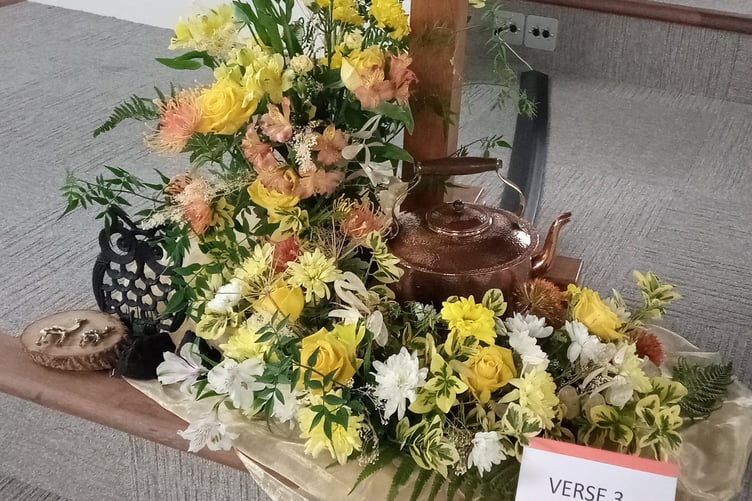
THE Harvest Festival Service at Crediton Methodist Church on Sunday, September 27 was led by our minister, Rev Dr Simon Leigh.
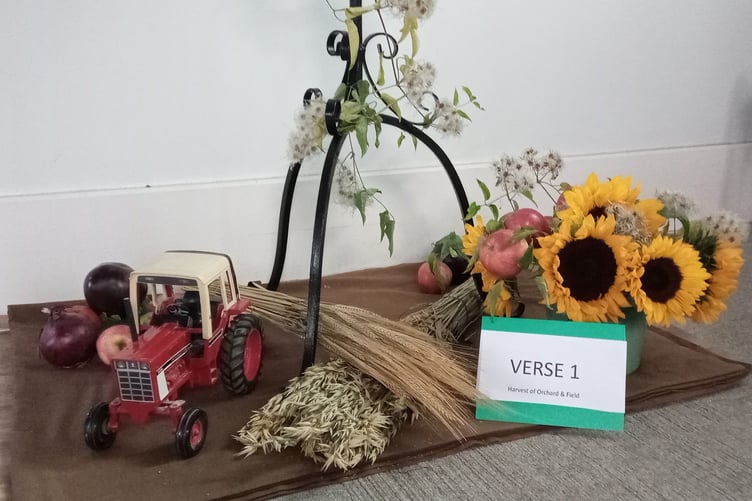
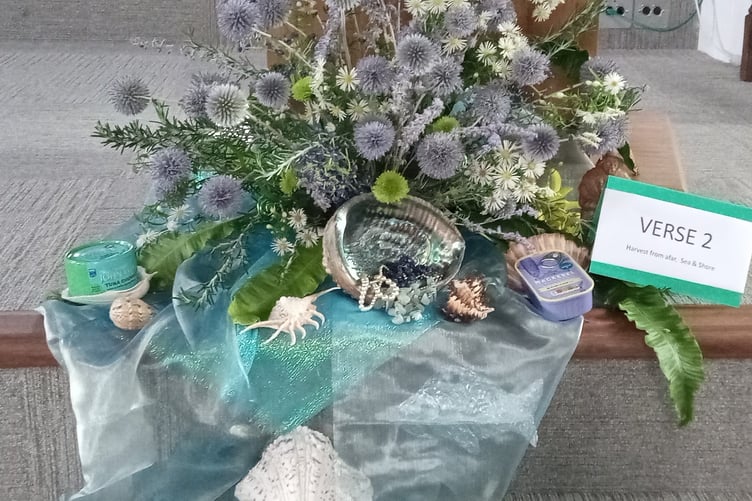
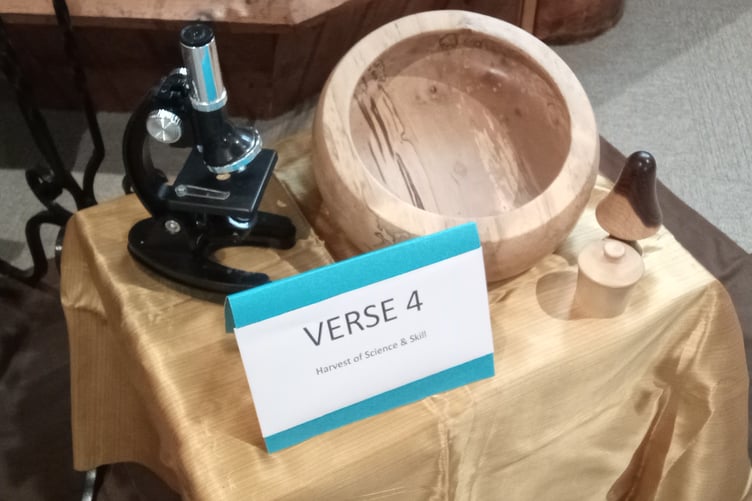
The Church was decorated with displays of differing harvests described in the verses of the first hymn – harvests of orchard and field, of sea and shore, of minerals quarried or mined, of harvest of science and skill and harvest of justice and love.
During the singing of the first hymn goods were brought out which will be delivered to the Crediton Foodbank.
The psalmist paints a picture of provision and all creation and deals directly with what a landscape and harvest is all about. This is a time of God’s provision for those who desperately needed to be fed.
When the psalms are being written, we think about the land of Israel and a desert, bareness and wilderness. We think about heat and the lack of water and a landscape which is drastically different from our own – a landscape where when it rains, with God’s provision, it can be transformed almost overnight into verdant pasture.
This is the image of paradise, a new Eden, the psalmist is portraying. This is where the people of God shall dwell in somewhere that is peaceful, where there is no starvation, no drought – where the people of God live with the people of God and God dwells richly with His people.
It is an idealised vision of what the Kingdom of God shall be like for God’s people.
In John 6 we read of a crowd of folk following Jesus (it says 5,000) who were getting hungry. The disciples asked Jesus how they were going to cope with such a number.
Jesus asked them ‘what are you going to do?’ Andrew realistically said that even half a year’s wages would not feed all these people.
Peter shows something of insight and intelligence which at first sounds quite foolish.
He says there is a little lad with 5 loaves and 2 fish – perhaps they might help?
Rev Simon said he could imagine the other disciples’ faces when they looked at Peter. Jesus asked for the loaves and the fish and then unfolds a familiar story of Christ’s provision for those in the crowd.
The test for every one of us and for us as a church is what Jesus will ask us ‘what are you going to do?’
Against the calamity the world faces, climate change, warfare, religious intolerance, some who are fabulously rich and others who are infamously poor, Jesus looks at us and asks ‘what are you going to do?’
The challenge of AI and the possibilities it could create for great good or it could be used in such a way that it threatens the very existence of human kind. Jesus looks at us and asked ‘what are you going to do?’
What are you going to do with the challenges in the world that land on your doorstep? Perhaps, we will have a Church Council or form a committee and write a report which will sit on the shelf and nobody reads it? It is a real challenge to the church of the 21st century.
Rev Simon’s previous Circuit was in rural North Devon and North Cornwall. He visited Holsworthy Market and speak to farmers.
We rely on these farmers because if they do not produce food for our tables what are we going to do? We cannot rely on produce coming in from all over the world. There is a responsibility for us to take care of our farmers and growers.
When we listen to the TV, we hear stories of agriculture and farming results in much effort for so little reward it begs the question what are we going to do to square the circle that makes being a farmer and grower something that is respected and acknowledged and given due weight.
At this time of harvest it brings to our minds that the harvest is fragile. Some years it is bountiful and in some years it is poor.
We are used to being able to visit the supermarket and fill our trollies. That is a western privilege but not a reality in many countries around the world.
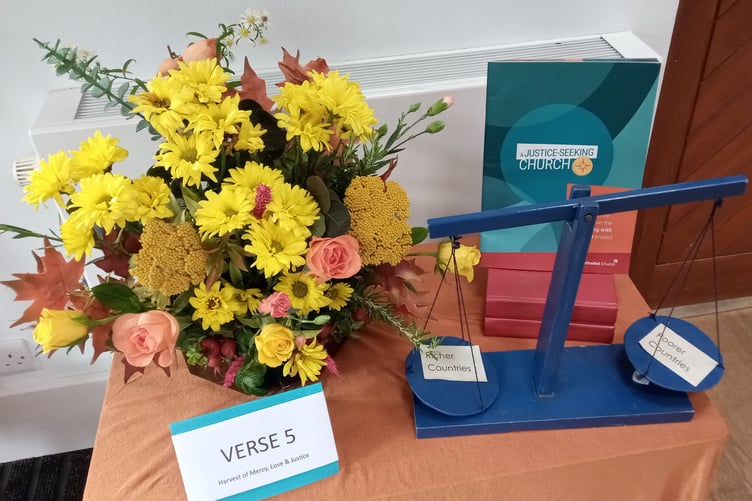
Harvest is a time for us to reflect and remember our own good fortune and the plight of others and realise their plight is our plight because, as Christians, we have a responsibility to be good stewards of the earth and to speak out against injustice.
One of Rev Simon’s farming friends grows potatoes and said they had nine bad years but on the 10th year it was a good harvest which made a profit.
He had just installed a £500,000 mechanised milking parlour but now did not need any staff to help. He calculated in 5 years he would make a saving of £250,000. Economics are making sense at the cost of labour.
The world is changing rapidly and Jesus asked the disciples and He asks us ‘what are you going to do in the face of all this?’
The answer comes in the response of Peter. In those few words ‘we have 5 loaves and 2 small fish’ Peter expresses the essence of faith. When Jesus looks at us against the troubles of the world - ‘what are you going to do?’
We can say that we have hope in our hearts and we trust in those that can make a difference. We trust in ourselves to pray and do what we can in the place we are set.
That might sound like a cop out to the challenges of the age, but it is a confession to what we are capable of doing and an expression of faith in what we can do and what we can offer.
Sometimes, when we look at ourselves, when we look at our harvest gifts, when we ask ourselves what is it that God is calling us to do, we simply see that we are called to continue keeping faith in Christ who makes provision.
We keep faith in God whose love sustains us and keeps us. We believe in a God whose providential will is to prosper us, to provide through the faith of those who will believe in that which is almost seemingly impossible to believe.
What are we to do? We are to pray. We are to act in response to our prayers and our response prayerfully will be wholeheartedly to what we can do.
Peter said here is a little lad with loaves and fishes and presented him to Jesus. And here in front of us, he offers what he can.
Likewise, when Jesus asks us ‘what can you do?’, the response is ‘Here I am – I will do what I can do’.
Bronwyn Nott
Comments
We've recently changed our login process. If you have an account for commenting, you will need to re-register on the login window.
This article has no comments yet. Be the first to leave a comment.