

St Boniface Vets - helping to protect herd genetics
DUE to the serious effects of bovine TB in our area, many farmers are losing the herd genetics that they have spent a lifetime improving.
Vets at St Boniface Veterinary Clinic, in Crediton, provide an advanced cattle breeding service, where the aim is to help preserve these family lines.
There are two options where genetic line preservation is concerned.




The first, and most common, is Multiple Ovulation Embryo Transfer (MOET), a conventional embryo flush.
This procedure involves a five-week superovulation programme, resulting in several eggs being released from the donor cow, as opposed to one during a natural heat.
The cow is inseminated and embryos are then flushed from the cow’s uterus the following week.
This non-surgical procedure involves placing a catheter through the cervix and into the uterus, where a cuff is inflated and fluid is flushed in and out to collect the embryos from each horn. This can all be done on farm.
An average flush would produce five embryos and those embryos could either be transferred fresh or be frozen and stored for implantation into recipient animals in the future.
The second option is a much newer technique and is only available through a handful of practices in the country, of which St Boniface Vets are one.
It is called Ovum Pick Up/In Vitro Embryo Production (OPU/IVP).
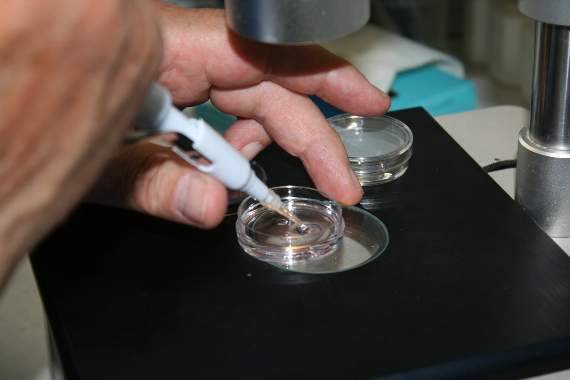
In this case only the eggs are removed from the donor animal and the fertilisation takes place in a laboratory rather than inside the cow.
The cow has to come to the advanced breeding facility for the OPU session, as everything has to be heat controlled. Under epidural, an ultrasound probe is placed into the vagina along with a needle and guide, so that eggs can be taken from ovarian follicles and collected into a test tube.
It is also non-surgical, but is superior to conventional embryo flushing for the following reasons:
· A larger number of embryos can be generated in a shorter time frame as an egg collection can be made every two weeks
· Eggs can be collected from juvenile heifers
· Eggs can be collected from pregnant donors during their first trimester
· Eggs can be collected from animals with a range of reproductive disorders
· Less semen is used per fertilisation
· Several bulls can be used giving greater scope for genetic improvement
· The latest science minimises the high birth weights that have previously been linked with this technique
If you would like any more information on either of the above embryo services or would like to attend St Boniface Vets advanced cattle breeding open day on May 9, please call the practice on 01363 772860.
Alternatively, keep an eye out for the details on practice "Facebook" page.
Comments
This article has no comments yet. Be the first to leave a comment.