

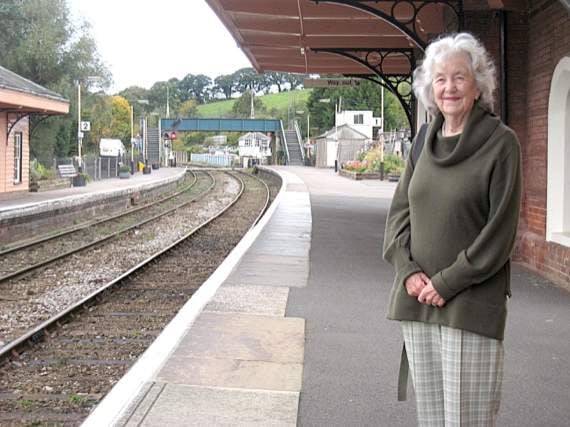
BORN during a Zeppelin air raid in London on September 26, 1917, Eileen Seddon is looking forward to celebrating her 100th birthday.
For most of her life Mrs Seddon has lived in Shobrooke - a life that has seen her achieve much.
Born Eileen Lilian Whicher, her father was a schoolteacher and mother was a seamstress.
She was quite good at school but famously got a mere three per cent in maths “matriculation” (the school leaving exam).
The family managed to have modest summer holidays by the sea. Her father would always travel to the destination a few weeks in advance to check the standard of the accommodation.
Her mother would make new dresses for every day of the holiday both for Eileen and her sister. These would be packed up and forwarded to the accommodation address in advance.
Aged 19 she got a job as secretary at the BBC. She became engaged to John Seddon - literally the “boy next door”. Occasionally they were able to take holidays with friends from London who had moved to the Crediton area. This kindled a lifelong attachment to the area.
Soon after the outbreak of war, the BBC’s National News Department moved to Bristol. Eileen took lodgings in the city and typed the wartime news bulletins and organised the rota of newsreaders.
Both Eileen and John were musically talented. On her regular trips back to London to visit her relatives, they would entertain folks who crowded at night on the platforms of the local underground station during air raids - Eileen singing and John accompanying on a piano that had been manoeuvred down there.
Eileen married John Seddon in January 1941. He had been medically disqualified from military service so they moved to Devon soon after and found a house to rent in Shobrooke.
John was earning £4 a week as an accountant and the weekly rent was equivalent to 75p.
They had two children during the war and supplemented the finances by keeping chickens, ducks, geese and pigs. Some of these were sold to Mr Cox, the butcher from Crediton.
There was no mains electricity so charged “accumulators” were delivered regularly to power the radio; water was pumped from a well; oil lamps were used to read by in the evening; and Eileen had to milk the cows for her own supplies! During the war, they hosted young “evacuees”, who had been moved away from the more vulnerable cities.
When hostilities ceased, Eileen joined the Crediton Arts Society and frequently appeared in theatrical productions and choral presentations.
The family moved into Exeter during the 60s but Eileen and John returned to Shobrooke as soon as the boys had left home.
They were keen participants in village life but regrettably had to move into Crediton when John’s health began to fail in the 90s.
Eileen has two sons, six grandchildren, nine great-grandchildren, and five great-great grandchildren.
Eileen’s passion has been for spinning wool and the activities and friendships associated with it. She taught herself to spin in her 50s and such was her interest that by the age of 67 she became chairman of the Devon Guild of Spinners, Weavers and Dyers.
During a subsequent six-year stint as President of the Guild she hosted an international conference with guests coming from as far afield as Japan.
She was part of the team that made a beautiful altar throwover for Exeter Cathedral. She has dyed, spun and knitted from local fleece many garments for her large family.
When in her late 80s, she was one of the oldest students locally to pass an exam in webpage design.
Eileen is a regular attender at St Swithun’s Church in Shobrooke and has supported its activities throughout. She has been a member of the Parochial Church Council and was part of a team delivering meals to housebound people.
Failing eyesight means she is no longer able to contribute so much these days. But the church community, and the friends she has made in the village, have been as important to her as her own family.
Martin Seddon
Comments
This article has no comments yet. Be the first to leave a comment.