

by Alan Quick
A CREDITON man who has been running a project to protect house martins says he fears the birds are in frightening decline.
Greg Martin has been running the Westernlea house martin survey for five years, as part of the Britain in Bloom initiative.
Greg explained: “I’ve been watching these birds since before Westernlea was built on the outskirts of Crediton, when they returned year-after-year to the barns to raise their chicks.

.jpeg?width=209&height=140&crop=209:145,smart&quality=75)


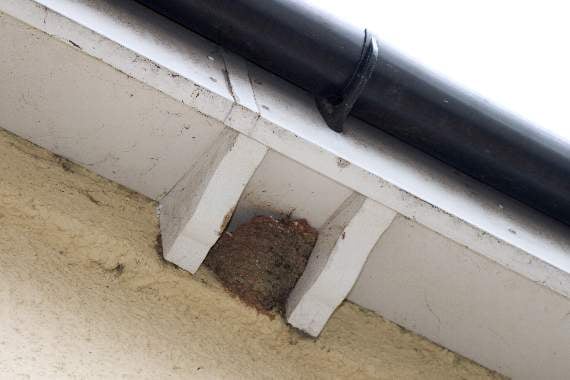
“They still return, but of course their barn homes are gone, so they nest in the houses instead. It takes a thousand trips for them to build one mud nest, and the neighbouring grassland provides the midges on which they feed.
“The brave little birds leave for Africa around October, and return in April to the same nest site.”
Mr Martin continued: “House martins are in frightening decline, and one of the main reasons is that old rough soffits and eaves are being replaced by shiny plastic.
“The mud can’t grip on the plastic, so the nests fall and the chicks die.
“It is illegal to knock down the nests during the breeding season, but modern building materials are causing them to fall unintentionally as well as intentionally.
“These little birds face untold dangers on their mammoth migration from Africa and over Europe, and many don’t survive the journey, so it is ironic that so many are killed here in England when they finally reach their ancestral destination.”
Recently it has been reported to Devon and Cornwall Police that an active nest was destroyed in Crediton.
PC 1776 Marshall, Devon and Cornwall Police Wildlife Crime Officer explained: “Within the spring and summer months Police receive increased reports in relation to the destruction of birds nests in local communities. This can range from Herring Gull to House Sparrow nests.
“All birds and their nests are protected under the Wildlife and Countryside Act 1981. This makes it an offence to destroy a nest whilst it is active. So specifically whilst the nest is being built, has eggs or dependent young within it. It is important when cutting hedges, trees, and renovating properties that care is taken and adequate checks carried out prior to work commencing.
“Commonly calls at this time of year relate to the destruction of house martin nests.
“This is a migrant bird that travels long distances to Britain to breed during the spring and summer months. Unlike many summer visitors, House martins do not always start breeding immediately after they return to the UK in April.
“Despite this, House martins still manage to raise two broods and some may even raise three broods. The breeding season can last longer than many other species, and a small number of House martins may still have young in the nest in September or even October.
“Nests of house martins are very obvious as they build domed mud nests under the eaves of houses. They often breed in small colonies and are noticeable via their regular nests visits and calls around the nest sites. The nests are beautifully constructed and contain up to 1,000+ pellets of mud.
“Quite often people are found to have knocked these down intentionally due to renovation work or the fact that the droppings can leave a mess under the nest.
“It is vital to remember that it is a criminal offence to destroy these nests whilst the nest is active.
“Best advice would be that if you feel the need to remove these nests then carry out the work within the winter months. That being said these birds are at risk and are declining and are currently are of a conservation concern within the UK so you should feel very privileged that they have chosen to use your property to breed.”
Mr Martin added that in the next week or so he is hoping to take Landscore Primary School children on a nature walk around Westernlea to observe the birds and their nests, and hopefully instil an interest in the natural world.
Comments
This article has no comments yet. Be the first to leave a comment.