

by Sue Read
CUT air pollution, keep green spaces green and better recycling were all discussed at Crediton Town Council’s Policy and Forward Planning committee last Tuesday evening (March 6).
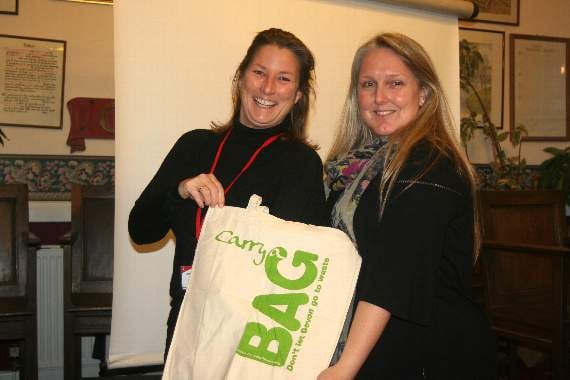
Miss Felicity Jones, Recycling Officer at Mid Devon District Council, was invited to discuss waste and recycling in the area and the work of the Waste Transfer Station near Willand, where refuse, food and garden waste is collected and stored prior to being transferred for processing.
Miss Jones said that the transfer station was not a processing plant, it was purely to hold waste for transfer waste such as that from garden food wastes which went to Cannington in Somerset for composting.


Recycling, refuse, garden waste and trade waste all go to the Transfer Station. All of Mid Devon’s residential and trade refuse is transferred to Energy from Waste Plants and residential recycling materials are baled and stored in-house ready for collection by UK processors.
Miss Jones said it would be too big a carbon footprint for MDDC refuse lorries to go into Marsh Barton every day, hence the Transfer Station which was a section of the big concrete building with concrete dividers.
It worked to strict guidelines even to the point of catching and storing all drainage. Nothing would go to landfill. The council had cut the amount of miles travelled by its lorries which now start and finish at Willand at the Waste and Recycling Depot.
She suggested councillors should visit the Energy from Waste plant in Exeter, which they hope to do at some time.
Committee chairman Cllr Liz Brookes-Hocking asked what incentive there was for Mid Devon as an authority to make sure fewer black sacks were put out.
She was told the council has a compulsory recycling policy and those found to be using black sacks for disposing of food, garden and recyclable materials could be fined.
Cllr Frank Letch commented that he had seen houses put out as many as 19 black bags. Miss Jones said lorry crews were supposed to report if there were things in the black sacks that should not be there but should be recycled.
However, she did say that the marjority of people did their recycling properly.
Usually a letter to anyone not doing it properly sufficed, education was a large part of helping people be aware that recycling was compulsory in Mid Devon. If it was a whole street with no recycling put out, then all the properties would receive a letter from the district council.
Cllr John Ross wondered if the town council could help to improve matters, maybe education and encouragement.
Miss Jones added that if people let the district council know where recycling was not being done or not being done properly, it could begin to address the matter and hopefully highlght the severity of the problem.
"We have a place where not one single resident was putting out a black recycling box or blue caddy, after receiving a letter from the council there was a noticeable reduction in black sacks and residents were putting out recycling and food waste," she said adding that this was quite often a problem at flats. However, the district council was working with its housing department over this.
She added that people felt recycling was not their responsibility, but it was. It was everyone’s responsibility.
There was a discussion about use of plastic and how to discourage this, plus the problems of black plastic and recycling.
She said a lot of work had gone into making sure the MDDC collection lorries were not wasting fuel, that they were run as economically as possible.
The Transfer Station is a DCC-funded facility that allows residual waste to be separated, loaded into bulk vehicles and delivered to the Energy from Waste Facilities, where it is converted into energy.
It also allows food and garden waste to be separated so they can be treated separately.
Reducing waste saves the taxpayer money from treating and disposing less waste. The saving which is made by DCC is now shared with MDDC.
AIR QUALITY
Looking at the 2017 Air Quality annual status report, the committee wanted to know whether there had been any assessment into the impact of and number of heavy lorries through the town.
Cllr Ross commented that the amount of house building must have a knock-on effect on the amount of traffic. Cllr Brookes-Hocking said everyone knew that the UK was "not up to standard" as regards air quality.
Cllr Letch commented: "You only have to stand at Barnfield to count the buses going up and down that hill, the smoke from their exhausts and the age of the buses.
"I think we should be looking at the quality of those buses, many are quite old." However, it was pointed out that there was a higher tax on the newer diesel vehicles.
Also that Crediton was "a victim of a split school site" with one at the top of a steep hill.
When Cllr Ross said the amount of commercial traffic that used the High Street was apparent by its absence during the recent A377 closure, Cllr Joyce Harris said this had always been a problem.
It was said that house building either side of Crediton would bring more traffic through the town.
Members said they totally disagreed with any proposed plans to alter the Air Quality Management, especially with the level of building outside the town, which would impact on the air quality in the town.
Cllr Brookes Hocking added that Devon County Council had said it would do an assessment of the impact of the Link Road but the town council had not yet received those figures.
OPEN SPACES
Comments
This article has no comments yet. Be the first to leave a comment.