

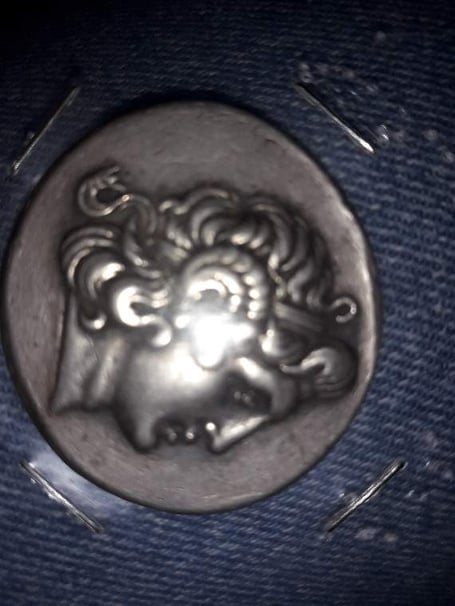
THE June open meeting of Crediton and District Third Age Group included a talk by Bryan Short about the History of Coins during the period from 650BC to the present.
Before the introduction of coins some sort of commodity, such as a bundle of iron rods, was used to aid trade.
The first coins were introduced in 650BC in South West Asia to pay soldiers in silver and gold pieces.
As the Greek power spread all round the Mediterranean the use of coins became widespread as Greece was a very powerful trading nation.

These coins were produced by striking metal with dies and were works of art on a coin.
In 325 BC Alexander the Great from Macedonia, who died at the young age of 33, wanted to conquer the world. At his death he had more than a million square miles under his power.
Alexander wished to produce coins in silver and gold of the finest quality. A coin from this period was handed around the audience - it was beautifully crafted!
In contrast the coins introduced by the Romans in the West at this time were large and crudely formed in bronze.
Coins developed during the intervening years and there were mints all over England but the coins were still manually produced and mint workers were treated badly.
Some were not allowed to leave their places of work and were confined to the premises. We were shown a picture of mint workers peering out of windows to watch street entertainment at Christmas.
If they were found to be "spiking" the coins they were executed by being spiked - a disturbing picture!
During Charles 1 reign machine-made coins were introduced after several false starts where the men trying to introduce the machines were executed after being accused of treason. One of the early machines, that was successfully introduced by a brave designer (who wasn’t executed!), was used in the Mint near St Nicholas Priory in Exeter.
The audience were able to hold (in a plastic wallet) one of the World’s smallest golden coins. It was about the size of a grain of sand and came from India. Coins such as these apparently were carried around in the mouth in front of the lower teeth - you learn such a lot at a U3A talk!
Bryan answered a variety of questions from the audience - thank you Bryan for a very interesting talk.
The Crediton and District Third Age Group, for the retired or semi-retired, is a not-for-profit organisation with a variety of member-led groups to join.
Membership of £12-a-year, gives access to a wide range of interest groups and outings.
The groups (which meet either weekly or monthly) include: Current Affairs, Tai Chi, French, Mindfulness, Arts and Crafts, Historical Buildings and Churches Visiting group, Walking - short and longer, Wildlife Walks, Pub Lunches, Photography, Creative Writing and History.
A new Abstract Art group started on May 1 and a Cycling group, where electric bikes are welcome, has its second meeting at the beginning of July. See the full list of groups and how to join on the website: u3asites.org.uk/crediton .
A visit is being planned to the Lost Gardens of Heligan during July.
An open meeting is held every third week of every month at the Boniface Centre (doors open at 9.30am for a 10.15am start), admission £1.50.
The fee includes a cup of coffee/tea, biscuit, the chance to hear the speaker and to chat and learn more about the organisation.
The next open meeting will be held on Wednesday, July 17, and includes a talk to be given by Dr Keith Hooper entitled: "Charles Dickens: faith, angels and the poor".
On August 21, the speaker will be Kirsty Peake, the talk entitled "From wolf to dog".
For more information visit the website or telephone David Agasee (chair) on 01363 775698.
Comments
This article has no comments yet. Be the first to leave a comment.