

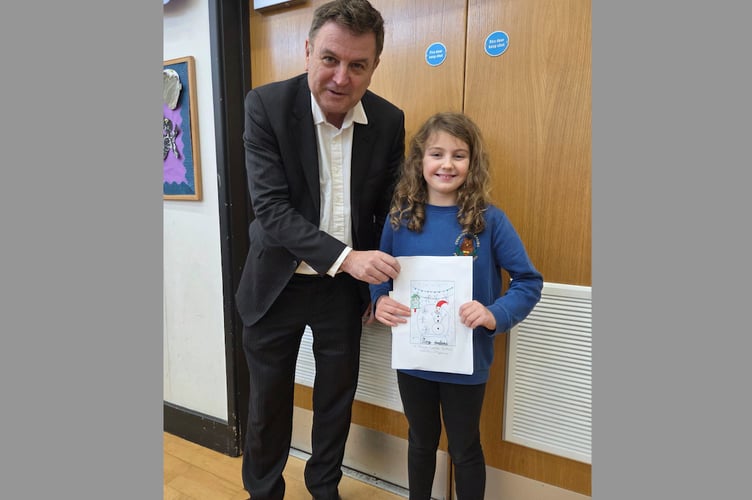
I WAS delighted to visit Cheriton Fitzpaine Primary School recently to personally congratulate Imogen Costelleo, who was runner-up in my Christmas Card competition.
It was wonderful to see the creativity and talent of our young people on display, and Imogen’s design truly captured the festive spirit of our rural communities. A big thank you to all the teachers for their warm welcome during my visit.
My Christmas Card competition has become a valued tradition that connects me with schools across Central Devon, and it reminds me just how fortunate we are to have such dedicated staff and talented pupils in our community schools.
Meeting the pupils and staff at Cheriton Fitzpaine was a genuine pleasure, and I was impressed by the vibrant learning environment they have created in this small village school, which forms part of the Exe Valley Federation of rural primaries.




During my visit, I had the opportunity to thank the teaching team for their work. Full-time teachers in England are working an average of around 52 hours per week according to the Department for Education’s own survey work – well above the standard 48‑hour working week used in working time regulations.
Primary school teachers in particular face immense pressure, with nine in 10 teachers considering leaving the profession citing high workload as a factor.
These statistics should concern us all, particularly when teacher recruitment into initial teacher training remains persistently poor, falling short of government targets overall by around 30 per cent last year and missing targets in most secondary subjects.
Small rural schools like Cheriton Fitzpaine face unique challenges that the current government appears unwilling to properly address.
We are seeing schools across England under pressure to merge or close over time as birth rates decline and pupil rolls fall.
These changes can have a highly negative effect on rural communities, forcing children to travel greater distances and weakening vital connections between schools and their villages.
Cheriton Fitzpaine, as part of the Exe Valley Federation, demonstrates how collaboration between rural schools can help them thrive, but they need proper support from government to succeed.
The funding situation for schools nationally remains deeply troubling. Independent analysis suggests that around three quarters of primary schools and well over nine in 10 secondary schools will be unable to afford their costs next year on current plans, with real‑terms cuts to their spending power.
On average, primary schools face a real‑terms cut of just over one per cent and secondary schools around 1.2 per cent in 2025–26, with the majority of schools seeing their budgets squeezed.
This risks wiping out much of the progress made in restoring per pupil funding in real terms since the 2010s.
While mainstream school funding per pupil is set to increase by about 2.8 per cent in cash terms for 2025–26, analysis indicates that school costs are likely to rise by around 3.6 per cent next year, leaving almost no real‑terms headroom.
At the same time, the government has recommended a 2.8 per cent teacher pay rise, again without providing sufficient additional funding to cover rising costs in full. Schools after years of constraint now often face difficult choices between cutting resources, reducing staff numbers, or running deficits.
The government promised change at the last election. Parents voted for better funding for education, yet school budgets continue to be squeezed in real terms and are forecast to come under even greater strain in the years ahead.
Labour pledged to recruit 6,500 new expert teachers, but with funding this tight and workload pressures so intense, it is difficult to see how they will meet this target without a more ambitious plan to improve both pay and conditions.
Teacher retention remains fragile, with repeated surveys and labour market reports showing high proportions of teachers considering leaving and vacancy rates at or near historic highs in several key subjects.
Our rural schools deserve better than being treated as an afterthought by government. Recent changes to the local government funding framework have, as Conservative MP Neil O’Brien has highlighted, disproportionately benefited London and metropolitan areas at the expense of county and rural communities, with the removal of “remoteness” factors and other tweaks diverting hundreds of millions of pounds over time from rural to urban areas. This is particularly concerning for counties like Devon, where geographical challenges make education provision more expensive yet crucial to maintaining vibrant communities.
I will continue to champion our local schools in Parliament and hold the government to account for the funding pressures they face.
The dedication shown by teachers and staff at schools like Cheriton Fitzpaine Primary deserves to be matched by proper investment from Westminster. Our children’s education should not be compromised by a government that promised change but continues to squeeze school budgets.
Facebook: Mel Stride MP X: @MelJStride Instagram: @melstridemp Website: www.melstridemp.com
Comments
This article has no comments yet. Be the first to leave a comment.