

by Alan Quick
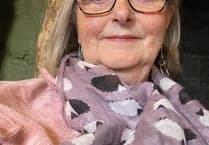
AS a nurse, midwife and health visitor local woman, Mary-Flowa Houldsworth, practised in the NHS, occasionally taking six months unpaid leave to work for the aid agency Medicins Sans Frontiers (Doctors without Borders) MSF.
MSF is a leading independent humanitarian organisation delivering emergency medical aid to more than 60 countries worldwide, providing relief for the victims of war, natural disasters and epidemics of race, religion, gender or political affiliation.
Her first mission for the charity began in South Sudan in 2000/2001 working as a nurse/midwife in remote villages during the country’s civil conflict, sometimes running clinics only two hours from the front-line.

Delivering babies in dark, mud huts, three hours flying distance from the nearest hospital was an anxious time, until the babies were safely born without difficulties.
Afghanistan 2001/2 was a fascinating experience for her when MSF operated a children’s feeding centre for refugees returning from Pakistan.
The outbreak of Ebola in West Africa witnessed MSF as the lead agency managing centres which treated more than 10,000 victims for almost a year.
In September/October 2014, as the disease reached its peak in Liberia, Mary was one of the 80 international volunteer team who responded to the world’s largest tented unit desperately trying to bring relief to the devastated population.
She said it was an emotionally challenging time and children died in front of their eyes.
Pregnant mothers lost their babies and their lives, and she said the memories of the incredible sadness for grieving families was unforgettable.
Here Mary recounts one particular day: “The day has been hot and dry, and the clinic busier than usual.
“The temperature in South Sudan has reached 44 degrees under the shade of the acacia tree, where the team from Médecins Sans Frontières (MSF) is holding its clinic. Wherever MSF opens healthcare facilities, families walk for days to bring their sick relatives for treatment for malaria, kala azar, meningitis, malnutrition, diarrhoeal disease and other tropical diseases.
“In the late evening, a staff member races into our compound reporting that a pregnant mother has walked for miles to reach us. She is resting in an empty mud hut in the scrubland half-a-mile away. Can I go and assess her? Sure, dinner can wait.
“The patient, Nyuma, is exhausted. This is her first pregnancy. Her mother watches anxiously as I give her oral rehydration solution before palpating her abdomen. On examination, I find she is full-term with twins and already experiencing occasional mild contractions.
“Her blood pressure is raised to a level that, in the West, would see her immediately admitted to hospital. But the nearest hospital is three hours’ flight away, and the eight-seater aircraft can only reach us during daylight hours.
“We give her the drugs that are available and ask her to move into our compound, where we will be able to give her constant care through the night. But Nyuma declines. Neither she nor her mother want us to stay the night in their temporary home. Her mother assures us she will fetch us if necessary.
“It is a sleepless night, as my ears are tuned for any movement or voices outside. Should I have booked a plane for the morning, I wonder, just in case complications arise? But supposing all goes well and the pilot ends up with a wasted six-hour round trip?
“At 6am, an excited staff member comes racing into the compound, shouting, ’Flowa you’re a god. Nyuma has delivered two babies!’ Apparently twin pregnancies are not common, and the staff were disbelieving when I explained I could feel two babies.
“We rush off to assess the situation, fearing the worst.
“We calm ourselves before entering the hut. There, lying on the mud floor, are two beautiful babies, both good weights, and more importantly a smiling Nyuma and glowing new granny.
“What a relief! The outcome could have been so different. All I have to do now is convince the staff I am human, and demonstrate how twin pregnancies come about using a few sticks and two stones!”
• Mary-Flowa Houldsworth will be giving a talk on Ebola and the work of Medecins Sans Frontieres (MSF) at Crediton Congregational Church on Sunday, October 11, at 11am.
Everyone is welcome, and there will be refreshments afterwards.
Comments
This article has no comments yet. Be the first to leave a comment.