

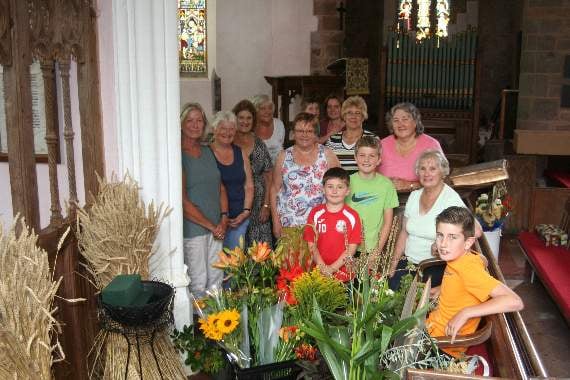
STUNNING displays of flowers greeted visitors to St Andrew’s Church at Colebrooke during the last weekend in July for the Flower Festival celebrating the seasons of the church year.
Beside the church door were items that raised curiosity or brought back memories with the Plough Sunday and Rogation display that included an old plough, a seed fiddle and a zellup or seedlip with tubs of flowers.
This set the delight with all the other arrangements being so well crafted with much thought obviously having been given.
The bell tower was open so that people could see the refurbished church bells back in their proper place. That meant a climb of 68 steps, but a number of people did it.



Members of the ringing team were there to show off the bells and to let people see one of them being rung. Ear defenders were provided.
Refreshments including cream teas were available right through the weekend, cakes all home-made with several extras having to be made during the weekend. There was also ploughman’s lunches.
The festival ended with a service of Re-Dedication and Blessing of the newly restored church bells when a celebratory Eucharist was led by the Bishop of Exeter, the Rt Rev Robert Atwell who gave a most interesting address in a lovely service.
Copies of the short history of Colebrooke church bells by Margaret Enderson were for sale plus the book of the history of the church.
A booklet explaining each of the seasons was available with the whole weekend being to help maintain the fabric of this church, parts of which date back to the 12th century.
In case people are interested, this came from a 1918 Devonshire Association Transactions, provided by Neville Enderson: “In former times all corn was sown broadcast from a zellup (seedlip), a kidney-shaped, deep wooden tray, which was carried by means of a broad strap across the shoulders, and in some cases supported by the left hand engaging with a handhole or handle at the outer edge. It is still frequently used for distributing artificial manure, though the modern zellup is made of galvanised iron. There is a local saying at Hartland:
When the say-gulls cry by lan’,?’Tis time to tak the zellup in han’;?When the say-gulls cry by say,?’Tis time to draw the zellup away.
The sea-gulls crying by land indicate the approach of wet, stormy weather, before which the corn should be sown; while the sea-gulls crying by sea indicate continued fine weather, which is unsuitable for seed-sowing owing to the lack of moisture to promote germination. The seeds are covered in by harrowing with light barrows, and rolling.”
See more pictures in the Crediton Courier on Friday, August 10.
Comments
This article has no comments yet. Be the first to leave a comment.