

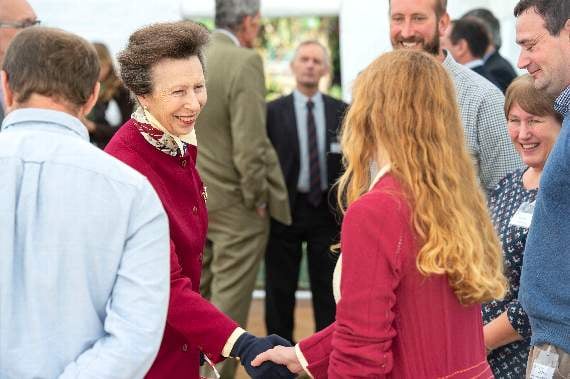
?HRH The Princess Royal visited the Devon agricultural research campus of Rothamsted Research at North Wyke, near North Tawton, today (Monday, September 24) to hear about a new chapter in sustainable livestock production and the 60-year heritage on which the development builds.
Sheep and cattle were the focus, along with the science of raising such livestock sustainably to reduce their environmental impact.
The Princess Royal joined celebrations of more than half a century of livestock research at North Wyke, which brings together many local and regional researchers, farmers and small businesses, and heard about plans for a new £2 million research facility to support the UK’s sheep industry.
The Small Ruminant Research Facility, due to be in place early next year, will address policy and industry needs around sustainable ruminant livestock production using sheep as a model for all ruminants. This is important because often the cost of initial investigations in dairy or beef cows can be prohibitive.

“This state-of-the-art facility will be invaluable for the next generation of livestock science researchers to analyse, at a farm system scale, the impact of management decisions on sheep productivity at the level currently afforded to cattle,” says Michael Lee, Head of Sustainable Agricultural Sciences at North Wyke.
Mr Lee, who is also Professor of Sustainable Livestock Systems at Bristol Veterinary School, hosted The Princess Royal alongside Achim Dobermann, Director and Chief Executive of Rothamsted Research, which is itself marking 175 years since the start of agricultural research at its campus in Hertfordshire in 1843.
“We have been delighted to welcome The Princess Royal to our Devon campus today,” said Mr Dobermann. “Her Royal Highness was keen to find out more about every aspect of the research that takes place here.
“She has bamboozled us with her knowledge,” added Mr Lee.
The visit provided an opportunity to bring together many of the academic, industry and farming stakeholders who have helped contribute to the research at North Wyke. They continue to support the need for research in the livestock sector, which contributes more than £8 billion a year to the UK economy.?“As The Princess Royal unveiled a plaque to commemorate her visit,” said Mr Dobermann, “Her Royal Highness told an audience of friends and colleagues of North Wyke, that what is so valuable here is our ability to produce information for farmers for whatever farm system they happen to be using, and to be able to measure accurately and appropriately.”
He continued: “Her Royal Highness reminded us that Rothamsted’s reputation and experience are older and longer than most, in terms of agricultural research, and that it’s a huge encouragement to those who still farm, under whatever heading, that there are people in research who are genuinely keen to understand the problems and to find practical answers that are applicable to those who actually work on the land.”
Mr Lee added: “The new facility is a testament to Rothamsted’s commitment to the need to address issues of food security, and research on grazing livestock systems in particular, and will provide vital, evidence-based support for the UK sheep industry for decades to come.”
The facility will open up new areas of investigation. It will enable detailed animal feeding trials on grassland systems to be monitored using a range of instrumentation across the entire production season. There is scope to cover 600 ewes and their lambs, their feed and the land they graze on.
The findings will help farmers to make informed decisions about when animals require supplemental or residual feed, and the best feed to use to maximise production from pasture. The overall aim is efficient production, reduced greenhouse gas emissions, and better silage with maximum availability of minerals.
Investment in the new facility has come from Rothamsted, the Biotechnology and Biological Sciences Research Council (BBSRC) and the Centre of Innovation Excellence in Livestock (CIEL), which is one of the UK’s four agri-tech centres.
Three “farmlets” make up the farm platform. They provide real-world, farm-scale models that enable researchers, farmers, and industry to compare and contrast a variety of approaches to raising livestock sustainably, and the data to support their findings.
“Her Royal Highness was very interested in how we manage the inputs and outputs and, in particular, the cattle and sheep on our farmlets,” said Jane Hawkins, a specialist in soil and water science at Rothamsted.
“The Princess Royal wanted to know more about how we are monitoring all the metrics of the farm platform, and about the land management before the platform was established, in particular the grass species that were here originally, and how those compare with our current permanent pasture.”
Research at North Wyke is helping to address some of agriculture’s most pressing challenges, such as mitigating and adapting to climate change, protecting natural resources, maintaining food security, and sustaining the pasture-based livestock systems that are dominant in regions such as the South West of England.
Comments
This article has no comments yet. Be the first to leave a comment.