
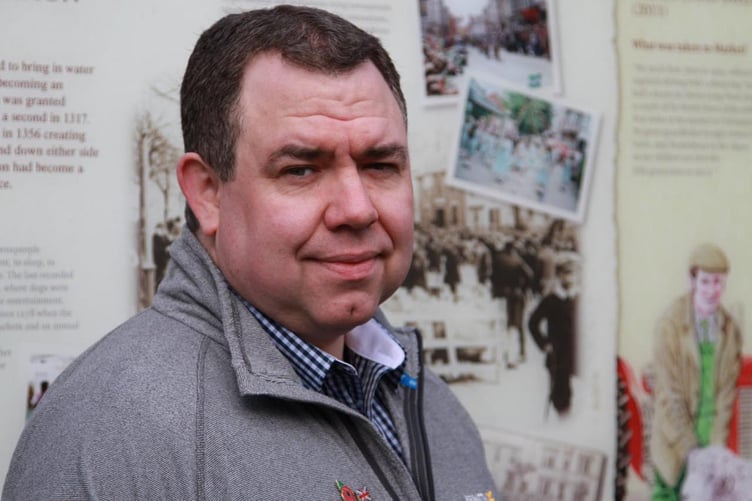
A SENIOR Devon politician has raised “significant concerns” about proposals for the expansion of his own town.
Major long-term plans for Cullompton have been developed in recent years leading to the proposed Culm Garden Village that would accommodate up to 5,000 homes at some point in the future.
But even though only around 1,700 of those are being targeted by 2033, Councillor James Buczkowski (Liberal Democrat), who represents Cullompton at town, district and county level, has issued an 11-page missive outlining his objection to the approach being deployed.
One of his major concerns revolves around the so-called “three-village concept”, which envisages the new homes within a trio of distinct but nearby conurbations.
The Culm Garden Village was announced as part of government plans in 2017 for new garden villages and towns across the country, with new homes set to be accompanied by employment, shops, schools, transport improvements, healthcare facilities and leisure opportunities.
As part of the plans for the area, Mid Devon District Council adopted its masterplan for East Cullompton in 2023, which is intended to support the first phase of delivery of new homes and facilities for the area.
Cllr Buczkowski said he believed development should grow outwards from Cullompton “rather than establishing separate areas of development which are subsequently expected to grow together”.
“My preferred approach is sequential growth outwards from Cullompton, completing coherent areas and providing the infrastructure and facilities necessary to support them before development progresses onwards,” he said.
“I support distinctive neighbourhoods and character areas, but these should be neighbourhoods of Cullompton, not three separate villages alongside Cullompton.”
He added that he feared approaching the growth plan as three separate locations would render them unattractive for the likes of businesses to set up in, with their small size also potentially being an impediment for new infrastructure.

And he highlighted the potential impact of building homes in three locations simultaneously.
“The three-village approach could also multiply the impact of construction,” he said.
“Three development areas progressing simultaneously potentially means three construction fronts, with HGVs, contractors and other construction traffic affecting different parts of the surrounding rural highway network at the same time.”
While Cullompton’s relief road scheme is now progressing, the town is slated for other major infrastructure upgrades, notably Junction 28 on the M5, as well as the potential reopening of Cullompton railway station.
But both latter schemes rely on national funding, and Cllr Buczkowski raised a warning that banking on this happening could be a risk.
“I am concerned that there is a growing disconnect between the scale and pace of development being contemplated and the certainty of the infrastructure required to support it,” he said.
“It is not sufficient to identify infrastructure aspirations within a strategy. There must be credible, funded and deliverable plans, with clear responsibilities, timescales and enforceable triggers ensuring that essential infrastructure is available when it is needed.
“I therefore question whether it is appropriate to progress a delivery framework for thousands of additional homes without greater certainty over the strategic infrastructure upon which that growth will depend.”
Elsewhere, Cllr Buczkowski criticised what he called the “predominantly digital approach to public engagement” on the proposals, meaning he felt it was “essential that residents are given meaningful and accessible opportunities to understand the proposals, examine their implications, and contribute to the decisions being made”.
“I acknowledge that the consultation team has attended a public meeting in Kentisbeare, meetings of Cullompton Town Council and Kentisbeare Parish Council, and the Cullompton Autumn Festival,” he said.
“These opportunities are welcome. However, I remain concerned that the wider programme of public engagement has been limited, particularly given the scale and significance of the proposals.
“There have been no dedicated public drop-in sessions advertised at accessible community venues such as Cullompton Library, where residents could examine the proposals, ask questions and discuss their concerns directly with officers.
“Promotion of the consultation also appears to have been limited, raising questions about how effectively the wider community has been made aware of the opportunity to participate.”
On a dedicated webpage, Mid Devon District Council recently announced it had extended a Culm Garden Village design consultation until October 30.
Earlier this month, the council confirmed it wanted a design code in place before decisions on major planning applications were considered.
A report prepared for its September cabinet meeting stated: “The council, as local planning authority, is currently considering major planning applications for up to 2,800 houses with associated infrastructure, employment, services, community facilities and public open space within the allocation.
“The code will be used to guide design aspects of the planning and development of the East Cullompton Allocation.
“Engagement has already taken place with technical and other consultees and land promoters/developers to inform the development of the draft Code.
“However, the draft Strategic Design Code would benefit from further engagement with consultees and the public to obtain feedback on the proposed document.”
Comments
We've recently changed our login process. If you have an account for commenting, you will need to re-register on the login window.
This article has no comments yet. Be the first to leave a comment.