

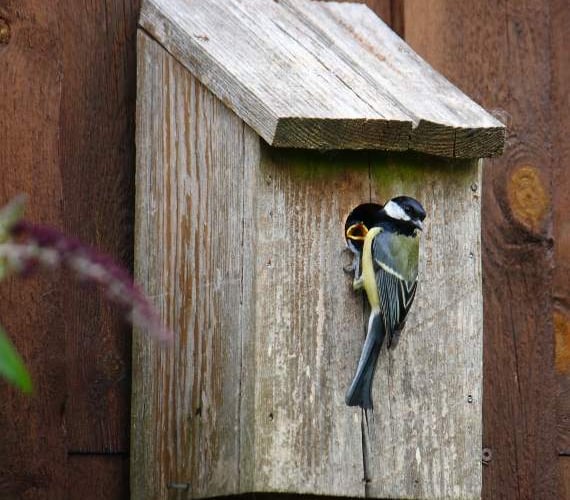
VALENTINE’S Day 2018 will see the start of the 21st annual National Nest Box Week (NNBW), in which people across Britain are encouraged to put up a nest box and provide a family home for our birds.
Mid-February is the time that birds across the country begin to pair up, or get back together for the forthcoming breeding season, and the search to find a safe place in which to build a nest and raise a family begins in earnest.More than 20 different bird species regularly use nest boxes: from Blue Tits, which use the "standard" small-hole type of nest box, to birds like the Barn Owl that use a much larger nest box with a much larger entrance hole.To help inform which nest box to use, the British Trust for Ornithology (BTO) has produced a brand new nest box guide.
This contains information on the different types of nest box, where to site them, plans for how to make them and guidelines on how you can make your nest box count if and when it is occupied, by monitoring the outcome for science.Hazel Evans, BTO Nest Box Challenge organiser, said: “It is amazing how much of a difference can be made by the simple act of putting up a nest box.
"Two of our closest bird neighbours, the house sparrow and the starling, have shown dramatic declines in recent years and by putting up a nest box we can help provide the space they need to build a nest, and present an opportunity to collect valuable data. For house sparrows a nest box with a 32mm entrance hole is what is needed, and for starlings a slightly larger box with a 45mm entrance hole is ideal.



"No garden is too small for a nest box, in the case of the house sparrow and the starling all you need is a little space high up on the wall of the house.
"For those lucky enough to have more space why not put up two or more boxes? "Even if your nest box isn’t used to raise a family it might still be used as a safe, warm and dry space to roost overnight.
So, go on, put up a nest box this National Nest Box Week.For more information visit: www.bto.org/volunteer-surveys/nbc .
Comments
This article has no comments yet. Be the first to leave a comment.