

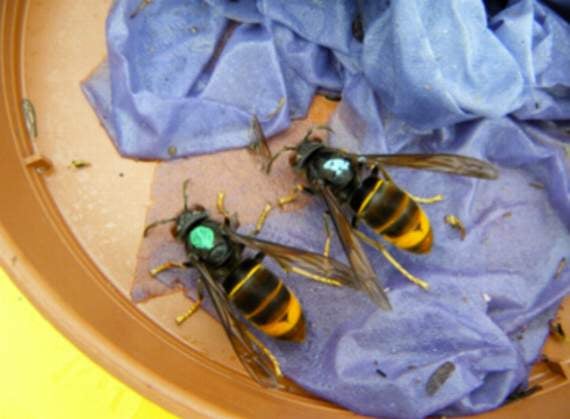
AHEAD of Asian Hornet Awareness Week, which runs from September 7 to 13, Will Pyne from Okehampton Beekeepers explains:
YOU may already be aware of a serious threat to our indigenous insect population, bumblebees, butterflies, dragonflies, honeybees and wasps, lurking just a couple of dozen miles away across the English Channel.
The Asian Hornet is a non-native invasive species which some 15 years ago hitched a ride from its home territory, the Far East in a consignment of pots bound for a garden centre in France.
It is thought that this initial incursion in 2005 was by a single queen hornet that emerged from her hiding place in the spring, set up a primary nest, and the rest, as they say is history.



One successful undiscovered nest can release up to 200 viable queens into the area the following autumn. Even though typically only 10 per cent survive, if unchecked this is sufficient to generate a rapid population explosion and within 10 years thousands of viable hornet nests had appeared throughout France with incursions into neighbouring states, Italy, Spain, Portugal and Germany.
The first incursion into the UK was in 2016 with a nest detected and eradicated in Tetbury in Gloucestershire.
Nests have been found and destroyed each year since 2016, usually being detected from August to October when the hornet colonies reach their maximum size.
So far we are hopeful that all colonies have been detected and successfully destroyed before they have the chance to produce queens (gynes) capable of overwintering and raising new nests the following year.
No Asian Hornet sightings have yet been reported in 2020. This may be because post Covid-19 Lockdown people are not getting out and about as much and are not noticing them or maybe it is because reduced traffic from the continent is removing opportunities for the hornet queens to stowaway and get a free lift to the UK.
The British Beekeepers Association (BBKA) is, however, not complacent and is launching a campaign to be on the lookout for the hornet.
Beekeepers up and down the country will be putting out bait stations from September 7, containing a lure (Suterra) which attracts Asian hornets at this time of year.
Any sightings will be photographed or trapped and evidence sent to the National Bee Unit who will then swing into action to locate and destroy the nest. But there are only a few thousand beekeepers in BBKA and to-date, since 2016 the majority of Asian Hornet sightings have been by members of the public.
So, if we are to keep this threat at bay, it is vital that we all work together. Be aware and be alert.
The BBKA has put together information to advise and assist with hornet identification and give guidance on how to proceed if you believe that there are Asian hornets in your area. Please take the time to look at this information and help with the campaign to protect our insect pollinators.
And if you think that you have seen an Asian Hornet, the easiest way to notify the responsible authority (The Non Native Species Secretariat) is by taking a picture of the hornet on your mobile telephone and sending the image to the NNSS using the dedicated app which you can download onto your telephone using links (either for iPhone or android) on the BBKA Asian Hornet Action Week page at: https://www.bbka.org.uk/Event/asian-hornet-week-2020 .
Alternatively, you can access additional help by contacting your nearest Asian Hornet Action Team member. Details can be found on the AHAT map accessed via the link: https://www.bbka.org.uk/asian-hornet-action-team-map .
Many thanks for your help.
Will Pyne
Okehampton Beekeepers Publicity Officer
Comments
This article has no comments yet. Be the first to leave a comment.