

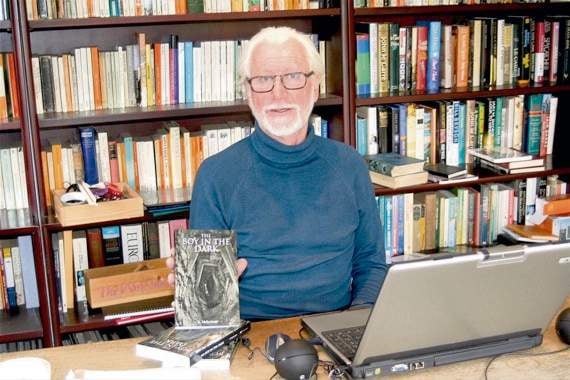
A CHANCE remark on a walk over the moors a few years ago led to a book that deserves to be a best seller.
Skulduggery, betrayal and violence, hope and loss is woven so skilfully by Ken McKechnie that it is extremely difficult not to keep turning pages - whatever the time.
Published this year, A Boy in the Dark tells the story of a lad who has to abandon hopes of a better life and become a miner after the death of his father.
In the mid 19th century Cornish families were used to mining accidents, but was this an accident? Was there more to it than at first seems? And if it was an accident, why, when what John Pascoe knew was so amazing. How does the boy learn to read his father’s journal and protect it?


The novel is superbly put together. Ken really does take the reader down the mine, into the wet and foetid atmosphere, the dust and noise.
He knows what he is writing about. He has spent 40 years working with mines and minerals, so he is well able to bring us this story of how the miners lived and worked 160 years ago. It is the way he has done it that hits the top notes.
A Boy in the Dark is Ken’s fourth novel and the result of two years’ research into Cornwall’s mining history and the way of life of Cornish miners and their families. It is as authentic as he could make it. Initially he wanted to write about women in mining - the bal maidens - a woman or girl employed at the surface of a mine, generally in the dressing of ore or crushing the lumps of ore. It might be hard but at least was above ground.
But bal maidens were generally not permitted underground so he developed the story around a bal maiden’s son who goes down the mine when he is only 12.
Ken has a good idea of what life could be like in a 19th century mine from working underground in a very old gold mine in Indonesia. ”It was cramped, hot, dark and very dangerous,” says Ken.
Ken says landscape is important, where possible it is about places he knows, as at the end of this book, or he researches as much as he can.
“Narrative scenes might pop up anywhere,” he says. It is rare if he does not have a notebook to jot down ideas although all his work is done on the computer.
“My writing is visual, I write what I can see. This book, about the Pascoe family, took two years of research. I had begun writing about the bal maiden but her son took over.
My life has been fascinating just by luck - and I began writing about it,” he said.
Ken’s career in mining came by chance. He grew up in Brighton and loved it.
“For a long time I didn’t like sandy beaches, they should all be pebbles. You could tell the locals by the way they walk over the pebbles. Visitors usually hobble,” he commented.
Ken studied at London University, Chelsea College of Science and Technology which then, in the 1960s, was in the Kings Road.
“I knew I wanted to work outdoors. I did Botany, Zoology with Geology as an ancillary and found it was right up my street.
“I got a degree and ended up in Northern Canada exploring for copper and nickel where the lowest temperature was minus 60 degrees below. We were living in tents but they were really well adapted.
“I was there for two years, decided it was too cold, saw a job in Botswana on the edge of the Kalahari and, once I got used to the climate, I had a great time. I actually discovered a nickel deposit which became a mine.”
This was followed by a return to university and the Royal School of Mines, Imperial College, then in the same building as the Royal College of Art and the Royal College of Music and opposite the Albert Hall. Wonderful times.
He got married in Zimbabwe, then came a job exploring in Iran followed by five years in Zaire on what has become the world’s biggest cobalt mine. “It was exciting, it was dangerous,” he said.
“Our working language was French, we spoke Swahili with the local people and English at home.” When Zaire (now the Congo) erupted into civil war Ken and his family were evacuated and he took a job in The Hague with Shell.
The family then spent five years in Brazil which they adored and all still speak Portuguese. “It was a fantastic place,” says Ken, “Amazing culture, music, theatre and cinema and I was able to travel the whole country. We still love to go back.”
Ken was then given the job of managing Shell’s gold mining operations in Indonesia for five years. “This was extremely challenging, to say the least,” says Ken.
He then left Shell and set up his own consultancy before getting involved with small mining companies in Southeast Asia and Africa.
“My last mining venture was a gold mine in Zimbabwe. This was in the 1990’s. By misfortune we started gold production on the same day that Blair and Brown sold three quarters of our (the UK) gold reserves. The price of gold whistled down. We closed the mine and it was then that I started writing.”
As well as novels, Ken has written short stories, poetry and other pieces, mostly unpublished.
This time he has hit a really good lode that surely must go on the best sellers lists. I am looking forward to the next ...
The Boy in the Dark is available from Crediton Community Bookshop at £7.99.
The cover photograph of inside a mine is by Cornish photographer Simon Bone. The book is published by Redgate Books.
Sue Read
Comments
This article has no comments yet. Be the first to leave a comment.