

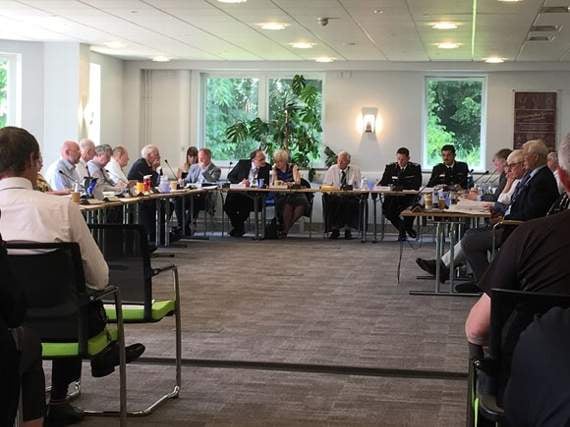
Seven fire stations in Devon and one in Somerset have been earmarked for complete closure while another eight, including Crediton, could lose one of their engines.
The plan might also mean the removal of whole-time night cover at Paignton, Barnstaple and Exmouth, while a further 14 stations could see their current daytime cover of two on-call engines reduced to just one.
The service said it wanted to bring an outdated service into the 21st Century and fire incidents in both areas had decreased 36 per cent between 2008 and 2018.


Unions said closing any stations would be a mistake and expressed concerns about a lack of fire cover.
Responding to the announcement, made on June 28, Devon and Somerset Fire Brigades Union (FBU) said: “We condemn today’s Fire Authority decision to publicly consult on six options that include station closures, removal of appliances and cuts in appliance availability.
“All of these options will put firefighter and public lives at risk.
“These options are totally unacceptable to this committee and we will now campaign, both politically and industrially, against these dangerous proposals.”
PROPOSALS
DSFRS says the way it operates could undergo its most significant change for 50 years under new proposals.
It says some stations attend only a handful of fires each year and have more resources than they need. Elsewhere, it adds that more resources are needed to improve the response the service can provide.
It says its proposals seek to address these issues and also create more flexibility and capability to deliver targeted prevention and protection work to reach the most vulnerable members of society and help keep them safe.
DSFRS says the risk has changed in the area, with new housing developments and new road networks in place, but most of its fire stations are in the same place they were 50 years ago.
In a statement DSFRS said: “We need to ensure our fire stations and fire engines are located to be in the right place to meet the demand.
SHRINKING BUDGET
“Risk and our activity has reduced in some areas and increased in other areas. The Service therefore needs to ensure it is as effective as it can be with the resources available within the context of a shrinking budget.
“The Service wants to significantly increase its fire prevention visits and building protection audits to make both people and buildings safer. The Service also needs to improve the reliability of our ‘on-call’ model which last year saw 20 per cent of our on-call fire engines not available due to lack of crew.
“Importantly, rather than just responding to emergencies when they have occurred from the existing fire stations, the Service has outlined an option that puts in place six additional wholetime crewed fire engines during the day that will move to where the risk is highest.
“Sometimes, these will be located in urban areas and sometimes they will be located in rural areas – the Service will use data to inform where emergencies are most likely to occur and will try to be in the right place at the right time to improve response as a result.”
To fund these changes, the DSFRS says it will need to consider closing a number of low risk/low activity fire stations, remove low risk/low activity fire engines and make some other changes to the way in which some fire engines are crewed.
It says that demand for Fire and Rescue Service response is reducing, as is the amount of money the service receives, so says “important decisions need to be made to ensure the budget is spent wisely and efficiently”.
NEED TO ADAPT
It adds: “People’s lifestyles and the shape of the population have changed dramatically during this time and the Fire Service needs to adapt to these changes. New fire safety measures, building regulations, the smoking ban and even the humble oven chip together with preventative work has resulted in people being safer than ever before and a reduction in the number of fires.
“More changes in society, such as an ageing population, now mean the Service needs to work harder to protect those most at risk from fires.”
The Service says it has carefully reviewed where it should locate its staff and appliances to minimise risk and provide better response coverage.
It says it has also closely examined the risks associated with different communities and the activity levels of all fire appliances during the last five years. It added that the changes are designed to ensure the right number of staff and appliances are located in each community and to free-up more time for safety and prevention work.
Chief fire officer Lee Howell said: “We all know that the main way to save lives is to prevent fires from happening in the first place.
“As a Service, we have made great progress but we feel we can and should be doing more to make people and buildings safer.
“At the same time, we need to improve our ability to respond to emergencies and ensure we better match our resources to our risks. These proposals aim to do just that.
“We do understand that communities affected by these changes will want more information and we will be engaging with them in the coming months to listen to their views.
“This will also be a difficult time for the staff affected and we are committed to working with them to consider how we might provide options as we move forward.”
CREDITON CONCERNS
The Devon County Councillor for Crediton, Cllr Nick Way, who has just been appointed as a member of Devon and Somerset Fire and Rescue Authority, told the “Courier”: “I know the proposals do not include the closure of Crediton Fire Station as is proposed for some towns but a significant issue would be the loss of one of our pumps.
“If it were the smaller ‘light rescue pump’ it would be significant for our rural areas.
“If it were the larger Crediton appliance then that loss would be equally important as well.
“We have both types of appliance at Crediton to meet the needs of residents, both rural and in the town, and to be able to respond to incidents.”
The public consultation will run until September 20.
The service says there will be a number of ways in which the public can give their views, including a series of public drop-in exhibitions.
Further information has been published on the website: www.dsfire.gov.uk .
• Do you have concerns about the proposals which could see the removal of one of the two Crediton fire appliances?
Share your views with fellow “Crediton Courier” readers. Write a letter, suitable for publication and with your name, address and a daytime telephone number, to: The Editorial Manager, “Crediton Courier”, 102 High Street, Crediton EX17 3LF.
Alternatively, email your letter, with the required information, to: [email protected] .
Comments
This article has no comments yet. Be the first to leave a comment.