
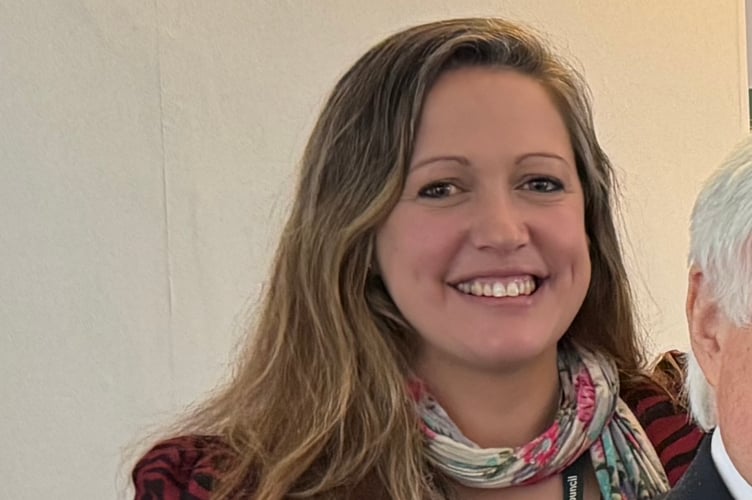
FASTER testing, financial support and better communication are among the demands being made by Devon County Council to push the government to better tackle the bluetongue outbreak.
A plea has been sent by farmer and Councillor Cheryl Cottle-Hunkin to Dame Angela Eagle, the secretary of state for the environment, food and rural affairs (Defra), calling for “immediate and decisive action” in tackling the animal health emergency.
In the urgent letter, Cllr Cottle-Hunkin (Liberal Democrat, Torrington Rural), the cabinet member for rural affairs at Devon County Council, said the county’s farmers are already facing “devastating consequences for their animals, businesses and families” and so needed comprehensive support.
This included a request for a ring-fenced fund to help farmers meet the exceptional costs of carcass disposal and disease management, and longer term, a national disease management strategy that included a funded national vaccination programme.
Cllr Cottle-Hunkin, whose Facebook video helped amplify the plight of the county’s farmers in the face of the bluetongue outbreak, called for the testing and reporting process to be “significantly accelerated and simplified” to help farmers make informed decisions more rapidly.
The Animal and Plant Health Agency (APHA) only tests three animals per holding, but Cllr Cottle-Hunkin said it was essential that government recognises outbreaks at holding level, not just of individual animals.
“A holding may have only three animals sampled for laboratory confirmation, yet there may be dozens, or in some cases hundreds of sheep or cattle displaying clinical signs of bluetongue across that same farm,” Cllr Cottle-Hunkin said.
“Reporting only the number of laboratory-confirmed animals nationally gives the impression that the outbreak is far smaller than the reality experienced by farmers on the ground.
She added that testing must be improved to confirm bluetongue more quickly, and to rule out other diseases with similar clinical signs.
Criticism is also levelled at the government’s communication, with Cllr Cottle-Hunkin stating it had “fallen well short of what farmers had every right to expect”.




The letter also emphasises the longer-term consequences for livestock that survive a bluetongue infection, including reduced fertility, reproductive complications and impacts on future breeding.
“[We need] faster testing, honest and transparent reporting, proactive communication, adequate vaccine supply, practical financial support and a long-term national strategy that prepares the country for the realities of a changing climate,” she added.
Defra said the midges that spread bluetongue became active again on March 31.
“Following the recent warm weather, experts advise that cumulative temperatures are now high enough for the virus to develop inside the midges, and onward transmission is now possible.
“Animals can also get infected through germinal products (semen, ova or embryos).
“Temperatures are also now high enough in many areas of nearby continental Europe for the virus to have developed inside midges.
“This means that we would expect any midges in these areas which were newly infected in the last few months to have the potential to have completed their extrinsic incubation period (EIP) and become infectious.
“The risk of transmission from midges blown across the channel has increased.”
Comments
This article has no comments yet. Be the first to leave a comment.