

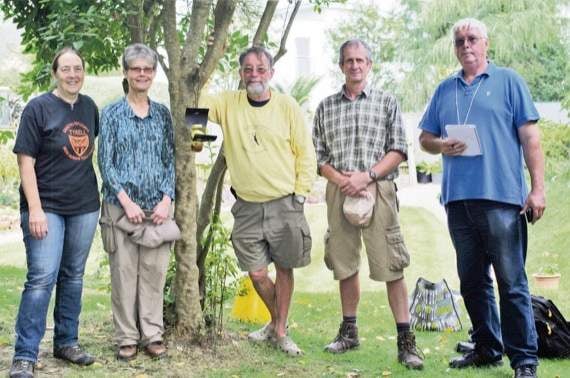
FOUR Devon beekeepers, including two from the Crediton area, have recently returned from Jersey where they were helping local beekeepers track down nests of the Asian Hornet.
In the last three years the insect has spread from one nest, found and destroyed in 2016, 14 in 2017 to this year when 24 nests have been found with more sightings recorded.
The Asian Hornet, which has no natural predators in Jersey or mainland UK, is now endemic in France where up to 50 per cent of honey bee colonies have reportedly been lost. It is now spreading through Spain and parts of Portugal.
It feeds not only on honey bees but on all flying pollinating insects including butterflies and moths. At a time when pollinators are suffering a serious decline from other causes, this threat could be seen as the “last straw”.



Simon O’Sullivan, Chairman of Okehampton Beekeepers and one of the local volunteers, said: The Jersey beekeepers were finding it difficult to cope with the rapid spread of this insect, so sent out a call to beekeepers on the mainland for help, and we responded.
“Our role was to help in the tracking of the hornets back to the nest: a time-consuming job which needs a lot of people to be effective. We were helping with the Jersey problem but we were also experiencing handling and working with the hornet and the techniques which the Jersey group have been perfecting.
“Earlier this month a sighting of the Asian hornet was confirmed in the Fowey area of Cornwall so if this insect becomes established on the mainland the skills which the volunteers have been developing may prove very useful.”
Dr Sarah Bunker, entomologist and the other Crediton-based beekeeper asked for members of the public to be on the lookout for the Asian hornet, but please do not confuse it with our native hornet which plays an important role within our environment and is in danger of being unfairly persecuted.
The Asian hornet is mostly black, it has yellow legs and one orange band on the second to last segment of its abdomen. Its wings extend beyond its body and it is slightly smaller than our native hornet.
If members of the public see this insect please take a photograph and email it to: [email protected] with your details.
The website: www.ahat.org.uk , is very useful to help with correct identification.
Comments
This article has no comments yet. Be the first to leave a comment.