

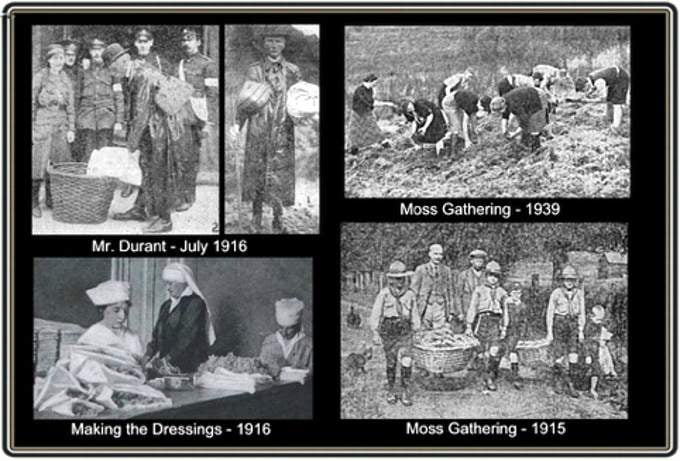
THORVERTON History Society members were treated to a consolidation of interesting information researched and collected by Dr Ann Pulsford into the forgotten numbers of moss gatherers who collectively made such a difference to medical supplies in the First World War.
Dr Pulsford presented her zoom talk “Dartmoor Moss Gatherers” on Friday, October 22.
Our Chair briefly welcomed everybody and went on to sadly note the loss of Brian Please who was a local historian who lived in Newton St Cyres, and was descended from families from this part of Devon.
He was a member of the Newton St Cyres History Group and discovered the remains of manganese mining in a field next to his home.


It can be claimed that, together, Upton Pyne, Newton St Cyres had the first commercially successful manganese mines in the world!
Dr Pulsford then provided a well-illustrated and comprehensive delivery which entertained and informed a good turn out of 20 members to the forum.
In 1914 when Egyptian cotton supplies became disrupted Sphagnum moss became the cheap alternative for medical dressings as the cotton cellulose that was available was diverted to explosives and ammunitions.
Dried Sphagnum can absorb up to 20 times its own volume of liquids, such as blood, pus, or antiseptic solution, and promotes antisepsis. Sphagnum was thus superior to inert cotton wool dressings (pure cellulose), the raw material for which was expensive and increasingly being commandeered.
The large number of infected wounds incurred by the troops in World War One due in part to the atrocious conditions at the Front and the huge numbers of traumatic shrapnel damage, required effective antiseptic dressings.
The use of maggots as well as moss was introduced to provide nature’s bandage! The high levels of iodine which inhibit the growth of bacteria, as well as the absorbent qualities of the plant cells unique to Sphagnum moss when dried, provided such a solution in a time of crisis.
Sphagnum or “Bog moss” had been adopted and recorded as an effective dressing for wounds since early times: it was mentioned in the Gaelic Chronicles (1014), at Flodden Field (1513) and in Europe progressively through the 19th century.
By 1916 it was officially adopted by the War Office and moss was gathered, harvested and processed on an industrial scale in Scotland, Ireland and on Dartmoor.
The headquarters for the Dartmoor moss gathering was at Princetown and was supported and financed by the then Prince of Wales and later Edward XIII.
Moss gathering was done voluntarily, mostly by women and children and public support through organisations like the Scouts and Girl Guides. It was gathered by hand or using rakes, then taken by donkey or carts across Dartmoor to depots to be picked over for leaves and twigs, then dried and treated using a process of sublimation.
It was then sewn into muslin bags or recycled lace curtains 10 by 14 inches containing two ounces of moss per bag and sent to hospitals receiving the wounded and to the France. By 1918 one million dressings were prepared a month.
Today very few monuments or records exist to the significant effort of these moss gatherers. One does exist in Widecombe where a 15-inch naval shell was donated to the town in recognition of the work of these anonymous helpers. It remains in place in front of the Alms Houses in the town.
Historically and today the use of the different varieties of this especial moss have extended to flower arranging, insulation, caulking material and even used as nappies and toilet paper! An exceptional plant for which we must be very grateful.
A very interesting talk on a little known contribution to medical history.
Ann Marshall
Comments
This article has no comments yet. Be the first to leave a comment.