

"HOW was your trip?" This is ordinarily a simple nicety one hears on their return after travelling abroad, and one which I have been asked by all of my family and friends since my most recent trip.
However, the journey in question was not ordinary, and so I struggled to concisely answer.
On Wednesday, March 1, I flew to Poland, along with Seb, another year 12 student from Queen Elizabeth’s School sixth form in Crediton.
We were amongst around 200 17-18 year-olds from the South West to visit Auschwitz-Birkenau, the largest Nazi concentration camp, in which at least 1.1 million people died.
Although most people are aware that the Holocaust is the name given to the mass murder of more than six million, largely Jewish, people, under the German Nazi regime of the 1930s-40s, it is a faraway concept.
It has somewhat faded from the public consciousness, in particular amongst younger generations, for whom the events of World War Two are so distant that they have become impersonal.
This trip, organised by the Holocaust Educational Trust, is part of the Trust’s "Lessons from Auschwitz" project, run throughout the country.
RELEVANCE
It aims to humanise the Holocaust and promote consideration of its relevance today, not only amongst the students taking part, but also in the students’ social circles and wider communities as they share what they have learned.
Although it might initially seem strange to want to visit such a terrible place, I found the aims of the trip compelling and was keen to become more educated.
In preparation for the visit, we heard the testimony of holocaust survivor Mala Tribich in Exeter.
Mala is from Poland, and when the Nazis invaded in 1939, her family were forced to live in a squalid Jewish ghetto in her town Piotrkow Trybunalski.
From there on, Mala’s life was full of uncertainty and reached points on numerous occasions when, had there been one small difference, she almost certainly would not have survived.
After around two years of appalling conditions in the ghetto, deportations began and it was rumoured the Jews were to be sent to their deaths.
Her family sent her and her cousin Idiza to live with a couple in the city of Czestochowa, where they hoped the children would be safer pretending to be relatives from Warsaw.
HOMESICK
The girls were very homesick and often had to hide when there were visitors.
On one occasion Mala remembers being terrified when a guest asked her what district of Warsaw she came from. She improvised, but this could have resulted in her discovery as a Jew: the sense of tension of this period must have been an unbearable burden for an 11-year-old child. Idiza persuaded the guardians to let her live with friends of her family, but she was never heard from again.
Eventually Mala did return to the ghetto. Her mother and sister were deported and killed in the forest, and Mala, at 14, began to care for her five-year-old cousin Ann.
The girls were separated from Mala’s father and brother and first deported to Ravensbruck concentration camp, and then to the Bergen-Belsen camp.
CHILDREN’S BARRACKS
Here, Mala is sure that she only survived because she was allowed into the children’s barracks where the conditions were slightly better.
The special area was created by Dr Hadassah Bimko Rosensaft, a prisoner herself. She allowed Mala to enter because Ann was so distressed at the prospect of leaving her cousin - this kindness was risky for the Doctor because Mala was supposedly too old for the children’s barracks.
When the camp was liberated by the British, Mala was very ill with Typhus, but recovered and came to live in England to be reunited with her brother Ben, who she was surprised to find had also survived.
Hearing this story first hand was very moving.
Through this I got a sense of Mala as a person: she was very warm and genuine.
It helped me to remember that every single victim of the holocaust was a unique human being with their own favourite meal, sense of humour and pet hates.
Every single person, like Mala, had a story of their own, even if for so many it was cut tragically short. It is almost impossible to avoid using statistics entirely when explaining the holocaust, but I started to realise how important it is to remember the people behind the numbers.
I felt a little more ready for my trip to Auschwitz-Birkenau.
AUSCHWITZ
We took an early flight from Exeter to Krakow and arrived at Oswiecim (this is a town close to Auschwitz-Birkenau, "Auschwitz" is the Germanised version) in the late morning.
In 1939, Jews made up 58 per cent of the population, and like in much of Poland there was a high degree of tolerance between Christians and Jews. Today, there are no Jews in Oswiecim.
Auschwitz has three main camps and many more sub camps - like most Nazi concentration camps it is eerily compartmentalised for maximum efficiency.
We visited the two main camps- Auschwitz I and Birkenau.
Auschwitz I was mostly used to hold political prisoners, prisoners of war and Roma and Sinti, many of whom would have been used for slave labour, whilst Birkenau eventually came to be the main extermination camp.
The industrial size of the camps is far greater than we expected - they stretch further than the eye can see.
BLEAK AND DISPASSIONATE
Auschwitz I has been preserved, and so the site remains as bleak and dispassionate as ever.
Inside are museum exhibits - there are enormous piles of personal objects confiscated by the Nazis. All of the items were valued more highly than people’s lives: pots and pans, shaving brushes, shoes and suitcases - many items were sent to Germany for reuse.
Most disturbingly is the enormous tank containing human hair: it is believed to have been harvested from bodies for use in textiles.
When we visited the camps, it was very early March. The wind was freezing. I couldn’t imagine life there, let alone in midwinter, when there are sub-zero temperatures and prisoners had to work outside all day.
As a stark contrast, on the edge of Auschwitz I is a comfortable family home: it was that of Rudolf Hoess, camp commandant.
Hoess oversaw the camp operations, and so might be what one would think of as an irrational monster.
Perhaps the most frightening thing about the man however, is how he could take pride in a job that represents the absolute worst in humanity’s nature, yet be so ordinary.
By all accounts he was rather an unremarkable man, outwardly calm and collected. At the end of the day he would return to his home, kiss his wife and tuck his five children into bed, whilst the horror continued just beyond the garden wall and the chimneys were visible out of the window.
It is known that he was an affectionate father and husband because he wrote about his family. He was a human being. This is a very uncomfortable fact, but it is wholly necessary to confront.
We must recognise that not only was each and every victim a human being, but every perpetrator was too: if we fail to do this we are failing to recognise that the holocaust was the result of human actions, and that it is far from impossible for such atrocities to happen again.
CHILLING
As survivors become fewer each year, it remains as important as ever to consider the relevance of the Holocaust today.
In visiting the sites physically, I found the logicality and order of the camps extremely chilling.
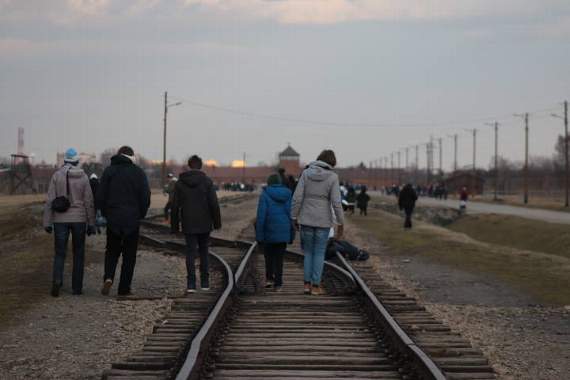
The train track leading to the famous gate house at Birkenau was built so the maximum number of victims could be received using minimum resources.
The use of gas chambers for mass murder was partly developed for efficiency, but also so that the perpetrators could distance themselves from the killing.
The need to depersonalise the barbarity indicates that the killers were not monsters: instead they were human beings with a conscience, who were the product of their times and convinced themselves of this evil way of thinking.
We must remember that humans are still capable of overcoming their natural instinct to protect life and be vigilant of this; it did not happen overnight and the build-up to the "final solution" was very gradual.
Every single person involved in the holocaust- victims, perpetrators and bystanders- was just that: a person, like us.
My trip was fascinating and moving, and will remain with me for the rest of my life.
Aphra Beart-Albrecht
Comments
This article has no comments yet. Be the first to leave a comment.