

A TOTAL of 25 members of Crediton Probus Club met for their monthly meeting at Downes Crediton Golf Club on a mild February day.
Grace was given by Malcolm Davies and after we had eaten, David Dornom gave a long but very amusing quote. John Stone won the draw and Brian Threlfall gave us an update on issues relating to members. Two guests, John and Arthur, were welcomed.
The president then invited Brian Healey to introduce our speaker, Simon o’Sullivan, chairman of the Okehampton Beekeepers’ Association.
Simon told us that he had been introduced to beekeeping by one of our members, Ray King. He began by outlining some of the current problems faced by the beekeepers of Britain and Europe, particularly the decrease in foraging areas, parasites and the use of pesticides, especially neonicotinoids.
 Government invests £245m in South West bus services
 Royal Devon University Healthcare Foundation Trust: how long patients waited for NHS treatment in October
 Christmas jumpers worn by Crediton Dairy staff for Save the Children
 Just two-thirds of A&E arrivals at the Royal Devon University Healthcare Trust seen within four hours
However, the subject of today’s talk was a really drastic potential problem, the Asian hornet.
The Asian hornet, also known as the yellow-legged hornet, is indigenous to South East Asia. It was accidentally brought into Europe in a consignment of pots landed at Bordeaux in 2004, since when it has spread to many parts of mainland Europe and is now endemic there.
In 2016 a nest was found on Alderney – in 2018 52 nests were found on Jersey.
In September 2016 a nest was found in Tetbury, Gloucestershire. It was destroyed and no breeding adults were found inside it.
In 2017 an Asian hornet was sighted at Woolacombe in Devon. Last year there were 13 confirmed sightings in England and six nests were destroyed. Three of those sightings were in Cornwall.
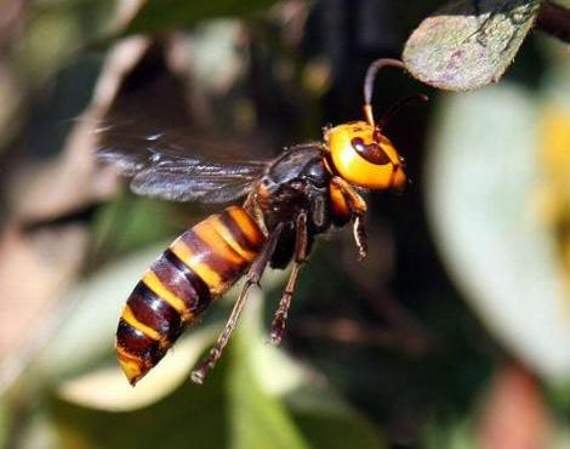
The Asian variety is slightly smaller than the European hornet, it has a dark body and yellow legs. Like the European species it is a predatory creature. It hunts many insect types, including all the pollinating species. It “hawks”, or snatches insects, but takes only the wing muscles of its victims. These are taken back to the nest where they are fed to the larvae that they “farm” to produce a sweet liquid that they feed to their own grubs.
The first nest built by a queen is small, no more than a few inches in diameter, but when this is outgrown, workers leave it and build a much larger nest high in a tree. This can be up to one metre in diameter. Nests are built from chewed wood which results in the similar sort of paper to that of wasp’s nests.
Whilst a European hornet’s nest is populated by between 200-400 insects, an Asian hornet’s nest has upwards of 1,500. When a worker has identified a food source (eg a beehive) it will return to the nest to tell the rest of the colony.
They then return en-masse to the beehive to consume as much of its population as they can. Honey bees are completely defenceless against their attack.
Now Jersey had 52 nests in 2018. If we assume that each nest produced 200 queens in a year and that just two-and-a-half per cent of these survived, by 2019 there would be 260 nests.
There are at least 1,500 hornets in a nest at the height of the season each of which will kill around 10 pollinating insects every day. This would account for 3,900,000 insects every day between the 260 nests. You can see why beekeepers, farmers and governments are getting worried.
Last year Simon went to Jersey with some fellow West Country beekeepers to help try to control the spread of the hornets. The method used was devised by Exeter University scientists and consists of tempting hornet workers to a wasp trap with sweet substances, fixing a tiny electronic tag to them and using signals from this, following them to the nest. Simon showed images of nests his group found (which were later destroyed).
If anyone sees an Asian hornet (they are about an inch long and the body is entirely black apart from a yellow/orange band on their abdomen. The legs are yellow) they should report it via the following email address: [email protected] .
They should, if possible, send a photograph and a note of exactly where it was sighted.
Simon was thanked for his interesting but rather disturbing talk by Richard Adams.
The meeting ended with the usual toast “’Til the next time”.
KB
Comments
This article has no comments yet. Be the first to leave a comment.