

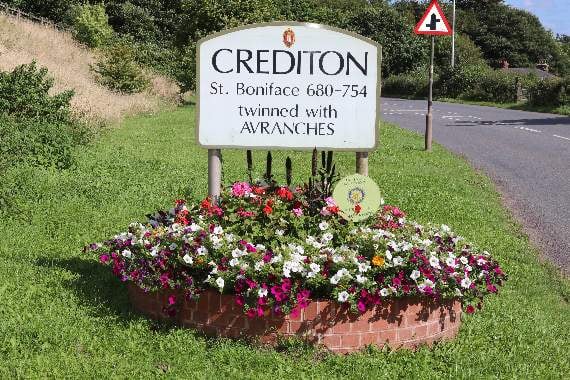
ON a much cooler and more unsettled day than many in the recent past, Keith Beetlestone, deputy President of Crediton Probus Club, standing in for Russ Ballard, opened the August meeting and invited John Pike to give grace.
After the meal, Keith introduced two new members, John Haddleton and Malcolm Davies. The draw was won by Jack Fey and the quote given by Burford Cupper.
Bryan Healey then introduced our speaker, Earl Connolly. Earl is Secretary of Dawlish Probus and he gave us an excellent illustrated talk on the history of the Exeter Ship Canal.
Earl is not Devonian, but originates from Birmingham which is criss-crossed by a network of canals. These however are much younger than the Exeter Ship Canal.



The canals of the Midlands were mostly built in the great age of canal building in the 18th and early 19th centuries, the ship canal was originally built in the 16th century.
From the late 13th century successive Earls of Devon had blocked the passage of ships down the Exe to Exeter initially by the building of a weir across the river in the 1270’s or 1280’s by the Countess of Devon, to provide power for her mills.
Trade was partially restored in 1290’s only for the Earl of Devon to build another weir in the early 1300’s. Boats had to unload at Topsham and goods were transported to Exeter by road.
Monarchs were petitioned to have the waterway reopened through the rest of the 1300’s and the 1400’s, but it wasn’t until 1550 that this was given.
By then it was too late as the river channel had completely silted up. The Exeter Ship Canal was constructed to allow the continued passage of ships - and goods - to Exeter.
In 1563 the traders of Exeter employed of John Trew of Glamorgan to design and build a canal to bypass the weirs and rejoin the River Exe in the centre of the city where a quay would be built.
Work began on the first part in 1564 and was finished in 1566 or 1567. This first section of Exeter Ship Canal was shallow and under two miles long, it did, however, have three pound locks to ease navigation – the first to be built in Britain.
During the Civil War (1642-51) the towpath was used for skirmishes and in 1641 a royal charter had been granted to operate a ferry across the river at the canal basin (Butt’s Ferry).
In 1677 the canal was extended and the entrance was moved downstream to Topsham. In 1701 the canal was deepened and widened to allow the passage of ocean-going ships. At the same time the number of locks on the canal was reduced to one.
These improvements (and in 1770 the purchase by city fathers of Topsham Quay) led to the canal being highly successful until demand for access declined with the end of the wool trade in the early 19th century and later with the rise of the railways.
Earl took us through the long history of the canal with its building then decline. Its present width and depth were reached in three stages. Double Locks was built in 1701, the canal was extended to Turf Lock in 1827 and the canal basin and the Turf Lock Hotel were built between 1827 and 1830.
It had been planned to use Grand Western Canal to join Exeter with the rest of Britain’s waterways, but wars and the advent of the railways meant that the project never came to fruition.
In the early 20th century, its use was steadily declining and restricted to a few commercial operations such as the transport of sewage sludge from the sewage works built near the canal to the English Channel, the canal with the Exe became increasingly reliant on tourists for its raison d’etre.
Earl mentioned the establishment of a Maritime Museum at Exeter Quay in 1969 that was forced to close in 1997.
David Sylvester thanked Earl for a fascinating talk. Many of us have fond memories of taking children and grand-children to the canal for leisure activities of all sorts and his talk had greatly widened our knowledge of it.
The meeting finished with the toast “‘til the next time!”
KB
Comments
This article has no comments yet. Be the first to leave a comment.