

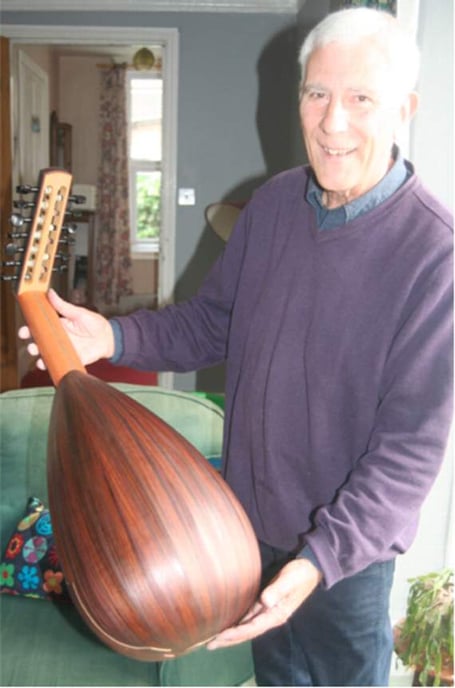
OVER the years many stringed instruments have come from the cellar workshop of a Crediton maker but never one so complicated as the seven course 13-string Renaissance lute.
Shaun Newman is the maker, he has been making instruments for a long time, his interest beginning when he learned to play the guitar in his 20s, later working out how to make one.
From teaching English in Germany he became a company director but after both his legs were broken in an accident, he went back to the guitar to salve the temporary immobility, later joining a local class in guitar making run by David Oddy.
All that was more than 25 years ago and although Shaun’s main interest is classical guitar, he is happy to work on almost anything stringed.



Twelve years ago he had made 40 or 50 guitars and wanted to stretch into “something new and different”.
“I had found this book by Ronald Taylor about making and playing a lute. I made the front, ordered the rosewood for the back, then orders came in for more guitars.
“This got put on the shelf until a client sent me a piece about Stephen Gottlieb, a quite famous London-based lutemaker who has now died.
“That video inspired me, it was a BBC programme from the 1970’s. I borrowed the book back from the library that I had borrowed 12 years before, followed some of the tips in the video and completed the lute!”
Shaun added that this was probably, by a long way, the most difficult instrument he has ever made - and he has made about 120 guitars, mandolins, harps “you name it” but added that this had been wonderful.
The back is made from Indian rosewood (“they used to give wood some wonderful names, this wood has nothing to do with roses,” he said).
“You can’t use the sort of strings you’d use on a guitar, they would probably pull the front off.
“I had to look for special strings. There is one reliable firm left in this country who sell strings for medieval instruments - they were superb and helped me to understand how to tune it.
“This is quite tricky and was done over the telephone chatting to this man! The Early Music website has some amazing stuff too,” added Shaun.
The neck of the lute is made from Brazilian cedar inlaid with a rope twist made by Shaun, the peg box is maple with an edge of cocobolo, the pegs made of ebony.
He explained that the lute was derived from the Arab oud which crossed into Spain, then it only had seven strings; people wanted more and more volume, strings were added, the size and shape began to change, the instrument travelled further into Europe and by 1600 it would have had between 13 and 21 strings, the later ones became known as the archlute. After this came the bigger theorbo. Shaun said that a 6ft 4in friend of his was the only person he has seen play a theorbo.
Such is the precision that it took Shaun about two hours each to put the 14 ribs in position and the ebony frets were made using a thumb plane.
The rosette was taken from a design by Georg Gerle of about 1580. It had to be cut into the centre by hand using a scalpel. Creating the bowl for the back really was a precision job, each piece being narrower at one end than the other and having a slight slant inwards so that they all sit smoothly together giving that wonderful curve. The sound of this seven course 13 string Renaissance lute is truly beautiful.
This summer Shaun exhibited at the Royal Greenwich Guitar Festival to which only 10 luthiers were invited with Shaun being one of the four from this country.
Sue Read
Comments
This article has no comments yet. Be the first to leave a comment.