

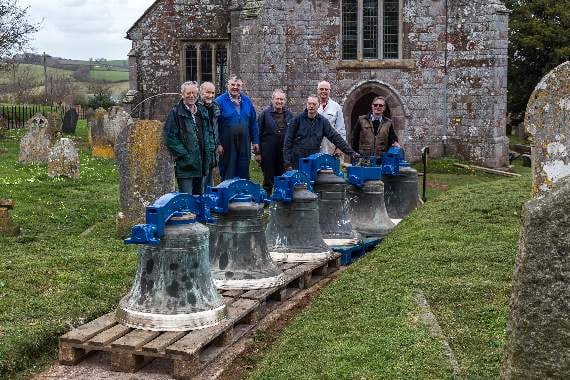
SAINT Andrew’s Church at Colebrooke will host a flower festival and celebration of the refurbishment of the church bells from Friday, July 27 to Sunday, July 29.
The church will be open for visitors from 10.30am to 6pm on the Friday, from 10.30am to 6pm on the Saturday and from 10.30am to 2pm on the Sunday.
Tours of the tower to see the newly refurbished bells will be available between 10am and 4pm on the Friday and Saturday.
A member of the bell ringing team will be on-hand to show visitors the bells in the bell chamber.




Due to restricted space only one person, plus one child if appropriate, will be allowed up the tower at a time.
The steps up the tower are not suitable for children under the age of five. Ear defenders will be available so that visitors can see a bell in motion.
On the Saturday it is hoped that the bells will be rung by ringing teams from other churches, giving those who go along the chance to hear the bells.
Coffee, cakes and light lunches will be available and cream teas in the afternoon.
On the Sunday, at 4pm, there will be a Service of Re-dedication of the refurbished bells led by the Rt Rev Robert Atwell, the Bishop of Exeter.
The Parochial Church Council was awarded a £35,000 funding boost from SUEZ Communities Trust (formerly SITA Trust) towards the refurbishment work of the six bells.
St Andrew’s Church is Grade I listed and has one of the heaviest peals of six bells in Devon.
The bells date back as far as 1627 and are still rung every Sunday, as well as for weddings and special occasions.
The team of church bellringers at the church said it had become increasingly difficult to ring the bells and a professional survey conducted in 2016 recommended complete restoration and re-hanging of the bells, which required the bells to be removed and transported to a foundry.
Whites of Appleton, specialist bell-hangers, undertake the restoration with Neal Herridge, the project manager for the restoration scheme.
Many of the bells are of historical significance, some cast or recast by Thomas Pennington of Exeter between 1627 and 1664.
The tenor, the largest bell in the peal weighs an incredible 18cwt, which is large for a rural church.
Comments
This article has no comments yet. Be the first to leave a comment.