

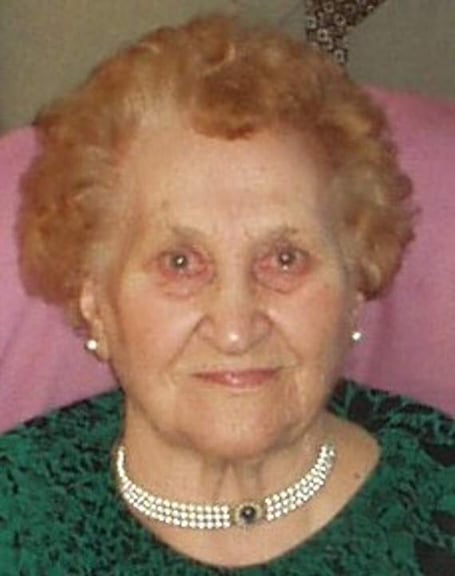
WINIFRED DOROTHY MARTIN
THE funeral was recently held at Down St Mary of Winifred Martin, known as Wynne who had lived in the village for 37 years.
She had recently celebrated her 98th birthday. In her time, she saw many new residents arrive and was always ready to welcome them. But though she lived in Devon for 37 years, she was by birth a Londoner, living in London for 60 years until the retirement of her husband, Leslie Martin from the Civil Service.
She soon took to country life, becoming a pillar of the local Women’s Institute of which she was president for some years.

Winifred Dorothy Hopkins was born in West Norwood on December 18, 1918 when the ink was scarcely dry on the Armistice that ended World War One.
Her name reflected that; Winifred means Peace and Dorothy means gift of God, so her name meant peace, given by God.
Winifred was the fourth child of Joseph Hopkins and his wife Louise Mathieson. She was very proud of her Mother’s Scottish ancestry.
She had four siblings, all of whom she outlived, Brian, Elsie, Douglas and David. Her earliest years were happy, helped by the fact that her father had a firm selling toys until the Great Depression.
Winifred left Dulwich High School at the earliest opportunity and followed her aunts into the Central Telegraph Office in Central London.
When war began, their work became more vital. She recalled the vast numbers of telegrammes that passed through the office as soldiers notified their families of their safe return from Dunkirk. Perhaps her future husband, Leslie was among them. She worked there right through the blitz when she never knew how her journey to and from work might be delayed.
She recalled that at the height of the blitz, she could hear the bombers flying overhead while she was left alone in her lodgings apart from the body of the daughter of the house who had recently died from TB.
In May 1943, Winifred decided to join the ATS. After three weeks being inducted at Northampton, they were taken to New Brighton and put on a ship.
Some thought they were being sent to Reykjavik, but in fact they were taken for further training at Douglas, Isle of Man, being billeted in a row of hotels, next to an Italian POW camp. They were taught many things including how to understand Morse Code.
One ATS girl has described that they were not issued with PE kit and had to run to Derby Castle for PE past the POW camp, clad only in khaki issue bloomers and a cotton vest. The prisoners crowded to the wire to shout encouragement.
The girls learnt that their task was to intercept German radio messages that would be in code and also not to tell anyone about their work.
The authorities failed to give them a cover story so every girl gave a different answer when asked by locals what they were doing. Even when The Princess Royal came on a visit, she asked one girl “what do you do, Private” and received the reply “we march and play games, Ma’am”. In fact, the games included bingo with letters where the calls were made in Morse.
The Royal Visit led to extra work – clearing the seaweed, painting dustbins etc. When Princess Mary saw the dining room, there were flowers, water, bread etc. on the tables. These extras soon disappeared before the second sitting.
After three months, they took up their positions at the Listening Stations. Wynne was posted to Forest Moor in Yorkshire and was billeted at Queen Ethelburga’s School, Harrogate from where lorries took them to Forest Moor for their shifts on duty.
At Forest Moor, they sat in what was called a set room with their wireless sets tuned to their allotted frequencies to monitor, taking down messages in blocks of five letters.
These messages were whisked away and sent to “station X” which we now know was Bletchley Park where the messages were deciphered. The outposts were each designated as “station Y”. They worked in isolation and had no idea of the importance or destination of their “scribble”; all they knew was that tight secrecy was essential.
The girls got to know the pattern of tapping of their usual targets and Winifred was commended once on spotting a change of operator on her watch.
In 1945, it became clear that the war was changing, operators were forgetting to use code and frantic messages were being sent with increased frequency.
Eventually VE day came and Wynne was one of those who slipped off to London to celebrate the day. The ATS all kept their secret and no-one knew what work Wynne did for another 25 years. She was grateful to Gordon Brown when he issued a special medal to all those who worked at the out stations.
In 1948, Winifred came on holiday with a friend to Devon, staying in Lynton. While walking in the Valley of the Rocks, she met a young man who offered to help her with her loose sandal.
She never believed in holiday romances so she gave him a false address, the address of her friend Mary. So, when she got back to London she had to call round to Mary’s house to collect his letters and eventually to meet him again. The young man was, of course, Leslie Martin.
Later in the year, Leslie took her down to Swanmore to meet his parents. While there he was working himself up to propose to her but was interrupted by his Father who had decided that was the right moment to take photographs of the couple.
In June 1949, Leslie and Wynne were married at the Catholic Apostolic Church in Camberwell. They remained married for 60 years and they were proud to receive congratulations from the Queen.
After a honeymoon spent at Lynton which they reached by travelling on the “Devon Belle” along our own local railway line, they began their married life in Norbury in Croydon, where Wynne gave birth to Anthony and Hilary.
Later on, the family moved to Dulwich. Wynne became President of the Women’s Evening Group and Treasurer of the Church Flower Fund. She never quite mastered the art of book-keeping and usually tore out pages when the accounts would not balance. By the time she got it balanced, the book had become very thin.
Finally, she moved to Down St Mary in 1979, living with Leslie until his death in 2009.
Not long after his death that she fell and broke her leg. After spells in Exeter and Moretonhampstead Hospitals, she returned home but despite exercises and help she was never really happy going out of the house again if it involved walking.
She had to be driven to medical appointments and to the hairdresser but she was pleased to be able to join Down St Mary WI on their celebratory anniversary.
Winifred was always cheerful and had a good sense of humour. She liked words. She claimed to be a battered wife because Leslie battered her at Scrabble during their regular daily matches. She took part in the WI county scrabble competition and even organised it one year.
She enjoyed watching “Countdown” often spotting some good words. She and Leslie shared an interest in crosswords. She enjoyed playing skittles as a member of one of the DSM teams, and played an active role in WI events
She was skilled at many household tasks. She was a very good cook and briefly helped to train ATS girls who were preparing for civilian life. She used to make her own dresses, as well as doing tapestry. She produced kneelers and hassocks for the church in Dulwich. She could be resourceful.
When her little dachshund, Libby, hurt her back and could not walk, Wynne took her on holiday in her shopping trolley, sitting on a large cushion and sticking her head out of the top.
Wynne was a committed Christian. Brought up in the Catholic Apostolic Church, she was later confirmed into the Church of England and remained a faithful member, worshipping mainly at Morchard Bishop and Lapford until the dispute over the ordination of women. She did attend the Forward in Faith parish in Heavitree a few times but the journey was awkward.
She was notable for her collection of hats for wearing to church, one of which gave her the look of a galleon in full sail.
Wynne based her behaviour on traditional Bible teaching and good manners.
She was generous in her support of charities. She was a member of the local committee for what is now Macmillan Cancer Support, regularly helping with collections. For some years, she was also responsible for collecting boxes for the Church of England Children’s Society.
She spent the last two months of 2016 in hospital at Exeter and Okehampton, where she was very well looked after. Winifred was very keen to leave hospital and persuaded the staff to let her home just in time for Christmas. Since then she had become more frail and sometimes confused, but her mind remained as sharp as ever most of the time.
Her death came suddenly which was a shock, but did mean she was spared any lingering illness or the threat of a decline in her mental powers.
She had seemed indestructible but after a full life of 98 years, her time had come. She is one of the last of that generation who served in the war and I think she will be much missed, not just by Anthony and Hilary but also by Hilary’s children Simon and Laura and by her other relatives and friends, many of whom attended the funeral.
Anthony Martin
Comments
This article has no comments yet. Be the first to leave a comment.