

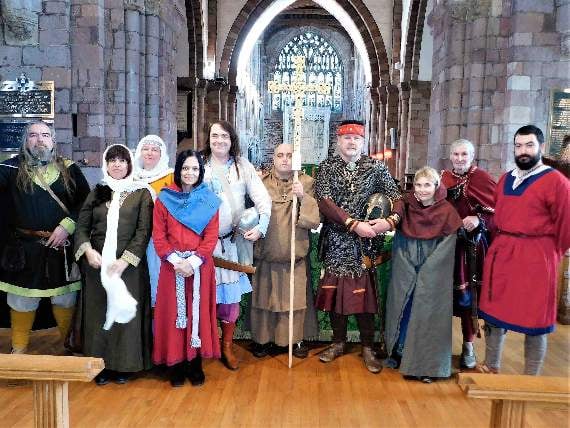
DEVON County Councillors will later this month be asked to consider a proposal that the Patron Saint of Crediton, St Boniface, is made the Patron Saint of Devon.
The County Councillor for Crediton, Nick Way, will present the recommendation to Devon County Council.
The recommendation has been prepared by the Boniface Link Association and is supported with the backing of many religious leaders and the Mayor of Crediton, Cllr Frank Letch MBE.
Judy Tucker, from the Boniface Link Association, explained: “The idea of St Boniface as Patron Saint of Devon originated with a group in South Zeal. They had just enjoyed a very successful Burns’ Night celebration in one of the local pubs and wondered why there was no similar sort of occasion to celebrate for Devon.


“After some considerable thought they came up with the suggestion that St Boniface could be adopted as Patron Saint of Devon and his feast day, June 5, should also be celebrated as Devonshire Day.
IN THE ‘CREDITON COURIER’
“The Boniface Link Association of Crediton heard of this idea through the ‘Crediton Courier’ and agreed to try to take it forward.”
In a letter to all of the Devon County Councillors, Mrs Tucker explains: “Patron Saints tend to differ in importance from the general calendar of saints because they are, or become, cultural icons as well as religious figures. St George overcoming his enemy the dragon (evil) is invoked against England’s enemies in Shakespeare’s ‘Henry V’ and again in the special film version of that play, starring Sir Lawrence Olivier, made during World War Two to inspire the whole country in the fight against the evils of Nazi Germany.
CULTURAL
“What cultural support can Devon gain from St Boniface? Boniface believed that church and state should work together, to the glory of God and the good of His people. Many people nowadays are probably happy to leave God to those they view as a few eccentrics in church on Sundays but the good of the people is as important as ever. The name ‘Boniface’, bestowed on him by the Pope, means maker, or doer, of good.
EDUCATION
“Education is the first thing that springs to mind. Boniface got himself the best education he could and used it to change the world, as he knew it. What an example to our young people today!
“First an enthusiastic student, he then became a respected teacher to the extent that his fellow monks at the monastery where he taught wanted him to become their abbot after the death of the former abbot. Boniface declined, however, as he felt called to missionary work abroad.
“As he converted different areas of the country, he established religious houses to support the converts in their new faith but also to provide education where none had been available before. In our rapidly changing world and global economy, education is going to assume ever greater importance for our county to earn its living and support a decent quality of life for its citizens.
‘FRIEND OF PEACE’
“Boniface was also dedicated to peaceful co-existence among the peoples with whom he worked. Indeed his birth name, Wynfrith, means ‘friend of peace’. Whatever people’s views on Brexit and whether we end up in or out of the EU, there can, alas, be little doubt that the utter shambles that has possessed our government and parliament since the Brexit referendum has damaged Britain’s standing abroad and most especially among our nearest neighbours in Europe.
“Publicly adopting a prominent European saint as our patron could go some way to restoring trust and friendship with the county’s principal contacts in Europe for, as Boniface himself said, ‘they are flesh of our flesh and bone of our bone’.
TOURISM
“Celebrating St Boniface as our patron saint could also celebrate our Saxon heritage, to encourage tourism and support our economy. This would fit well with the government’s stated intention to encourage counties to fly their flags to boost community pride, promote county identity and encourage tourism.
“A communities minister was quoted in the ‘Sunday Telegraph’ saying ‘Our historic counties are at the heart of communities and are part of the fabric of British society that has been woven into our national story since Saxon times’.
DEVONSHIRE DAY
“How wonderful it would be if St Boniface’s Day could also become our ‘Devonshire Day’.
“The idea of Boniface as Patron Saint of Devon has gained the support of all the main churches with none of them suggesting anyone else for the role.
“We do hope that you will support Cllr. Nick Way’s motion to adopt Boniface as Patron Saint of our county. It will cost nothing but could, in time reap considerable rewards.”
FULL SUPPORT
The Mayor of Crediton, Cllr Frank Letch, said: “I fully support the efforts by the Boniface Link Association to have Boniface, who was born Wynfryth in Crediton in 680, made Patron Saint of Devon.”
DESERVES TO BE BETTER KNOWN
The Rt Rev Robert Attwell, Bishop of Exeter, said: “I am pleased to add my support to the initiative taken by the Boniface Link Association in Crediton to see St Boniface declared the Patron Saint of Devon.
“Boniface not only has strong links to Devon but his strong links with Europe would convey the image of a county which is outward-looking and engaged.
“The Oxford Dictionary of Saints concludes its article on him with these words: ‘He had a deeper influence on the history of Europe than any other Englishman. This should be understood, not only in terms of Christian conversion but also in those of the alliance he made between popes and emperors, fundamental to Europe’s future, and in the educational and literary influences of his monasteries. His own character, reflected in his correspondence, was notable for courage, affection, loyalty, foresight and determination. He deserves to be better known and appreciated by his own countrymen’.”
Hieromonk Porphyrios, Rector of the Orthodox Parish of the Holy Prophet Elias in Devon, said he gladly supports the move to have St Boniface of Crediton made Patron Saint of Devon.
WHOLEHEARTED SUPPORT
Rt Rev Mark O’Toole, the Bishop of Plymouth, about the recommendation, said: “I would be delighted to see this as he is not only a most extraordinary Devonian but also one of the most exceptional Englishmen that we have had in our history.
“It may interest you to know that he is one of the patrons of the Catholic Diocese of Plymouth which covers not only Devon but also Dorset and Cornwall.
“This is obviously because of his base within Devon but also for his work in this part of the country before becoming a significant missionary on the continent.”
Rt Rev O’Toole added: “…not only is Boniface ‘effectively’, ‘the Apostle of Germany’, but also his contribution to the intellectual and civic life of those centuries which is significant.
“I know I speak on behalf of the whole Catholic community in this part of the country and throughout the county of Devon when I say that we would wholeheartedly support the declaration of St Boniface as Patron of the county.”
CONGREGATIONAL CHURCH SUPPORT
Rev James Gregory, Senior Pastor at Crediton Congregational Church, said that while followers of the Congregational Way do not recognise sainthood as a qualitatively different category than that of the ‘priesthood of all believers’: “…we do consider Boniface’s life and ministry to be a good challenge to the people of Crediton and Devon today.
“We particularly like that Boniface realised the significance of the world outside of our lovely county and on being obedient to a call to leave his home he had great influence in the wider world.
“Having spoken about your request at a recent meeting of our leadership team we decided that we would like to support your campaign.”
METHODIST CHURCH SUPPORT
On behalf of Crediton Methodist Church, Mrs Pamela Murphy writes: “I can confirm that here at Crediton Methodist Church we are happy to add our support.
“As Christians, we join with other denominations in looking for inspiration from the lives and work of Christian men and women who have gone before us.
“St Boniface takes his place within that for the work that he dedicated himself to in Christ’s name, and that is still relevant and necessary in our work and mission today; in spreading Christianity, in encouraging young people in their education and in striving for a peaceful society.”
HIS EARLY LIFE IN CREDITON
St Boniface, who was born and Christened Wynfrith or Winfrith (or Winfrid), grew to become a major figure in the Roman Catholic Church and continues to be commonly-known as, but not appointed as, “Apostle of Germany” and the first archbishop of Mainz.
This included the symbolic felling of Thor’s Oak, which converted many pagans to Christianity, and his recognition as the creator of the first ever Christmas tree.
The National Shrine to Crediton’s most famous son is in the Roman Catholic Church in Park Road, Crediton.
Crediton’s history is strongly based on Winfrith, who later became one of the greatest Christian missionaries and administrators, and one of the founding fathers of the Christian Church in Europe.
Crediton’s most famous building is the Parish Church of the Holy Cross. The history of the church and religion in Crediton dates back hundreds of years.
Boniface links with Crediton led to the founding of a monastery in the town in 739 which in turn is believed to have led to the choice of Crediton as the See of the first bishopric of Devon and the building in 909 of the first diocesan church in the town.
The current collegiate church was completed around 1410. There are many references to St Boniface in Crediton Parish Church including stained glass window representations and an effigy by Witold Kawalec.
The area of the town known as Tolleys in Crediton is regarded as the traditional birthplace of St Boniface and a blue plaque marking this can be seen at the corner of Tolleys and Downshead Lane.
An impressive statue of St Boniface is located in Newcombes Meadow, Crediton.
It was unveiled by Princess Margaret on Sunday, July 24, 1960 and the dedication was by the then Bishop of Crediton, Wilfrid Westall.
CHRISTMAS TREE
How St Boniface came to be acknowledged for starting the tradition of the Christmas tree is surrounded with some myth.
In the dramatised story about Boniface by Henry Van Dyke, “The First Christmas Tree” (1897), it states: “Armed with an axe he approached a sacred tree, the giant oak of Geismar, dedicated to Thor.
“After some effort, he felled the oak, and its branches lay on the ground in the shape of a cross. In its descent, sections of the oak had crushed every other tree around except a single small fir tree (this was possibly the origin of the Christmas tree).”
Other stories say that a fir tree grew from the roots of the fallen oak and the next year after he had felled it, all the pagans in the area had been converted to Christianity and hung decorations from the tree to celebrate what they now called Christmas rather than Winter Solstice.
Many will wonder how a fir tree grew big enough to decorate in one year.
The fir was seen as an image of God and many believed its evergreen symbolised the everlasting love of the Maker.
Whichever it was, the legend spread and soon Christmas trees became the norm in the newly converted Bavaria, and then spread out to become the tinsel strewn, electric lit, bauble hung festival we know today, popularised by Queen Victoria’s consort Albert, who brought the tradition of Christmas trees to England from Germany.
’THE GREATEST ENGLISHMAN’
St Boniface had an enormous impact on English and European history, far beyond the simple conversion of people to Christianity. His guidance of the early church in Germany, his establishment of structures which allowed it to co-exist with monarchy, were massively important, and the educational and literary influence from his monasteries and churches in his lifetime and over the next centuries was very significant.
He has been described by eminent historians as “The greatest Englishman of all time” and “the Englishman who has had a greater influence on the history of Europe than any other Englishman”, but in England he is not so greatly known.
• Do you support plans to have St Boniface recognised as the Patron Saint of Devon?
Share your views with fellow "Crediton Courier" readers. Write a letter, suitable for publication, to The Editorial Manager, "Crediton Courier", 102 High Street, Crediton EX17 3LF. Alternatively, email your letter to: [email protected] .
Comments
This article has no comments yet. Be the first to leave a comment.