
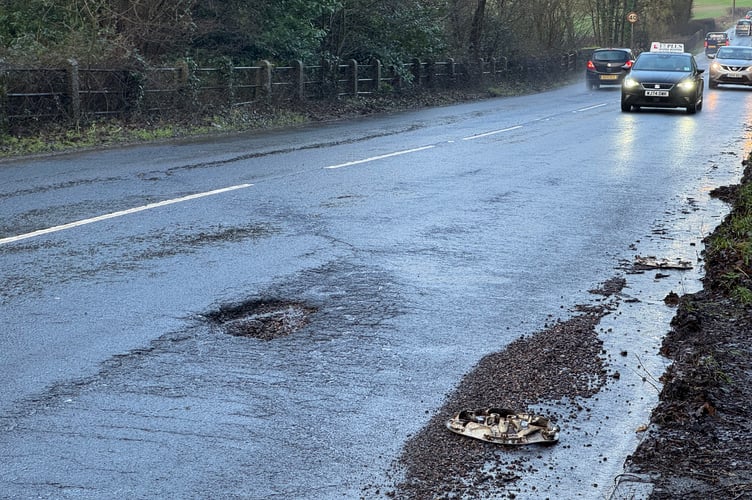
A “COMMON-SENSE” approach will be used to help fill Devon’s backlog of potholes with a recent trial being extended.
Residents have often complained that road crews only repair potholes that are on their work schedule, and don’t make other repairs that are visible in the vicinity.
That’s partly because potholes technically have to measure certain depths (40mm) and widths (300mm) to be considered formal “safety defects”, and also because crews are under pressure to tackle the long list of reported damage.
A recent trial in Barnstaple South and the electoral division of Hatherleigh and Chagford allowed highways teams to fix the defect they had logged, but also to be able to make repairs to other potholes within 500 metres of the specific defect or at least log them for future repairs.




While the trial was considered a success, it is being tweaked for its extension because it was generating more work than the crews could legitimately deal with.
This means that crews will be able to use “common sense” as the cabinet member for highways, Councillor Dan Thomas (Liberal Democrat, South Brent and Yealmpton) told Devon County Council’s cabinet, to still fill any nearby damage they see, but without having to analyse 500 metres either side of the issue they are fixing.
The council said the trial technically didn’t cost any more money to deliver because it used existing resources, but around £300,000 was spent in the trial area that would have been spread across the county.
An extra £4 million towards highways was confirmed, cash that was flagged as likely to be available earlier in the year.
The cabinet heard that the preference remained for highways teams to identify as many potholes for repair as possible when attending repair sites within the trial areas, although this may not happen in a single visit.
While the outcome of the trial was welcomed, it comes amid a push to engage local residents to train to become so-called ‘pothole wardens’ to fix damage in their neighbourhoods.
This winter proved brutal for Devon’s roads, with 8,340 potholes recorded in January this year – a huge 50 per cent spike on the 5,250 recorded in the same month in 2025 – albeit not all of those would qualify as formal “safety defects” and could include duplicate reports.
Analysis of the trial showed that pothole reports decreased during the trial, suggesting it had a positive impact on repairs, while the repair of holes that didn’t yet qualify as formal safety defects prevented them worsening.
“What we’re asking [with the extension of the trial] is that we reduce the 500-metre rule and instead adopt a common sense approach,” Cllr Thomas said.
“If a team is out repairing a safety defect and they see a pothole then they can go and fill it, but we don’t expect them to drive a kilometre down the road – if they can see it, and they are there, then they will go and fill it in.”
Cllr Thomas said the trial would be expanded but that officers would select the electoral divisions. Data would be used to identify areas with higher need, such as those with more elderly or disabled residents.
The report to cabinet also noted that highways teams “felt more satisfied” because they weren’t having to repeatedly return to the same sites, unlike when they are only repairing potholes on their list and then returning later to repair other damage.
“Anecdotally, they also felt they had more positive interactions with the public because defects were not being left unaddressed,” the report said.
It added: “During the trial, repair teams were empowered to record and repair any defect that they came across whilst on-site.
“This was to address the common public frustration i.e. ‘they repaired this pothole but not the one next to it’.
“However, there were zero instances where the repair teams were required to repair adjacent potholes that had not already been identified. This was a significant success, with the reason being that inspectors were recording all potholes, rather than just safety defects.”
Comments
We've recently changed our login process. If you have an account for commenting, you will need to re-register on the login window.
This article has no comments yet. Be the first to leave a comment.