

by Alan Quick
TWO Royal Flying Corps (RFC) aviators, one formerly from Bow, near Crediton and the other from the Bromsgrove area in Worcestershire, were honoured in a moving ceremony near The Somme in France, their final resting place, exactly 101 years after their deaths, following painstaking research by a retired Royal Canadian Navy Officer.
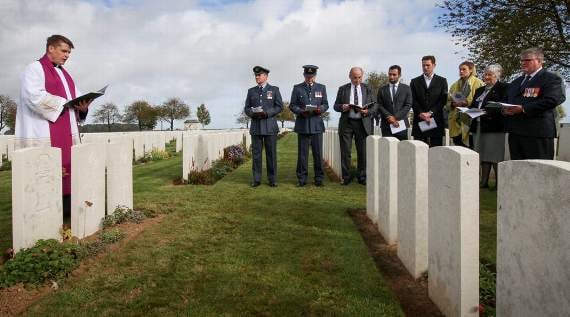
The graves of Lieutenant Leonard Cameron Kidd MC, who hailed from the Bromsgove area, and Second Lieutenant Fenton Ellis Stanley Phillips MC, the youngest son of the Rector of Bow, were rededicated with full military honours in a service on Thursday, October 12 at the Caterpillar Valley Cemetery in France. The graves of Lieutenant Kidd (Pilot) and Second Lieutenant Phillips (Observer) were previously marked as “A British Airman of the Great War”.
Lieutenant Kidd and Second Lieutenant Phillips were killed on October 12, 1916.
.jpeg?width=209&height=140&crop=209:145,smart&quality=75)

They were members of 3 Squadron RFC, and had flown out of the RFC Aerodrome at La Houssoye at around 1.50pm in a Morane Parasol reconnaissance aircraft. The pair did not return and were believed to have been shot down by anti-aircraft fire between Gueudecourt and Eaucourt L’Abbaye.
For a century their whereabouts remained unknown and the pair were commemorated by the Commonwealth War Graves Commission on the Arras Flying Services Memorial.
However, thorough research by Lieutenant Commander Steve St Amant, a retired Royal Canadian Navy Officer, has revealed that the two plots at the Caterpillar Valley Cemetery do indeed belong to Lieutenant Kidd and Second Lieutenant Phillips.
The service, organised by the Ministry of Defence’s Joint Casualty and Compassionate Centre (JCCC) was attended by personnel from the current 3 (Fighter) Squadron Royal Air Force, based at RAF Coningsby in Lincolnshire.
The service was conducted by Rev Fr Flight Lieutenant James Mealy, the RAF Coningsby Station Chaplain and Padre of 3 (Fighter) Squadron.
Also present was Lieutenant Commander St Amant alongside other representatives from the Royal Canadian Navy, the UK Embassy in Paris, Standard Bearers from the Royal British Legion, local dignitaries, and the Head Teacher and pupils from Bromsgrove School in Worcestershire, which was attended by Lieutenant Kidd.
Rev Fr Flight Lieutenant James Mealy said: “It is truly an honour and privilege to be part of this rededication service for Lieutenant Kidd and Second Lieutenant Phillips. They are remarkable and brave young officers who gave their everything so we can enjoy our today.
“Also, as the 3 (Fighter) Squadron Padre, it is especially meaningful to me, to finally give these two men the honour and blessing that they deserve and give praise and thanksgiving to God for the sacrifice they gave for us. Their names will continue to live on.”
Simon Bergg, Second Lieutenant Phillips’ great nephew who attended the ceremony, said: “We are extremely grateful for the opportunity to pay our respects to our great uncle at this Rededication Ceremony. It means a great deal to us that he no longer rests in an unmarked grave.
“We are also very thankful for the time and effort that Steve St Amant invested to unearth the history that has enabled this ceremony to take place.
“Through all of this we have learned so much about our Great Uncle and how he brought pleasure and joy to those around him during his short life, even during times of conflict.”
Tracey Bowers, who works for the JCCC, said: “It is only right and fitting that these two exceptionally brave men now have a named grave. It is humbling that so many people have travelled from so far away to attend today’s ceremony.”
HOW THE GRAVES WERE IDENTIFIED
Lieutenant Commander Steve St Amant found that the individuals buried in these plots had been recovered from the same location, in an area within which Lieutenant Kidd and Second Lieutenant Phillips were operating. He also found that both casualties were wearing RFC uniforms, and both wore the ribbon of the Military Cross, which the two individuals had both been awarded in 1916.
In a report which was submitted to the Commonwealth War Graves Commission in July 2015, and subsequently supported by the RAF’s Air Historical Branch, Lieutenant Commander St Amant presented his very detailed dossier showing how he had identified the two aircrew. The case was then passed to the Joint Casualty and Compassionate Centre for final adjudication, after which arrangements began for a rededication ceremony.
Lieutenant Commander Steve St Amant said: “I was ecstatic when I first got the news that their graves were to be rededicated. I also felt my research had been validated.
“Despite the fact these two young men lost their lives 101 years ago, they have been the catalyst for something wonderful. I will continue to do this research where I can simply, because I want to see unknowns come out of the cold. We owe it to them and their families, regardless of the passage of time.”
ABOUT FENTON PHILLIPS
Second Lieutenant Fenton Ellis Stanley Phillips MC was born in 1895.
At the outbreak of war he enlisted into the Artists Rifles as a Private, later being gazetted as a Second Lieutenant in the Devonshire Regiment. He was sent to France in May 1915 and in May 1916 joined the Royal Flying Corps.
In September 1916 he was awarded the Military Cross, which was recorded in the “London Gazette” of October 23, 1916. The citation reads: “for conspicuous gallantry and skill. He has done fine contact patrol work. On one occasion he came down to a low altitude while making a report, and his machine was much damaged by rifle and machine gun fire, but he carried on and successfully put our artillery on to the enemy, who were massing for a counterattack”.
In addition to the Military Cross, Fenton was awarded the 1914-15 Star, the British War Medal and the Victory Medal. Fenton was just 21 at the time of his death.
ABOUT LEONARD KIDD
Lieutenant Leonard Cameron Kidd MC was born in 1893 in the Bromsgrove area. He was educated at Bromsgrove School and at the outbreak of war was tea planting in Ceylon. Already a qualified pilot, he enlisted into the Royal Flying Corps and was sent to France in February 1916.
Operating over the Somme area, shortly before his death Leonard received notification that he had been awarded the Military Cross. An entry in the “London Gazette” of November 14, 1916 records that his Military Cross was awarded “for conspicuous skill and gallantry on contact patrol work. On one occasion he carried out three contact patrol flights, each 1,000 feet, and obtained valuable information under heavy fire. He also attacked enemy reinforcements with a machine gun from a height of 500 feet”.
In addition to the Military Cross Leonard was awarded the British War Medal and the Victory Medal. Leonard was 23 at the time of his death.
Following the discovery of the remains of British Service personnel from historic conflicts, the Ministry of Defence attempts to identify any living relatives so that they can be involved in the subsequent re-interment and memorial service.
New named headstones were provided for the previously “unknown” graves of both young men by the Joint Casualty and Compassionate Centre (JCCC).
Comments
This article has no comments yet. Be the first to leave a comment.