

IF the First XV has always been regarded as the flagship of any Club, then the Second XV’s would have to be the support ship upon which the entire fleet would depend.
In modern rugby, any Club that has the ability and presence of mind to run a Third XV will certainly be in a good place. Fortunately, Crediton falls into that latter category and makes every effort to ensure the lower XV’s are given the same opportunities and treated much the same as the lead side. Of course, it has to be said that whilst we do try to treat everyone the same, it is not always practically possible but we always try.
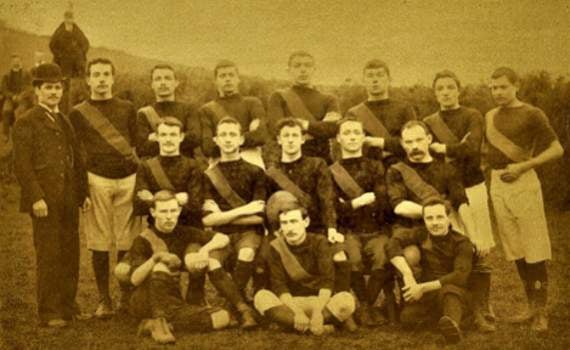
The early days of the Club, the first 25 years, a Second XV started in a rather haphazard fashion, although from the mid 1880’s we were putting out two teams regularly and in many instances three and sometimes four teams on a Saturday.
This was a period when rugby had become extremely popular and had certainly captured the imagination of the young men of Kirton.


Success in terms of results was intermittent, the best seasons prior to World War One were 1888-89 and 1895-96 when victories outstripped defeats by some considerable margin. As the seasons passed towards the Great War, the popularity of soccer became apparent and rugby in the town fell into decline and Crediton had barely enough players to fill one team let alone two.
Between the wars, whilst enthusiasm for the game was still there, running a Second XV remained inconsistent and in the years that we did manage to field two teams. The late 1930’s were certainly the best of that period and together with the First XV, the Seconds were putting in some good performances until another war interrupted proceedings.
Things really got going from the early 1950’s in fact since the 1947-48 season we have never failed to put out a Second XV and when the first Colts side made an appearance in 1957-58, the Club has always fielded at least three teams each week.
The 1960’ s and 70’s was a tremendous period for the Quins, as the Second XV had become known, indeed for 20 consecutive years they consistently won more than 50 per cent of their games.
It has to be said that Queen Elizabeth’s Grammar School and Hayward’s School played their part too, as many pupils at the schools were introduced to the game and ushered towards the rugby club. This was the era before regulations relating to age restrictions had come into force and many a young player had sampled senior rugby before leaving their teens.
The late 70’s and of course the Club was buzzing with excitement as the Centenary approached, by this time not only did we have First, Second and Colts XV’s, but a new group had joined, the Third XV. Each team was branded, the First XV had always been known as Crediton Chiefs, the Second XV had become the Harlequins and abbreviated to the Quins, the Third became known as the Hornets plus the Colts.
The 1975-76 season became hugely competitive between the Chiefs and Quins, both had enjoyed superb seasons and both were in a race to become the first team to score 1,000 in the season.
It was a close run thing but the Quins managed it on April 10, 1976 in a thumping win at Wiveliscombe (46-0), whilst a try from Fran Thorne in the 38-3 drubbing of Exeter “A” 12 days later secured the 1,000th point for the Chiefs. It was indeed a glorious season and one that is yet to be repeated and it is unlikely that 1,000 points will be scored in one season any time soon.
Whilst the try was worth four points back then, the Chiefs and Quins generally played over 40 games per season.
For the record that season, the Quins achieved 33 victories from their 39 games and the nucleus of the side contained the likes of Walter Andrews, who was serving his apprenticeship before going on to play more than 800 games for the Club, the majority of which were in the First XV.
He had a back row partner in Police Seargent Bob Harris who chipped in with 20 tries, front row regulars Peter Howison, Pete Sendell and Chris Scott all played well over half of the the games.
Fullback David Kemp played 25 games in addition to his 12 for the First XV. Speedy winger Alan Luxton bagged 17 tries from 19 games. Gavin White-Thompson with a total of 201 points from 27 games and Alan Tonkin with 133 from 31 games topped the scoring charts. A blend of youth and experience brought success but, rather sadly no team photo from that year.
Paul Harris
Comments
This article has no comments yet. Be the first to leave a comment.