

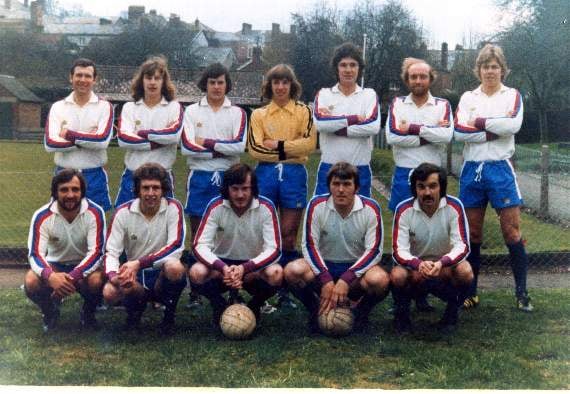
IN the early 1930’s there was great excitement for Crediton Townspeople with the development of the grand new pleasure park at Newcombes Meadow.
On hindsight it was the perfect position in the town for such an amenity – within a short walk for everyone. The original site was a bowl-shaped field requiring a lot of ground levelling for the bowling green and tennis courts and considerable excavation for the football pitch. No money was spared in providing the children’s play area as well.
Since the formation of the first regular football team in 1910 as Crediton United the Club had had no regular ground of its own and appeared to have used initially the Queen Elizabeth School “Rec” and then the Old Racecourse ground now part of the Downes Golf Course.
Presumably at the outset of the First World War after only eight years playing the Club folded and it wasn’t until after the war that football returned to Crediton in the shape of the main town team, Jackson’s United. By the end of the 1920’s the team was referred to just as “United” and in 1930 it changed its name to Crediton Town but was still playing at The Racecourse.

Football in the 20s and 30s appears to have been a very popular time for both players and spectators particularly.
In April 1923 Jackson’s played the Yeoford League Cup Final against Newton St Cyres at Lapford winning 2-1. A fortnight later the team travelled to North Tawton to play Hatherleigh to decide the overall winners of the Yeoford and North Tawton District League Championship. A local newspaper reported: “Between four and five hundred attended the match including 100 from Crediton travelling by ‘bikes, of ‘both pedal and motor variety’, others by motor car and train whilst 40 were conveyed in a large motor bus. In addition several travelled with the team in their charabanc.” Jackson’s ran out 3-1 winners. “The team was met on their return to Crediton by a crowd of several hundred headed by the town band who played ‘See the Conquering Hero Comes’ as they paraded down the town. The captain W.Jones was sitting on the bonnet of a motor car holding up both the League and Championship Cups. At the top of Market Street the procession halted and the crowd was addressed by William Pollard, President of the league, after which the team and a large number of supporters adjourned to the Old Swan Hotel.”
The Old Swan was then situated where Kitchen@25 (formerly Treloars Café) now is and from my memory of the pub must’ve been quite a squeeze inside.
In the early 1930’s Crediton Town and Crediton Imps were still playing at the Old Racecourse but in the same decade Crediton Rangers, and Crediton Haywardian’s were also running teams. At one stage in the decade there were three Crediton teams all playing in the same Division – Town, Rangers and the Imps.
Crediton Town were still the main club in town though and on April 21, 1934, played Topsham in the final of the East Devon Senior Cup at St James’ Park winning 2-1. The season ended for the people of Crediton when on May 5, Crediton played host at the Old Racecourse for the final of the Express Shield between Hayward’s and Central with the away side winning 2-0 in front of a crowd of 600 spectators!
The development of Newcombes Playing Field began at the start of the decade and the bowling green and tennis courts appear to have been established first, presumably using excavated soil from the football pitch. So it would probably have been several years into the 30’s before the football pitch was ready for use.
Crediton Town appear to have been the first Club to use Newcombes as its home ground but it subsequently returned to the Racecourse. Near the end of the decade the team appeared to vanish off the map, but had probably changed its name again as Jackson’s United had reformed at the start of the 1938/9 season so it is assumed the club folded.
Crediton Rangers, were playing in Mr Bricknell’s field near at the top of Barnfield – apparently there was no charge but was free on the condition his son Sam was allowed to play in goal occasionally! Rangers were eventually offered the use of the Newcombes pitch by the Urban Council in 1937 and played there until the start of the Second World War with changing accommodation provided at the White Hart Inn.
Football Leagues were disbanded during the Second World War years, apart from occasional matches, and it wasn’t until 1945-6 that league football started again. This time all interested parties joined together.
At the end of the 1947 season the Old Haywardian’s AFC folded and Bill Ash, the retiring treasurer, handed over the club’s assets - £19. 14s to United’s treasurer, Ivor Lawrence, and amalgamated with Crediton United. Bill then took over as secretary for the new Crediton United which has been the main town team now for 75 years.
The amalgamation of Clubs brought together all the best players in the town with United’s pre-war Exeter City and Brentford professional Stan Hurst back playing for Kirton.
From the late 1940’s until 1953 match reports in the local press were poor and it wasn’t until 1953 when surviving Club minute books could be studied to glean information.
United’s bright start on their new ground didn’t last many seasons as most of the players were ageing and within a few years had retired. So Crediton United were starting another new era.
In 1954 an Exeter City team came to Newcombes Meadow to help raise funds for the Club and attracted a large crowd, including yours truly at the tender age of nine!
The game had been arranged through three former Crediton players Fred Davey, Bill Ellaway and Keith Harvey who were all at the time on City’s books. Playing in the Crediton team was teenager Ian Grinney who impressed the City team manager so much that shortly after he also signed for the Grecians.
By that time Fred Davey was approaching retirement from football but there was one match, away to Brentford a few years later that all four Crediton players played in the same team.
The ground at Newcombes Meadow had become a popular place for kids and every evening or weekend there were games of football or cricket taking place. The layout of the main pitch had created a fantastic spot to view a United game as from the bank it was possible to look down on the game.
Because the ground had been excavated to level it however the playing surface was poor particularly in the winter months because the top soil had been removed to fill in the ground to build the bowling green and tennis courts. As a result the top surface of the pitch was clay sub soil and there were always problems with drainage. In the early 1950’s the Club tried to alleviate the problem by digging trenches and laying drains but this only had minimal effect.
Later in my 20s when I joined the club committee and was helping on the ground I arranged for John Roach to bring a heavy roller in to flatten the pitch surface. The pitch was still a bit damp but all went well until he reached the centre circle where both tractor and roller got stuck. With a match the following day I started to panic. By sheer chance Phillip Gibbings was driving his JCB along Belle Parade and saw our dilemma.
Luckily Phil was able to push the tractor and roller on to sound ground and the problem was over except I had to spend several hours repairing the mess with a spade.
In the early 1950’s the Rugby Club had built new changing accommodation near their pitch at the “Rec” and taken over the former wartime Fire Station as their Clubhouse.
As a result they vacated their changing facilities at the Oatsheaf Inn in Crediton High Street and the football club were able to take these over. This included a big concrete tub with showers and a massive coal fired boiler. It still meant a long trek down the High Street for both teams in football boots though.
The Club suffered during the latter 1950’s with poor results but in the early 1960’s things started to look up with the return of Fred Davey to the Club. Bill Ash also rejoined the Club as Chairman and there was more enthusiasm generated by others joining the Club and players getting involved.
The Crediton Urban District Council gave the Club permission to convert part of the Council buildings into changing rooms and also to allow the siting of a small Clubroom adjacent to the bowling green.
Changing rooms were built by players and committee members in what had at one time been a leather factory with the back door of the referees room opening onto the old mortuary.
This was probably the best post war season with all three ex-City players Fred Davey, Bill Ellaway and Ian Grinney in the team as well as two outstanding youngsters Melvyn Steer and Rodney Eakers. The team won the then Exeter and District League Senior One Division and promotion to the Premier Division.
The team’s fortunes looked good for a couple of seasons but after three seasons found themselves relegated. This was only for one season however as the following year they found themselves Champions again. In 1966/7 United, with Dave Blanchford now captain, the First team won the Senior Division again. This promotion lasted only two seasons as in 1969/70 they were back in Senior One.
In 1969 the Club appointed Ian Grinney as first team manager, who held the position for five years. He was followed by Alan Matten two years later and then in 1976 by Ken Granger. But that is another story.
The team alternated between Senior One and the Premier Division for the next 16 years following the move to the Lords Meadow ground and the appointment of Trevor Atkins as Manager.
The Club was ambitious to progress into a higher grade of football but there were restrictions as to how the Club could develop the pitch.
I am regularly told by ex-players and supporters what a great place it was to play or watch but building a clubhouse and enclosing the ground would’ve been impossible. A move to Lords Meadow was the answer. Unfortunately the playing surface suffers the same problems with drainage.
Chris Gillard
Comments
This article has no comments yet. Be the first to leave a comment.