

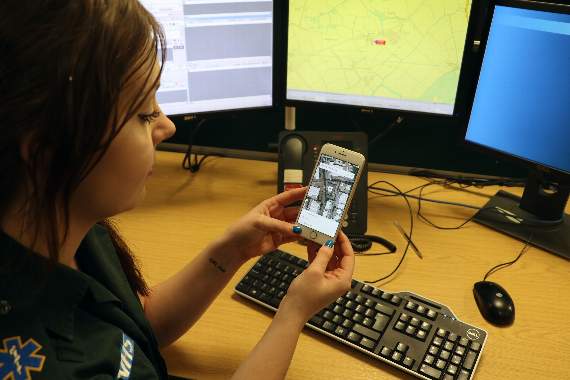
A SMARTPHONE app is helping South Western Ambulance Service NHS Foundation Trust (SWASFT) to find patients and save lives.
The what3words app divides the world into 57 trillion squares, each measuring 3m by 3m (10ft by 10ft) and having a unique three-word address such as “ ///slower.civil.twice ”.
SWASFT adopted the mobile mapping system in its Control Room earlier this year to locate patients faster and more precisely.
Hundreds of 999 callers are using the free app to pinpoint their exact location, so crews can be sent to the right place.

David Fletcher, Head of SWASFT Clinical Hubs, said: “What3words is helping us to find patients more easily and quickly than ever before.
“Our callers are using it on a daily basis to tell our Control Room staff exactly where they are, so our frontline crews can pinpoint the location of patients in need of emergency care.
“We cover 10,000 square miles, including many rural and remote areas, and we can spend vital time trying to find patients. This system means we can narrow down that search within seconds to a three-square metre area. By having a three-word address we are saving time, resources and lives.”
The what3words map shows callers their exact location with a corresponding three-word address, which they give to the call handler so help can be dispatched to the precise location. It is being used in addition to the existing computer system.
SWASFT is encouraging people to download the app, so they can use it in an emergency. The app uses GPS signal to identify the user’s current location and provide their three-word address. It means that once the user has the app on their mobile phone, they don’t even need a data signal to obtain their location.
999 Call Handler, Slade Stevens, said: “The app can be downloaded at the click of a button, and can make all the difference in an emergency when every second counts.
“I received a call from someone who was injured in a field, but didn’t know where they were. By using the app we were able to establish exactly where help was needed, so we could send resources straight to the scene.”
People are reminded only to call 999 when someone is seriously ill or injured, and their life may be at risk.
Comments
This article has no comments yet. Be the first to leave a comment.