

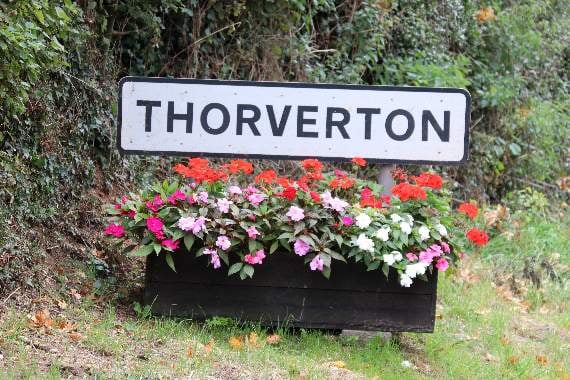
MEMBERS of Thorverton and District History Society enjoyed a talk entitled “From Beer to Brisbane and back” by Peter Dare at their September meeting.
This was a change to our programme and we managed to get Peter to give a talk that we were hoping to schedule for next year.
Peter lived in Thorverton for about 16 years but he was born in Beer. His grandfather was a fisherman there. He attended the local primary school before going on to secondary schooling in Axminster. He belonged to the local football and sailing clubs and worked in Trumps stores at weekends as a delivery boy.
On leaving school in 1956 he started an apprenticeship in the quarries at Beer. Stone has been quarried from here for centuries and as a boy he used to play in the mines which are now a tourist attraction.


Beer stone is a soft limestone and is cut out of underground mines, not an open quarry. It is cut with a saw and then hoisted by crane onto wagons. It was then taken by boat or road into Exeter.
It was worked with traditional tools which have changed little over the years. At the age of 18 Peter learned to drive in his father’s car and shortly after that the quarry closed.
He was offered similar employment in Portsmouth or Swansea but opted to go to Swansea where he worked on the stonework of new student accommodation as well as other buildings that had been damaged in the war.
He worked a 75-hour week with every third weekend off.
After 18 months he was sent to build an extension to a church in Petersfield and when that was finished onto Oxford to build a new Marks and Spencer store, along with replacing stonework on university buildings.
In 1962 he got a job with a masonry firm and in 1966 moved back to Devon to work for Dart and Francis. At that time they were working on Exeter Cathedral and in 1969 he became the master mason at the Cathedral.
He was now responsible for training apprentices and was involved in the removal of the Victorian Mary Major church in the Cathedral Close.
The cathedral had a winter cleaning programme and stone was needed so Peter went back to the quarry at Beer and reopened it along with another quarry at Salcombe Regis.
It was here they found tool marks on the stone from 1445 when the quarry had closed. They used tungsten bladed chainsaws to cut out blocks of stone and Peter did a lot of the carvings that can now be seen on the cathedral. His favourite one is of a dog called Butch who smoked a pipe.
In 1983 the Queen visited Exeter and Peter was presented with Maundy money, in appreciation of the work he had done.
In 1985 he did a lot of freelance work including Bradley Manor and Truro Cathedral. He became a partner in Dart and Francis and worked on the Powder Mills on Dartmoor as well as other conservation work on many local properties.
In 1989 he saw an advert for a job to complete the building of a cathedral in Brisbane, Australia. The construction had been started in 1906 but they ran out of money in 1912.
In the 1960’s they built some more of it based around a steel frame but it had been designed as a load-bearing building and Peter wanted the steel removed.
He purchased a quarry about 80 miles away to provide the stone they would need. Wooden cranes were still in use and initially they used stone rubble until they purchased a cutting machine.
Despite resistance, the steel work was removed and a lot of time was spent fundraising. In 1994 they purchased a cutting machine from Italy which would cut to computer design, although they had to hand-finish everything as that is what the architect wanted.
Work progressed on Brisbane cathedral and as they purchased further cutting machines they were able to sell stone for construction work in other countries.
At this time Peter started making furniture as well as carrying out further freelance work via a company he set up. He did all the carving and sculptural work at Brisbane, mostly at weekends and he had to work around the church services.
In 2000 he received an award and medal to recognise the work he had done in training the Australian apprentices. Many of the buildings in Brisbane have stone from the cathedral quarry.
Bells for the Cathedral were made in London and there were concerns they might be too heavy for the tower. A concrete slab secured the tower and there were no problems.
There is a benefactors’ gallery of those who donated one million Australian dollars to the project and Peter added one of himself without making the financial contribution.
In 2007 he was awarded the Australian Medal by the Queen in recognition of his work and in 2009 he was awarded Constructor of the Year by Queensland University. He had now almost retired and now lives in Exeter.
Robert Turner
Comments
This article has no comments yet. Be the first to leave a comment.