

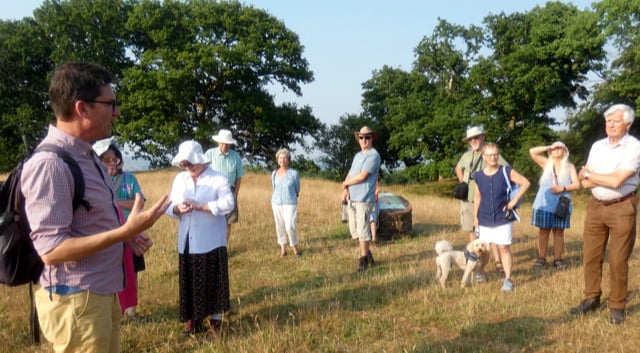
IN wonderful sunshine, on Tuesday, July 19, a happy band of Thorverton History Society members set forth up the hill to Cadbury Castle in the excellent company of the owners, David and Catriona Fursdon, accompanied by Tom Cadbury, the Assistant Curator of RAMM’s antiquities collection, local archaeologist Bryony Cole and our recent speaker, Greg Chuter, the Senior Archaeologist for the Environment Agency in the South West.
Cadbury Castle is acknowledged as the site of an ancient Iron Age fort.
It forms the highest part of the Fursdon estate owned by the family for nearly 800 years, and so we were particularly grateful to be accompanied and welcomed by David Fursdon who was able to give the group an overview of their careful trusteeship, archaeological finds and some of the known history of the site.
Cadbury Castle has been a scheduled monument since 1924 and is listed as a univallate hill fort (a defended enclosure).




It has an oval, grassed and level enclosure, defined by a three metre high rampart and an outer ditch.
A second rampart and ditch were added on the eastern, south and west sides, while a more modern entrance has been cut in the north-east rampart to enter the enclosure.
It is mentioned in both Risdon’s Survey of Devon in 1626 and featured in Donn’s important 1765 map of Devon.
It commands an excellent vantage point with views as far as the Sidmouth Gap to the south, to Dartmoor in the south-west and to Exmoor in the north.
On this particular day we were able to both enjoy and appreciate the views enjoyed by inhabitants from the Iron Age onwards and to feel the significance of the site in relation to other features in the local landscape surrounding us, made particularly tantalising through field markings more visible due to our dry weather.
All of our speakers and indeed our guests were able to put the site into its frame of reference and encouraged us to consider the longevity and its importance to the local population as a prime vantage point and as a defendable site, a meeting point or moot court as well as the possibility of religious and/or superstitious significance, as the finding of various artefacts which may have been offerings could indicate.
In 1843, an excavation down a shaft in the main enclosure (now filled in) which was possibly a well, produced coins, beads, bracelets, pottery, finger rings and a 17th century sword.
This last artefact was probably from the period of the Civil War when the site was briefly occupied by the Parliamentarian troops commanded by Fairfax. The finds are now held by the Fursdon family at Fursdon House and can occasionally be viewed.
More telling still is the competitive claim to be the home of our local dragon!
This was a lovely evening spent in the fresh air, with many valuable contributions and a chance to explore a significant feature of our local area.
Ann Marshall
Comments
This article has no comments yet. Be the first to leave a comment.