

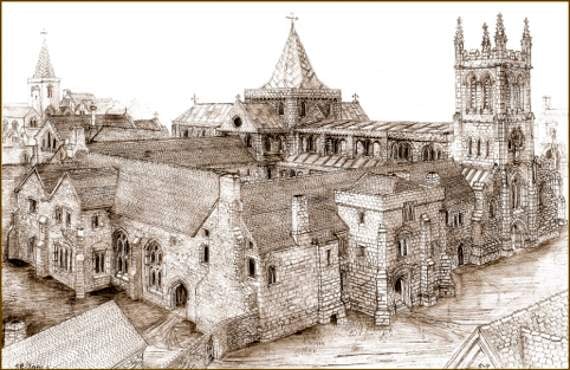
A TOTAL of 30 participants attended a fascinating zoom talk about St Nicholas Priory, a unique and historic site in Mint Lane (off Fore Street) in Exeter, by the very knowledgeable and distinguished speaker, John Allan, on Friday, March 26.
As well as introducing John, our Chair thoroughly recommends a donation to Exeter Historic Trust who now administer the buildings and museum and have done so much to preserve these structures and a visit when possible.
The earliest evidence on site has proven a Roman legionary fortress from the first century CE.
By the Anglo Saxon period, the area was strongly linked to the estate of the House of Godwin, a leading noble family, and Gytha the mother of the unfortunate Harold (of the Battle of Hastings fame).
The Priory itself was a Norman monastery, founded in 1087 in the reign of William the Conqueror, gifted to Benedictine monks.
John connected historic maps and documents to illustrate three possible Saxon enclaves in the City: the castle, the cathedral and "Irlisbury" (literally the "enclosure of the earls") and explained the significance of this benefice as a sign of William’s consolidation of power and effective penalty to the defeated Godwins.
The talk used excellent reconstructive illustrations by Richard Parker which allowed the audience to really feel the grandeur and extent of the architecture, much of which has been researched and re-established through archaeological finds within the precincts of the remaining ranges which used to surround the cloisters of the monastery.
The imposing church and chapter house shown in the illustration were destroyed during the Dissolution.
The western range, which housed the refectory, is one of the oldest standing buildings remaining in Devon from the Norman period and the undercroft, one of the best preserved.
John was able to include slides of some examples of Norman architecture such as encaustic tiles and rare capitols and twisted paired columns found here, reminiscent of examples found only in Canterbury and Byland Abbey in the UK.
The abbey buildings were later re-modelled in the perpendicular style and excavations in 1983 revealed the foundations of a tower…linking a Tudor contemporary story of Breton workmen leaping from said tower to escape rioting local women in their effort to save the Abbey from destruction.
Sadly, much of the stone work had been "rubbed out" and re-used, however, these two ranges still appear on historic maps and records as a private manor or town house, once owned by the wealthy Hurst family.
By the 19th century it had become "a rookery of tenements".
One notable resident, a Rev George Oliver (1807-1861), is commemorated by a plaque for his "lifelong services to his fellow citizens in history, literature, benevolence and pastoral zeal".
By 1914 the buildings were near to dereliction, however, luckily for us, the city council chose to purchase and to restore the remaining fabric.
The session was concluded with a wide range of questions from evidence of witchcraft to the origins St Olave and included current and recently published research.
John was roundly thanked for such an interesting and engaging lecture and members are reminded of our next talk by Paul Rendell (on April 23) on the "lost" Burrator Farms of Dartmoor.
Recorded by Ann Marshall
Comments
This article has no comments yet. Be the first to leave a comment.