

by Alan Quick
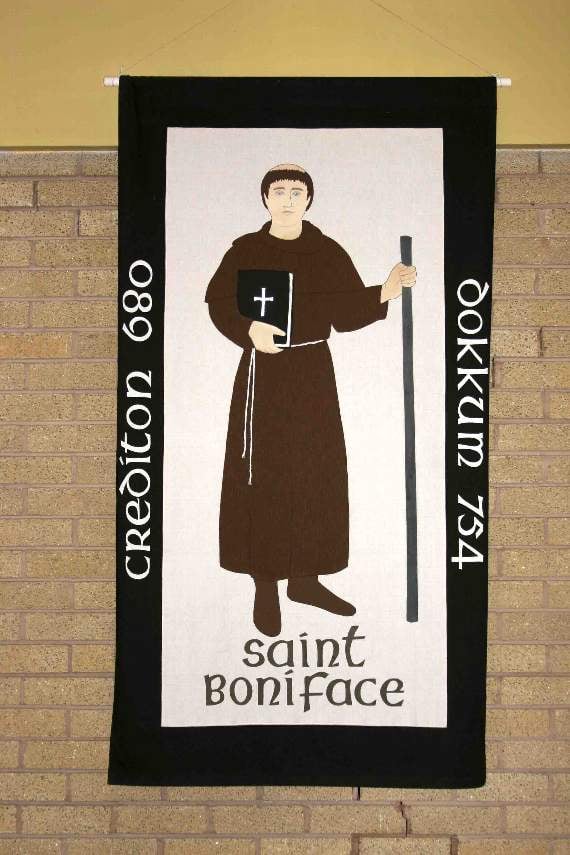
THERE is increasing interest in Crediton-born Winfrith, who became Saint Boniface, being recognised as the Patron Saint of Devon.
Devon’s most famous native-born saint is highly regarded for his missionary work in Germany, the Netherlands and across the German parts of the Frankish empire.
The efforts to have Saint Boniface recognised as the Patron Saint of Devon follow previous attempts to raise the profile of the Crediton-born Saint by the Mayor of Crediton, Cllr Frank Letch, and former South West of England Member of the European Parliament, Sir Giles Chichester, who had the same aim.


Sir Giles, when an MEP, proposed that Saint Boniface be recognised as the Patron Saint of Europe.
While this was not achieved, Crediton Town Council recognises Saint Boniface as the Patron Saint of Crediton.
More recently there have been suggestions that Boniface be recognised as Patron Saint of Devon.
Annually church services are held to mark St Boniface Day, June 5, and prayers are said at the St Boniface Statue in Newcombes Meadow in Crediton.
The annual Crediton Parish Church Flower Festival is held on or near the annual St Boniface Day.
ST BONIFACE FEAST
On June 5 this year a group of villagers from South Zeal, the heart of traditional folk music in Devon, will hold a Devonshire Day and St Boniface Feast at the Kings Arms at South Zeal.
Jim Causley, local folk musician and resident of the village, said: “We came up with the idea back in January at a Burns’ Night supper in the same pub.
“We were sat around chatting about the various other saints day celebrations; St Patrick’s, St Piran’s in Cornwall and the somewhat dismal attempts to celebrate St George’s in this country.
“And we thought, ‘Hey, we should have a day to celebrate Devon!’ and we decided St Boniface was perfect as he was actually born in Devon unlike a lot of the other saints linked to various counties and countries.”
It is proposed that the evening will include song and music, a Devon-themed quiz, some local humour and dialect readings.
There will also be a serenade of "Widecombe Fair" and other Devonshire favourites from members of Hatherleigh Silver Band.
Then will follow a meal of Devon food including Ruby Red Beef Wellington and junket with jam and cream.
The organisers hope: "It will be a small start in a little Dartmoor village that might spread the idea to similar events across the county that would make the likes of Tony Beard full of Devonian pride!"
HIS EARLY LIFE IN CREDITON
St Boniface, who was born and christened Wynfrith or Winfrith (or Winfrid), grew to become a major figure in the Roman Catholic Church and continues to be celebrated today as the “Apostle of Germany” and the first archbishop of Mainz.
This included the symbolic felling of Thor’s Oak, which converted many pagans to Christianity, and his recognition as the creator of the first ever Christmas tree.
The National Shrine to Crediton’s most famous son is in the Roman Catholic Church in Park Road, Crediton.
Crediton’s history is strongly based on Winfrith, who later became one of the greatest Christian missionaries and administrators, and one of the founding fathers of the Christian Church in Europe.
Crediton’s most famous building is the Parish Church of the Holy Cross. The history of the church and religion in Crediton dates back hundreds of years.
Boniface links with Crediton led to the founding of a monastery in the town in 739 which in turn is believed to have led to the choice of Crediton as the See of the first bishopric of Devon and the building in 909 of the first diocesan church in the town.
The current collegiate church was completed around 1410. There are many references to St Boniface in Crediton Parish Church including stained glass window representations and an effigy by Witold Kawalec.
The area of the town known as Tolleys in Crediton is regarded as the traditional birthplace of St Boniface and a blue plaque marking this can be seen at the corner of Tolleys and Downshead Lane.
An impressive statue of St Boniface is located in Newcombes Meadow, Crediton.
It was unveiled by Princess Margaret on Sunday, July 24, 1960 and the dedication was by the then Bishop of Crediton, Wilfrid Westall.
CHRISTMAS TREE
How St Boniface came to be acknowledged for starting the tradition of the Christmas tree is surrounded with some myth.
In the dramatised story about Boniface by Henry Van Dyke, “The First Christmas Tree” (1897), it states: “Armed with an axe he approached a sacred tree, the giant oak of Geismar, dedicated to Thor.
“After some effort, he felled the oak, and its branches lay on the ground in the shape of a cross. In its descent, sections of the oak had crushed every other tree around except a single small fir tree (this was possibly the origin of the Christmas tree).”
Other stories say that a fir tree grew from the roots of the fallen oak and the next year after he had felled it, all the pagans in the area had been converted to Christianity and hung decorations from the tree to celebrate what they now called Christmas rather than Winter Solstice.
Many will wonder how a fir tree grew big enough to decorate in one year.
The fir was seen as an image of God and many believed its evergreen symbolised the everlasting love of the Maker.
Whichever it was, the legend spread and soon Christmas trees became the norm in the newly converted Bavaria, and then spread out to become the tinsel strewn, electric lit, bauble hung festival we know today, popularised by Queen Victoria’s consort Albert, who brought the tradition of Christmas trees to England from Germany.
’THE GREATEST ENGLISHMAN’
St Boniface had an enormous impact on English and European history, far beyond the simple conversion of people to Christianity. His guidance of the early church in Germany, his establishment of structures which allowed it to co-exist with monarchy, were massively important, and the educational and literary influence from his monasteries and churches in his lifetime and over the next centuries was very significant.
He has been described by eminent historians as “The greatest Englishman of all time” and “the Englishman who has had a greater influence on the history of Europe than any other Englishman”, but in England he is not so greatly known.
• What do you think of plans to have St Boniface recognised as the Patron Saint of Devon?
Share your views with fellow "Crediton Courier" readers. Write a letter, suitable for publication, to The Editorial Manager, "Crediton Courier", 102 High Street, Crediton EX17 3LF. Alternatively, email your letter to: [email protected] .
Comments
This article has no comments yet. Be the first to leave a comment.