
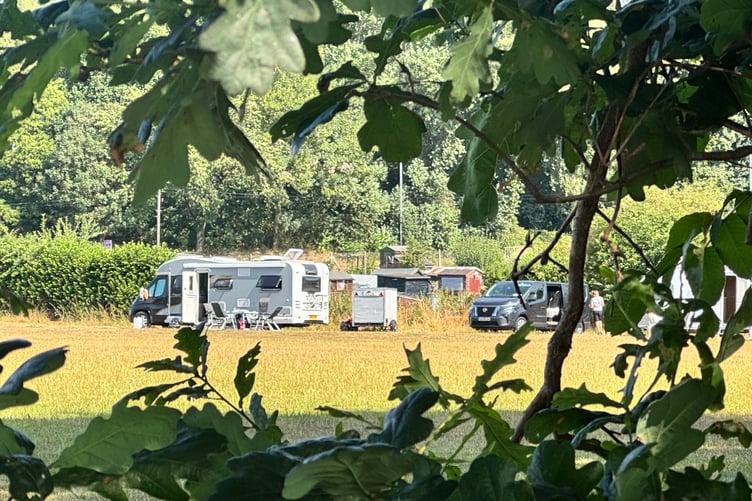
EFFORTS are underway to establish the demand for Gypsy and Traveller pitches after Mid Devon District Council revealed it spent £60,000 moving illegal encampments on.
The topic of creating enough sites for Gypsies and Travellers to stop arose during a discussion at the council, which was renewing its unauthorised encampments policy.
Its cabinet heard that the council had acted to remove a number of unauthorised encampments in the past three years at “some considerable cost”.
“[The cost has been] both financial, with a cost of circa £60,000 for external enforcement action and new security barriers and CCTV, and in terms of disruption to services and the community,” a report prepared for the cabinet stated.
Councillor Jane Lock (Liberal Democrat, Canonsleigh), the cabinet member for housing, assets and property services, said the policy “balances the rights and needs of those involved and a consistent approach to enforce where necessary”.
“We cannot identify the transit pitch need, but we are working with councils in Exeter, East Devon and Teignbridge, as well as Devon County Council, to share data to inform future plans and policy responses,” she said.
Cllr Lock said an “absence of data” of the number of caravans recorded on encampments, their length of stay, and common locations made it challenging for planning authorities to decide how many Gypsy and Traveller pitches to create.
“Additional information is needed on the origin of such groups, their purpose of travel, and their destinations,” she said.
“The district authorities and the county council are trying to remedy this with data and an agreement to share this with one another.”
Information on Devon County Council’s website states that while there are a “number of authorised private sites in Devon”, there is still a “serious shortage of Gypsy, Roma and Traveller (GRT) sites”.



“This has led to GRTs camping on land that they do not own (unauthorised encampments), or at times develop land without planning permission (unauthorised developments),” it states.
“At present, approximately one in five GRT caravans in England are on unauthorised sites and 90 per cent of planning applications that GRTs submit fail, which often forces them back onto the road with no fixed abode.
“When GRTs camp on land that they do not own, without the permission of the owner, they are trespassing; this is a civil matter and is not a criminal offence, hence the term ‘unauthorised encampment’ instead of ‘illegal encampment.”
The county council itself lists just two GRT sites it owns, one in Sowton, and another in Broadclyst.
Comments
We've recently changed our login process. If you have an account for commenting, you will need to re-register on the login window.
This article has no comments yet. Be the first to leave a comment.