

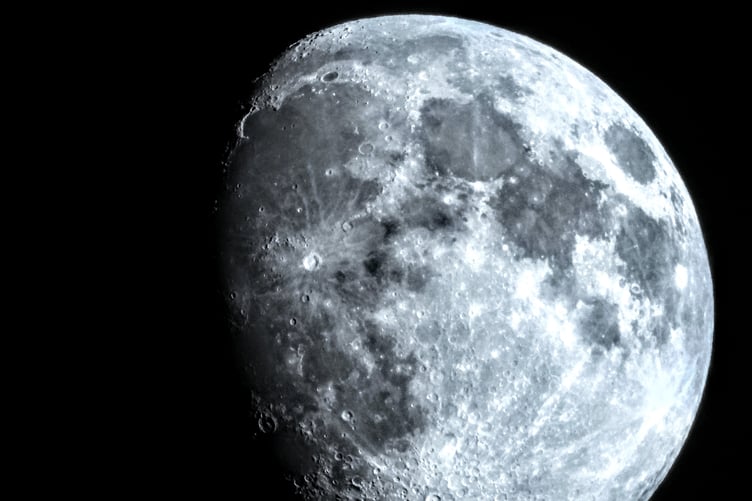
SOMEWHERE out beyond our everyday sky, a spacecraft is arcing around the moon.
Its crew are seeing things very few human eyes have ever seen – vast grey lunar plains, ancient craters, and our small blue-green Earth hanging in the dark.
I heard an astronaut on the radio describing views like this as a magnificent desolation, and the phrase has lingered with me. It seems to describe more than the lunar surface.
This Easter, we have found ourselves witnessing a peculiar conjunction of news – the Artemis mission reaching toward the moon; missiles crossing the skies of the Middle East; a war grinding on with no clear end. And alongside all of it, the ancient story of a tomb found empty, and the good news that life prevails.

.jpeg?width=209&height=140&crop=209:145,smart&quality=75)
I think there is something very human about our longing to go further – to leave our conflicts behind and reach the vastness and perspective of space.
Photographs from space offer something. Seen from out there, the earth is indivisibly one – no borders are visible, no front lines, just our home; fragile and fantastic in the dark.
And yet we must always return from these distant perspectives – to the news, and to the difficult day-to-day work of living alongside each other with all our differences on this small and suffering planet.
Easter doesn't ask us to look away from the desolation and the darkness.
The Christian story begins with a death that is real, brutal, and politically motivated, and it sits in that death for three days before anything changes.
At the weekend, I thought about the honesty of Holy Saturday.
It is the long and silent middle day between the crucifixion and the resurrection – the day when nothing has been resolved, and it is the day that feels, in some ways, like every day in the news.
We know how it starts, but when we look ahead, we cannot see how it ends. It is a demoralising, testing place to be.
But then something does change. The darkness is not cancelled out, but it is transcended. Life returns.
I look at the wars happening right now – and the hatred, misunderstanding, and division that causes them – and it feels as if we are in the waiting day of Holy Saturday.
We do not know what comes next and it can feel hopeless.
And then I look at the photographs from space – at our small bright earth, and at the moon's magnificent desolation – and I step outside at night and see that same moon shining down, and I feel a kind of awe, which also feels like a step towards hope, and an echo of the light and wonder of Easter Day.
It is a perspective that reminds me that we are very small, and very connected, and that Holy Saturday was not the end of the story.
Elizabeth Lloyd
Crediton Congregational Church
Comments
We've recently changed our login process. If you have an account for commenting, you will need to re-register on the login window.
This article has no comments yet. Be the first to leave a comment.