

WE are, as yet, not badly affected by the appalling floods, which now devastate Yorkshire. These follow the devastation of Cumbria and, not so long ago, Somerset.
Our town and our villages are, as yet not touched by the vast amounts of water pouring from the skies. But what can be done to prevent any future flooding?
According to the charity the Woodland Trust: “Around two thirds of all the flooding in 2007 was as a result of surface water run off”.
It remains to be seen what the response of our government, our local councils and our larger landowners will be to the present season’s floods.

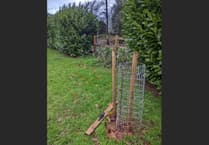


It may be that even more flood protection is called for in Britain. This will mean more expenditure on diverting rivers and more pouring of concrete to attempt to solve the problems.
Instead of which, we could be taking the advice of government hydrologists and re-creating woodlands, the natural barrier to flooding and soil erosion.
According to a published government report, our government wants to see “a steady expansion of tree cover …to increase the many diverse benefits that forests provide”. (The whole of the UK has only 13 per cent woodland cover compared with an EU average of 37 per cent).
Crediton itself is, thankfully on relatively high ground. But it we do not plant trees. We do not restore woodland.
We are, so far, not in the league of, for example, New York City where a million trees have been planted, nor even of Bristol where all their schools are involved in a substantial tree planting project. We don’t plant woods and trees – yet.
Do we need trees? Look out from the town to the surrounding areas. Many trees? Much greenery even?
Compare this with Exeter, where because of forethought, the city’s residents and visitors can stand on a street corner and see woods and fields easily.
But Crediton? We build houses, we increase commercial building: we demolish hedges and green spaces.
Flooding? Well, as local people will confirm, the Downeshead Lane area becomes a stream-bed whenever we suffer heavy downpours.
This localised flooding will not be improved by spreading yet more concrete in the area around the link road, nor by further developing the green hills to our south.
At the moment the Crediton area is due to increase considerably its volume of houses and commercial development.
Thereby we are actually decreasing Mid Devon’s famous “trees and green fields” environment and further decreasing the known benefits of trees to us all.
In fact, there is no true woodland surviving in Crediton. Only a few copses and a decreasing number of old orchards remain.
Old photographs show that only 70 years ago the Downeshead area was a massively tree covered area.
The debate in Crediton about the link road is long dead, but the area surrounding the new road does not have to be a concrete stream-bed in times of heavy rainfall.
We could, with a little vision and forethought, do what the government says it wants us to do: plant trees.
And not merely the sporadic new trees that line the link road, but recreated woodlands. Green stuff for which Devon was once famous.
An interesting comparison is that even in the heavily populated Black Country there is now the recently planted “Black Country Forest” which was creatively planted by the local council in the light of government advice.
No current plans exist to promote or develop woodlands or even orchards in Crediton.
The importance of Trees and Woodland is no longer in doubt.
According to the Woodland Trust: "Floods are becoming more common and it is predicted that changing weather patterns are likely to continue…winter rainfall has also increased throughout the UK over the last 40 years.
"Heavy and prolonged rainfall is undoubtedly a primary cause of flooding, there are many factors which contribute to flood risk…including the capacity of the drainage system and sewers to cope with increased rainfall; more homes in vulnerable areas such as flood plains, and changes in land use in urban areas.”
The importance of trees for the Crediton area seem to me to be obvious.
One example may illustrate some recent thinking about the advantages of re-developing woodlands to the local area.
It is clear that the Downes Estate (which owns considerable amounts of land in Crediton) has concerns about the susceptibility to summer drought on the land it owns.
In a report commissioned by the Estate (published on March 30, 2012) Passmore Wright and Company of Bideford commented that: “It is understood that parts of the estate… (are) susceptible to drought, whereby the soils are generally thin and crop yields suffer considerably in dry conditions.”
It seems that the consultants were mindful of the government’s comment that "…The shade provided by trees can help mitigate the effect of the urban heat island, where built-up areas absorb and retain heat more than the surrounding landscape."
But the principal aim of the report was to justify the creation of a lake on the Downes estate. No mention of redeveloping woodland was made. No plans are known to restore natural woodland.
No-one wants to block progress. The new housing at Wellparks and elsewhere must go ahead. But don’t the new residents of Crediton who will live there have the right to the enhanced protection and the increased amenity that more trees will provide, rather than the known problems of more hillsides covered with concrete?
It is clear to some of us that, while the re-creation of woodland will not be speedy, nor will the task of persuading local landowners to consider the future of our town be easy. Nonetheless some of us are trying to begin the process now.
If you agree with the above, please support CREDITON COMMUNITY WOODS, the new organisation trying to restore trees and woodland to our town.
(We are supported by your town council but not financially supported: to date we have no money and rely on goodwill and common sense alone.)
You can sign our petition at various points in the town. We will keep Kirtonians informed of our progress through the press… and hopefully with a mass tree planting in the not too distant future!
Rob Nicholls M.A.
(In my own capacity)
Crediton
by email
Comments
This article has no comments yet. Be the first to leave a comment.