

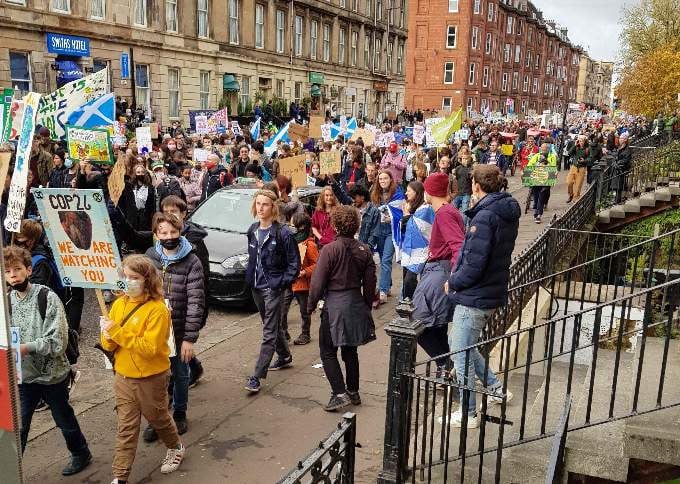
“THE world is at one minute to midnight and action is needed now to avert catastrophic climate change”, so said Boris Johnson at the launch of COP26.
The rhetoric was all about keeping the goal of 1.5 degrees alive but in practice, by the end of the conference, the likely range of temperature increase if all promises were kept, would be two degrees to 2.9 degrees by 2100 and possibly more after.
To put this in perspective, the differences between 1.5 and two degrees are huge: at two degrees of heating, we would see the continued loss of marine life including all coral, and areas supporting two billion people becoming unliveable, forcing inhabitants to migrate or die.
Outside the COP in Glasgow streets, the huge marches, full of home-made banners and costumes, and residents hanging out of windows with support signs, showed how many people understand the stakes and care deeply.

One day the precinct echoed with birdsong while Devon protestors displayed the losses of songbirds in UK, 91 per cent nightingales, 43 per cent cuckoos, 94 per cent turtle doves, 52 per cent swifts, 93 per cent tree sparrows, and 40 million birds fewer in the dawn chorus.
Young people, in their noisy, colourful and exuberant march, were already cynical about the influence of wealthy countries and corporations on COP outcomes. (And indeed, the 503 representatives of oil, gas and coal interests were more numerous than any of the country delegations at the conference).
Vanessa Nakate from Uganda spoke of how, at 1.1 per cent, already the failure of rains and unusually intense storms are causing harvest failure, famine and destruction of homes and buildings, and this story was echoed from other countries of the global south. A school built by a charity had its roof blown off, along with the gifted solar panels, and forests planted as carbon offsets had burnt in wildfires.
Inside COP26 US and UK blocked the proposal to form a fund to recompense poor countries for Loss and Damage due to greenhouse emissions mainly from wealthier nations. The pledge to phase out coal became “phase down”.
Agreements to stop deforestation and cut methane emissions (28 times the climate impact of CO2) were full of loopholes, and the issue of methane from livestock wasn’t mentioned. The US-China agreement to work together to cut emissions is good mood music but contained no specifics.
UK, like some other countries does not yet have policies in place to keep its promises, issuing 40 new oil and gas drilling licenses in the last year. The International Energy Association says there is no place for new fossil fuel development on a path to 1.5 degrees.
But the UK is chair of the COP process until next year, when countries are called to come back with better offers; so there is still time to show global leadership, and we hope that UK’s credibility will be enhanced by sticking to our legal obligations under the Paris Agreement to aim for well below two degrees; and making the policy commitments to walk our talk.
The Green Party has been committed to tackling global warming for longer than any other party, and whilst we support measures to move towards renewable energy sources and increase the production of electric cars, we do not see these technical solutions as enough. We believe that our problems are symptoms of an inherently unjust and unsustainable economic system, the roots of which have to be addressed. Many of those protesting in Glasgow come from countries where the extraction of resources such as lithium and cobalt - which make the new technologies possible – have left environmental devastation. Much of China’s emissions are to make cheap consumer goods for Europe and North America.
So how would we tackle this? Unlike other parties, we are not afraid to raise the issue of the lifestyle changes that are needed, for instance less dependence on cars, and better use (and provision) of public transport.
Surveys show that many people do accept this but want to be involved in discussions about how this could happen. Community conversations can play an important role, like the one held in Crediton on November 6, where a whole range of ideas were put forward to help us reach our goal of being net zero in Mid Devon by 2030.
The more formally organised, randomly selected Devon Climate Assembly called for better public transport and safe active travel alternatives to private cars before measures to discourage their use are taken.
The Green Party advocates a programme of providing proper insulation for our damp and leaky housing stock, which would reduce energy bills and a major source of carbon emissions. It would address the scourge of continuing fuel poverty with more than three million households facing a wretched winter as gas prices continue to rise, and it would also provide thousands of good jobs. The recent budget showed no signs of climate awareness, cutting air passenger duty, retaining the largest roadbuilding programme ever, and lacking substantial investment to replace the Green Homes programme, which was an expensive failure.
Much of this could be implemented by local authorities if they had the power and resources. The Green Party advocates decentralisation of power from Whitehall so that decisions can be taken close to where people live and work. The present government has been moving in the opposite direction and we are now one of the most centralised countries in Europe.
A key issue for us in Mid Devon is farming. Our food system is responsible for 30 per cent of our emissions, from agriculture to transportation, refrigeration and packaging.
A shift to regenerative farming practises would regenerate soils, allow local mixed farming and ensure resilience in the food system, and we agree that farmers, as well as those in other sectors, need support in this transition. They also need not to be undercut by imports which have poor animal welfare and environmental standards.
Much of this is contained in our commitment to a Green New Deal. New funding is needed, but being ahead in the new low-carbon economy carries rewards.
The Government’s response to the pandemic shows that money can be found in a crisis. As the prime minister has stated, this is what the whole world is facing. It’s time to act as if we meant it.
by Gerald Conyngham and Gill Westcott on behalf of Mid Devon Green Party
Comments
This article has no comments yet. Be the first to leave a comment.