

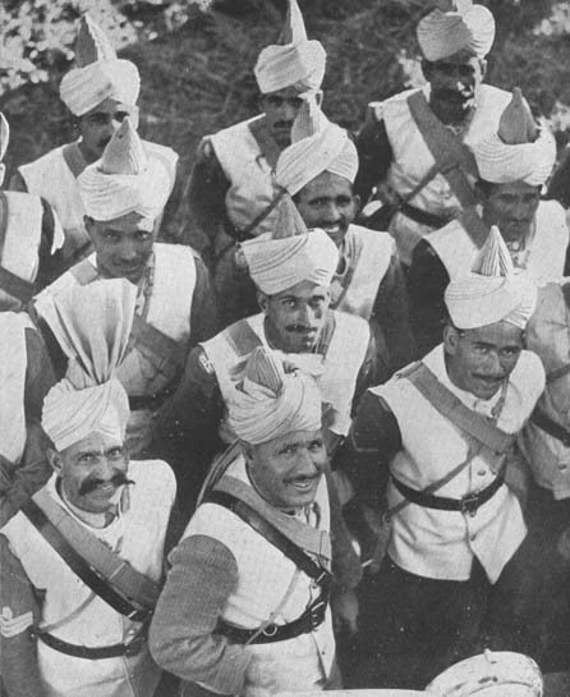
DO you have any memories or photographs of Indian soldiers stationed in Devon during the war?
If so, the Devon Rural Archive (DRA) would love to see you at its special talk on Monday, September 25, “Crossing the Imperial Colour Bar: Muslim Indian Soldiers in Devon in World War II”, hosted in association with the Devon History Society.
To be given by Ghee Bowman, a PhD student at Exeter University, this illustrated talk recalls the intriguing story of a wartime journey made across thousands of miles from Punjab to Plymouth, via Marseilles, Dunkirk and Lairg.
Using photographs and eyewitness accounts, Ghee will tell how between October 1940 and June 1942, soldiers of the Royal Indian Army Service Corps and their mules, came to be stationed across Devon.

“Many people are unaware that Muslim Indian soldiers were stationed at Plymouth, Teignmouth, Shaldon, Woodbarton Monastery, Ivybridge, Bigbury as well as on Dartmoor, during the war,” explained Abi Gray, Resident Archaeologist at the DRA.
“Inspired by some photographs he found in Gerald Wasley’s book ‘Devon at War’, of Indian soldiers wearing turbans and with mules, Ghee will enlighten us as to who they were and what they were doing here, and why their story seems to have been forgotten for so long.”
Ghee is currently studying for a PhD in history at Exeter University and is keen for anyone with any memories of the troops to go along on the evening and share them as part of his research.
The talk takes place at 7pm in the lecture theatre at the Devon Rural Archive, Shilstone near Modbury, PL21 0TW. Refreshments will be available from 6pm. Tickets are £5 each and booking is recommended. To book please call Abi on 01548 830832 or email: [email protected] . For further information visit: www.devonruralarchive.com .
Ghee Bowman worked as a teacher of English, theatre stage manager and more recently for the Global Centre in Exeter where he co-ordinated a project on Exeter’s multi-cultural history: http://www.tellingourstoriesexeter.org.uk/ before returning to university to study for his MA and now PhD.
Alan Quick
Comments
This article has no comments yet. Be the first to leave a comment.