

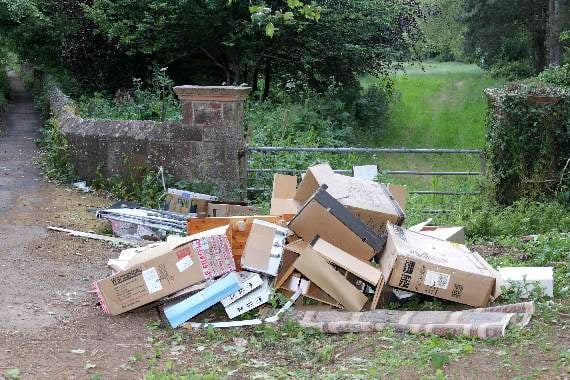
INCIDENTS of fly-tipping and rubbish dumped in lay-bys, on roads, in woodland and in fields have been a particular problem in the area recently.
Among the items was a wooden desk, metal bed frame, cardboard boxes, old children’s toys, packaging, a carpet and other material.
Some of the cardboard boxes included a name and address in Broadfields Road, Exeter.


On Tuesday, May 19, Lorraine Fidock, a volunteer litter picker with Mid Devon District Council came across a quantity of items dumped in the lay-by at Higher Road, Crediton.
The day before she found a garage door in the lay-by at Quarry Foot Cross.
Also recently, she found several items dumped in the lay-by at Half Moon, Newton St Cyres.
These items included fencing and cushions and many other items, in stinging nettles alongside the lay-by.
In another incident, just a few weeks ago, dumpy bags of building materials and insulation were found dumped, unusually, in a country lane near North Tawton.
The incident at North Tawton took place while recycling centres were closed due to the coronavirus pandemic.
The other incidents took place after local recycling centres were partially reopened.
PREDICTED
As predicted, the centre closures led to an increase in fly-tipping incidents on private land.
The CLA says it encourages both landowners and farmers, along with the public, to report any fly-tipping incidents to their local authorities.
Farmers and landowners can go some way to preventing fly-tipped waste on their land by ensuring gates to fields are locked, opening up concealed entrances so they are more visible to passers-by, using CCTV in black spots and reporting all instances to the local police force or local authority.
The CLA, which represents 30,000 landowners and farmers in England and Wales, has long called for decisive action in tackling this scourge by publishing a 5-point action plan in 2017. See: www.cla.org.uk/sites/default/files/CLA_flytipping%20action%20plan_FINAL.pdf .
As a result, the government introduced new regulations in 2018, which enabled local councils to issue fixed penalty notices or fines of up to £400 for small scale fly-tipping.
Fly-tipping can be reported to local councils via a dedicated online site: https://www.gov.uk/report-flytipping .
Waste crime can also be reported in confidence and anonymously to Crimestoppers by telephoning 0800 555 111.
HOW TO REPORT IN MID DEVON
Mid Devon District Council’s Street Scene team will try to act swiftly to remove fly-tipped items as soon as it has been reported in the district.
Fly-tipping can be liquid or solid in nature and can vary in scale significantly, from a single bin bag of waste to large quantities of waste dumped from trucks.
Fly-tipping is not only illegal, it poses a threat to humans and wildlife, damages our environment, and spoils our towns and countryside.
More than one million incidents of fly-tipping were reported to UK Councils in 2016/17, costing £57.7 million of tax payers’ money to clean up.
There are multiple ways to dispose of waste lawfully. Private individuals can use:
• the Council’s kerbside waste collection service to recycle household waste;
• the bulky waste service for large household and electrical items which are too large for the regular waste collection;
• clinical waste collections for infectious waste such as hypodermic needles and dialysis waste;
• numerous recycling banks distributed throughout the district, or;
• any of the Devon County Council-run recycling centres for most other waste needs.
Businesses can dispose of commercial waste by using:
• the council’s commercial waste & recycling service, or;
• a private service provider that holds a Waste Carrier’s Licence.
The Street Scene team is responsible for clearing fly-tipped waste from public land. Land managers, occupiers or owners of private property are responsible for clearing and disposing of any fly-tipping found on private land.
The team investigates all incidents of fly-tipping and says it will take enforcement action where appropriate, regardless of land ownership.
PROSECUTION
To make a successful prosecution, the team needs sufficient information, combined with a willingness from any witnesses to provide a written statement in line with court proceedings.
Anyone convicted for fly-tipping will face hefty fines, and/or prison sentences. The same penalties also apply to the person who produced the waste.
CHECK
Therefore, if you’ve hired the services of a private company to dispose of your waste, it’s imperative you check that the service provider holds a valid Waste Carrier’s Licence and you’re certain that the waste will be disposed of legally. Receipts and contact details of the company used should be retained.
If you witness fly-tipping taking place on public land, useful information to record includes:
• Time and date of the incident
• A description of the person(s) dumping the waste
• A description of the vehicle(s) involved, including registration numbers
• A description of the waste dumped, including amount and type
• A photograph, providing it is safe to take one.
Fly-tipping can be reported to the council via its Customer First team on 01884 255255, or online via the council’s website at middevon.gov.uk/ReportFlyTipping.
Do not try to rummage through the waste yourself to look for evidence as there may be hazardous or sharp items hidden in amongst it. The Street Scene team will carry out a thorough examination of the waste as part of their investigation.
Comments
This article has no comments yet. Be the first to leave a comment.