

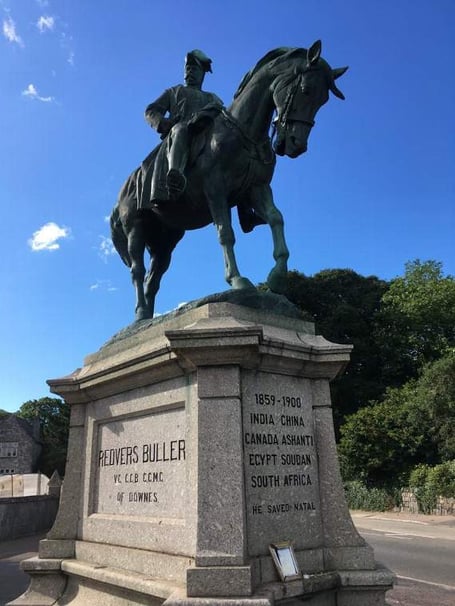
COUNCILLORS have unanimously voted to withdraw proposals that could have seen Exeter’s General Buller Statue moved from its current location.
The statue of General Sir Redvers Buller and his horse Biffen stands on the corner of New North Road and Hele Road outside the entrance to Exeter College and was erected back in 1905.
In January, Exeter City Council’s executive had agreed that without prejudice to a final decision on the matter, an application should be made for listed building consent for the relocation of the statue to an alternative location.
But Tuesday night’s meeting (February 9) saw them unanimously vote to overturn that decision and recommend to full council that no application for listed building consent for relocation should be made and the formal consultation over the future of the statue now not take place.



It follows recent comments by Robert Jenrick MP, Secretary of State for Housing, Communities and Local Government, who made it clear such applications were unlikely to be successful.
The Government recently revealed plans for a new law on cultural and historic heritage which will “make clear that historic monuments should be retained and explained”.
It would give the Secretary of State power to call in any application and ensure the law is followed, and Tuesday’s meeting heard it was considered unlikely that any bid to move to the Buller statue would be successful.
Cllr Phil Bialyk, leader of the council, said: “In light of the comments by the Secretary of State my Executive will be asked to amend the recommendations, and we will not be submitting a planning application to relocate the Buller statue.
“There is no proposal to remove the Buller statue. I hope that is clear and we are not talking about that at all.”
The executive though reaffirmed its support for the other recommendations that had been made back in January over the statue, in that the portfolio holder for culture and communities should establish a working group to develop an Anti-Racism Strategy for the Council.
An arts-based engagement project with residents is also set to be established, through a public art working group in conjunction with the University of Exeter and Exeter Culture, to consider the role of public art and create a new public art strategy in the city.
Temporary information boards are still set to be erected near to the statue, while consideration it set to be given to whether the statement “He saved Natal” on the plinth should be removed.
The statue was paid for by money raised by the people of Devon and unveiled on “Buller Day” in 1905.
It is situated on land owned by Devon County Council, with the monument itself maintained by the city council.
Buller served in Canada, China and most famously in South Africa in the Zulu Wars. It was here an operation led by him went wrong and he had to withdraw under intense fire.
The statue of Buller on his horse has previously been vandalised, as in 2019 an anarchist symbol and the word “scum” have been daubed on the statue, while banners saying “wanting for war crimes” had also been hung on it.
Daniel Clark
LDRS
Comments
This article has no comments yet. Be the first to leave a comment.